

"Household debt reaches 20 trillion won, fueled by real estate and margin investing... Rationale for interest rate hikes grows stronger"

Household debt in the second quarter surpassed 2 quadrillion won for the first time in history, a development of significant meaning as it was driven not only by rising mortgage loans but also by a full-scale surge in credit loans. With increased housing transactions, rising prices, and a booming stock market converging, demand for funds to purchase homes and for "margin investing (investing with debt)" grew simultaneously. As the burden of managing household debt intensifies, expectations are mounting that the Bank of Korea will move forward with additional interest rate hikes.
According to the Bank of Korea on the 19th, household credit in the second quarter of this year was recorded at 20.198 trillion won, an increase of 2.59 trillion won from the previous quarter. This marks the largest increase in 4 years and 9 months since the third quarter of 2021.
Housing-related loans increased by 12.2 trillion won, while other loans including credit loans rose by 12.8 trillion won. This marks the first time since the second quarter of 2021 that the increase in other loans has exceeded that of housing-related loans.
Housing-related loans increased as a surge in apartment transactions in the Seoul Capital Area coincided with collective loan demand for previously allocated housing. Apartment transaction volumes in the Seoul Capital Area rose from 27,000 units in March to 28,000 in April, 29,000 in May, and 30,000 in June. In Seoul, transactions increased from 6,400 units in March to 7,500 in April and 8,900 in May, before declining to 7,700 in June.
A boom in the stock market fueled an increase in credit loans. While total credit loans across all financial institutions decreased by 90 billion won in April, they rebounded with a 360 billion won increase in May and rose by another 260 billion won in June. The outstanding balance of securities companies' margin trading also increased by 930 billion won (approximately 34 percent), rising from 274 billion won at the beginning of the year to 3.67 trillion won by the end of June. Credit lending expanded primarily centered on the KOSPI, which was led by gains in large-cap stocks such as semiconductors.
A Bank of Korea official said, "Credit loans at deposit-taking banks and credit extensions by securities firms have increased significantly," adding, "We believe that funds related to stock investment demand have risen as the stock market showed strong performance in the second quarter." The official continued, "Looking at past trends, it is rare for other loans to increase this much," and evaluated that "the scale of the increase in credit loans is quite exceptional."
The government now faces a heavier burden of simultaneously managing household debt and supporting housing supply. The Financial Services Commission raised this year's target for the growth rate of total household debt from an initial 1.5% to around 3% on the 13th to promote housing supply and support young people and actual homebuyers. The increased lending capacity will be utilized for relocation loans in redevelopment projects and interim and final payment loans for newly constructed complexes, while speculative lending will be curbed.
The financial authorities have also strengthened oversight of credit financing and unsettled transactions used for margin investing (investing with debt). In May, they ordered securities firms to conduct a comprehensive review of their risk management practices and to consider additional measures if necessary. Some securities firms lowered credit limits for lower-rated stocks and restricted additional credit purchases when outstanding credit balances exceeded certain levels.
The trend of rising household debt is expected to add pressure on the Bank of Korea's base rate decision. The Bank of Korea raised its base rate from 2.50% to 2.75% last July, taking into account not only growth recovery and upward price pressures but also the increasing trends in housing prices and household loans. With a solid growth trajectory and inflation exceeding target levels, the rapid expansion of household debt has further strengthened the rationale for additional rate hikes.
However, the pace of loan growth has slowed somewhat since the third quarter. The increase in household loans across all financial institutions dropped from 830 billion won in June to 620 billion won in July. The Bank of Korea also expects that the growth trend in other loans seen in the second quarter is unlikely to continue, citing stock market corrections and expanding uncertainty. Future trends in household loans and housing prices are expected to be key variables for additional interest rate hikes.
[Exclusive] "Loans for young people and those with low-to-mid credit scores are sufficiently supplied" — Financial authorities convey guidelines
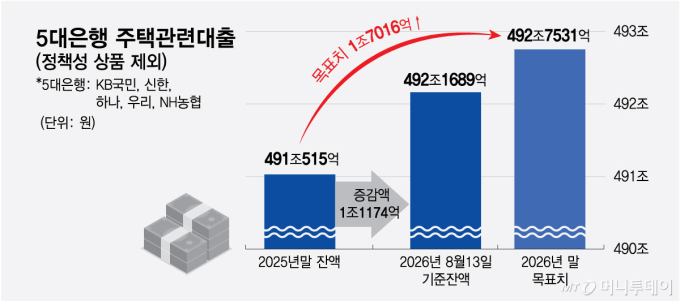
Financial authorities have begun coordinating the allocation of total household loan limits by bank as a follow-up measure to the the 13th policy package. The authorities plan to adjust approval ratios for loans to young people and those with medium-to-low credit scores to ensure sufficient supply.
According to the financial sector on the 19th, the Financial Supervisory Service held a "Practical Meeting on Household Loan Management Plan for the Second Half" at its headquarters this afternoon. Practitioners in charge of household loans from major banks including the five major banks (KB Kookmin, Shinhan, Hana, Woori, and NH Nonghyup), IBK Industrial Bank of Korea, local banks, and KakaoBank attended the meeting.
At the meeting, a plan to adjust the total household loan targets for each financial institution was discussed. Following the financial authorities' decision on the 13th to raise this year's management target for growth in household loans across the financial sector from 1.5% to 3.0%, opinions were gathered on how to specifically allocate the total volume to each financial institution.
The upward revision of the management target has created additional lending capacity of approximately 30 trillion won across the entire financial sector. However, the full 30 trillion won is not allocated uniformly to each bank as a limit. The financial authorities plan to set targets by comprehensively considering each bank's performance in handling household loans during the first half of the year and compliance with existing total volume targets.
Collective loans related to housing supply, including relocation costs for redevelopment and reconstruction projects and interim and final payment loans for new construction complexes, will be managed separately from the total volume targets set by each financial institution. While these collective loans are included in the overall 3% growth target for the entire financial sector, they will not deplete the individual lending limits of banks that handle them.
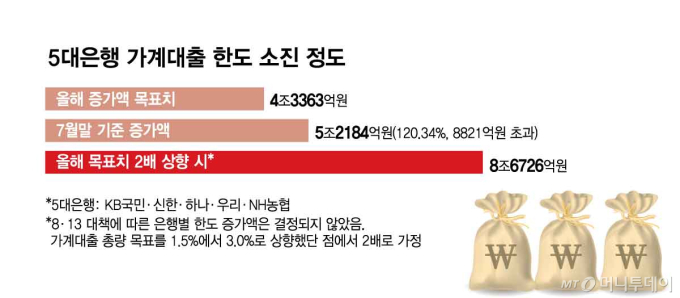
The authorities conveyed guidelines at the meeting today that loans for low-to-medium credit borrowers and young people should be aggressively approved. Currently, only 30% of increases in high-interest-rate loans are reflected; attention is focused on whether additional policy measures will follow. Regarding loans for young people, it is reported that authorities are considering a plan to exclude a certain portion from the total volume for financial products related to youth housing support included in the the 13th measures.
There was also a request to prevent so-called "open runs." This appears to reflect awareness of the situation where financial consumers seeking mortgage loans from internet banks compete in an "open run" starting at dawn. It is interpreted as a plea to expand loan limits so that the inconvenience to genuine homebuyers is minimized.
However, when asked whether group loans would be entirely excluded from the total volume target, the authorities replied that they are reviewing the matter. Regarding credit loans, they urged the banking sector to maintain continuous oversight.
The banking sector is understood to have been requested to submit data on the scale of business sites based on contracted volumes in the second-half group loans prior to the convening of the meeting that day. The financial authorities are expected to gather demand and opinions from each bank today and individually notify additional limits for each financial institution shortly.
Banks are highly likely to gradually ease the voluntary measures they have implemented so far to curb household loan demand, as their household loan limits increase.
NH Bank announced just before the meeting that it will resume handling its variable-rate home loan product, 'NH Home Mortgage Loan,' starting from the 20th. While new applications for variable-rate home loans were temporarily restricted since June as part of household loan volume management, the bank decided to resume lending after the outstanding loan balance fell within the target volume. An NH Bank official stated, "We have eased the measures because there are repayments coming in and we now have the capacity."
However, it remains to be seen whether this trend will spread across the entire banking sector. KB Kookmin Bank lowered its housing loan limit per person from 600 million won to 300 million won and has not yet lifted this restriction. Woori Bank continues to maintain a branch-level limit of 1.34 trillion won for housing loans.
A bank official stated, "Rapidly lifting existing restrictions would have too significant an impact on the market. If demand surges abruptly, it will be twice as difficult to restore the original situation." The official added, "We will first determine the total volume for each bank and then monitor trends before making a decision."
Credit loans still bearing scars from June's margin investing (debt-based investment)... Banks continue to tighten the squeeze
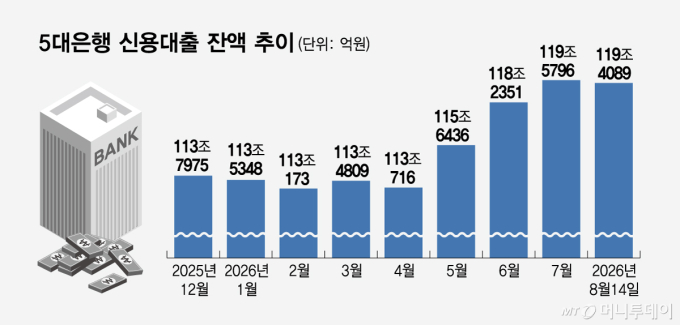
The growth in credit loans has shown some signs of slowing down. However, an estimated 5 trillion won balance accumulated during the "margin investing" frenzy in May and June remains, leading to assessments that the level is still burdensome. Even excluding policy-based products, the figure exceeds the target by 1.7 times, suggesting that banks will continue their management stance.
According to the financial sector on the 19th, as of the 14th of this month, the outstanding balance of credit loans at five major banks — KB Kookmin, Shinhan, Hana, Woori, and NH Agricultural Cooperative Bank — stood at 119.4089 trillion won, a decrease of 170.6 billion won compared to the end of July.
The balance of credit loans has continued to show a net increase since May, though the pace of growth has recently slowed. In May and June, the balance rose by 2.572 trillion won and 2.5915 trillion won respectively, swelling by more than 5 trillion won over the two-month period. However, in July, the increase narrowed to 1.3445 trillion won, and as of mid-August, the trend reversed into a net decrease.
However, the outstanding balance of credit loans remains at a burdensome level. Compared to the end of last year, the balance is 5.6115 trillion won higher. This is because the credit loan balances that surged sharply in May and June remain unpaid.
Accordingly, the total volume target set for this year has been significantly exceeded. The net increase target for other loans, including deposit-collateralized loans and credit loans (excluding policy-based products assigned to the five major banks), stands at 2.6347 trillion won. However, the outstanding balance of credit loans excluding policy-based products reaches approximately 4.5 trillion won, exceeding the target by a factor of 1.7.
The surge in credit loans is largely attributed to the impact of 'margin investing (investing with debt)' (borrowing to invest). With the KOSPI index breaking through the 9,000 mark for the first time in history during the second quarter and the stock market showing signs of a boom, it is estimated that significant funds were utilized for trading financial investment products such as stocks and funds. In response to this unprecedented surge, authorities activated an emergency management system in June, while banks have reduced individual loan limits and strengthened criteria for reducing unused credit lines upon maturity extensions. Currently, KB Kookmin Bank, Shinhan Bank, Hana Bank, and Woori Bank limit credit loan ceilings at 1.34 trillion won and overdraft account limits at 5 million won. Woori Bank is also not accepting new applications for refinancing credit loans from other platforms.
While preferential interest rates were also reduced, the interest rate band widened. The range for credit loans (six-month financial bond variable type) at the five major banks stood between 4.66% and 5.86%, with the upper and lower ends rising by 0.40 percentage points (p.p.) and 0.69 p.p., respectively, compared to two months ago.
Although the financial authorities have doubled the target growth rate for total household loans, they have emphasized stricter management of credit loans, so banks are expected to maintain their current voluntary regulatory stance for the time being. Shin Jin-chang, Secretary-General of the Financial Services Commission, stated at the the 13th real estate policy briefing that "for credit loans, banks should manage them voluntarily within a range that does not cause significant inconvenience unless absolutely necessary," and emphasized that "while total household loans will double, the focus remains on promoting housing supply, ensuring stable housing for young people, and resolving difficulties faced by actual homebuyers."
Complaints are also heard from the banking sector that available credit cards for managing consumer loans are insufficient. Most mortgage loans use a repayment method with installments over more than 30 years, requiring an average monthly repayment of 300 billion won in both principal and interest. For group loans, funds move step-by-step from interim loans to final balance loans, so the outstanding balance does not change significantly after new lending occurs. In contrast, overdraft accounts are structured such that new loans can be issued up to the agreed limit once the account is opened.
A source at a local bank stated, "While housing-related loans naturally see monthly repayments of several billion won without any action, the negative balance account cannot have its limit adjusted during the contract period, making it difficult to manage effectively." The official added, "Given that repayment amounts tend to increase around year-end when performance bonuses are paid, balances could potentially decrease as the end of the year approaches."

 in ECONOMY


