

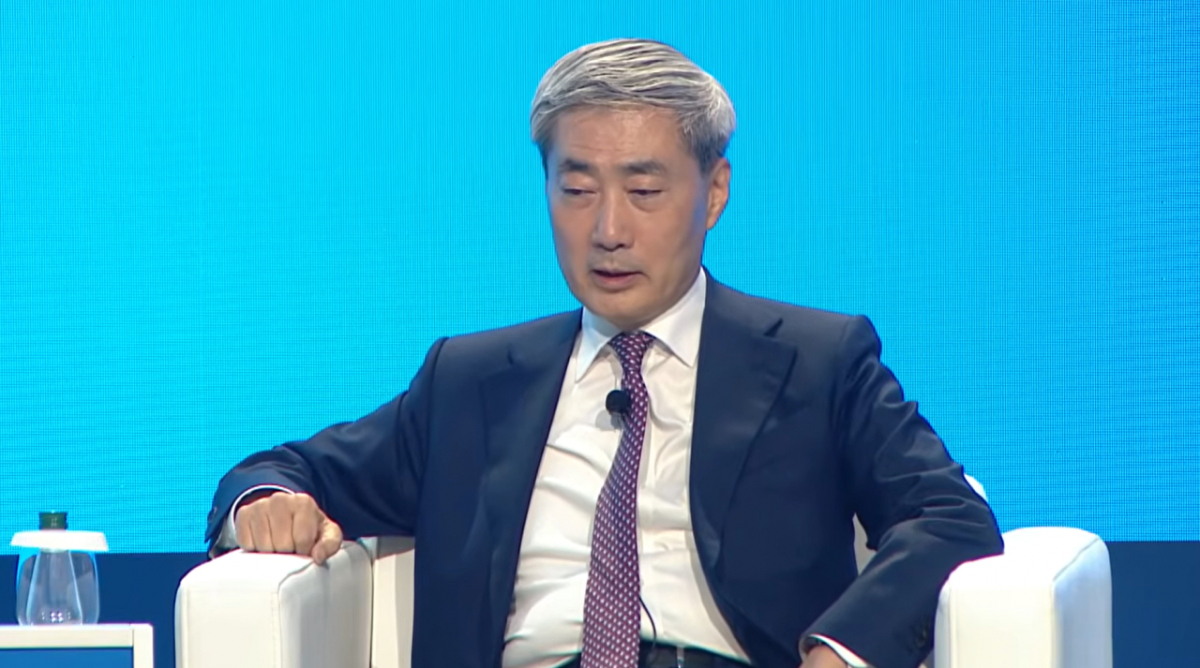
Bank of Korea Governor Shin Hyun-song stated that the central bank will maintain a tight monetary policy stance until it becomes confident that the inflation rate is converging to the target level of 2%. He also expressed the view that there is room for further appreciation of the won and that a stronger currency is desirable for the Korean economy.
Governor Shin made these remarks during a dialogue titled "AI Boom, Middle East War, and Challenges for Korean Monetary Policy" with the IMF’s Asia-Pacific Director at the "Governor Talk" session held on the sidelines of the International Monetary Fund (IMF) and World Bank (WB) Annual Meetings in Bangkok, Thailand, on the 13th (local time).
Governor Shin said, "We expect both headline and core inflation to remain above the target level of 2% for some time," adding, "We have been clear that we will maintain a tight monetary policy stance until we are confident that inflation will converge to the target level at an appropriate time."
Regarding the AI boom and the Middle East war affecting the Korean economy, he assessed that "in Korea, the AI boom is overwhelming the negative impacts of the Middle East war." He explained that cost increases due to the Middle East war and demand growth from the AI boom are acting as inflationary pressures.
Governor Shin emphasized that all three current policy objectives—price stability, exchange rate, and financial stability—support a tight monetary policy. While stating that "trade-offs in policy decisions are the norm rather than the exception," he said, "Currently in Korea, all three point in the same direction, making the policy direction quite clear."
On the value of the won, he clearly stated that not only is there room for further appreciation, but additional strengthening is also desirable. Governor Shin noted, "The won was significantly weak in the first half of this year, but it has shown significant strength since we shifted monetary policy to a tighter stance," adding, "There is room for the won to appreciate further, and I believe additional appreciation of the won is desirable."
He explained that a stronger won helps mitigate polarization between large export companies and the domestic consumption sector. He stated, "When the exchange rate falls, household purchasing power increases, particularly," noting that "the recent strengthening of the won has shifted the economic balance toward the domestic sector, which has also had a positive impact on the K-shaped economy."
He further remarked, "The exchange rate carries meaning beyond being a relative price that determines trade," calling it "an indicator of confidence in the currency and confidence in the entire economy." He added that returning to previously familiar exchange rate levels would also help financial stability.
He also raised the possibility that the AI boom could raise the neutral interest rate in the long term. Citing estimates that global major tech companies’ AI infrastructure investment will exceed $1 trillion annually by 2030, Governor Shin explained, "If productivity rises and growth rates increase, demand for investment and financing may also grow."
He mentioned the revenue-increasing effect of the AI boom as well. Governor Shin stated, "The AI infrastructure investment boom and the resulting large-scale export increases have brought fiscal benefits to the Korean government," revealing that "tax revenues are estimated to increase by 40% next year compared to this year."
Governor Shin pointed out that as the benefits of the AI boom concentrate on major IT companies, gaps by region and industry are emerging. He noted, "Low-income households are hit hardest by inflation," explaining that "households in the bottom 20% income bracket in Korea spend 32% of their income on food and energy." He added, "Stabilizing prices is a very effective way to help those in the most difficult circumstances."
He stated that fiscal policy needs to be deployed to alleviate the burden on vulnerable borrowers due to high interest rates. Governor Shin said, "Some small businesses, micro-enterprises, and households are struggling with high debt repayment burdens," adding, "It is necessary to deploy fiscal resources to mitigate the most severe impacts."
He also mentioned the possibility of debt restructuring. He explained, "If necessary, there may be room to adjust debt obligations," stating that "a balance must be found between reducing moral hazard and economic constraints from past debt burdens."

 in ECONOMY
