

The government is moving to establish a Future Response Fund using additional revenue, excess revenue, remaining balances of world surplus funds, and returns from the operation of surplus funds as sources. The Future Response Fund is planned to be used in four key areas: youth, growth drivers, local regions, and education and talent.
According to reports from the Ministry of Planning and Budget and the Ministry of Education on the 21st, the government plans to establish a new Future Response Fund to separately accumulate and utilize additional revenue generated from the semiconductor boom. The fund is intended to serve as a 'strategic investment platform' supporting a rebound in potential growth rates and as a 'fiscal stabilization platform' enhancing the stability and efficiency of fiscal operations.
An official at the Planning Office stated, "Our tax revenue structure has been characterized by fluctuations every 3–5 years due to semiconductor industry cycles, resulting in deficits followed by windfall profits." He added, "The fund will be operated as a reservoir that accumulates during boom periods based on trend values and functions for fiscal stabilization during shortfalls, allowing increased expenditures when needed."
The Future Response Fund will be used in four areas: youth, growth drivers, local regions, and education and talent.
To support youth, the government will provide comprehensive assistance tailored to each stage of growth, including employment, housing, assets, marriage, and childbirth. Funds will also be allocated to foster advanced strategic industries such as AI (artificial intelligence) and seven SEED projects under three mega-projects: SMR, nuclear fusion, renewable energy, quantum technology, and advanced biotechnology.
Some funds will be used to improve living conditions in local areas by expanding resident infrastructure to attract population inflows and spreading basic income programs in rural and fishing villages. Additionally, resources will be directed toward cultivating outstanding talent in science, engineering, and technology fields, as well as strengthening high school education, lifelong learning, and early childhood education.
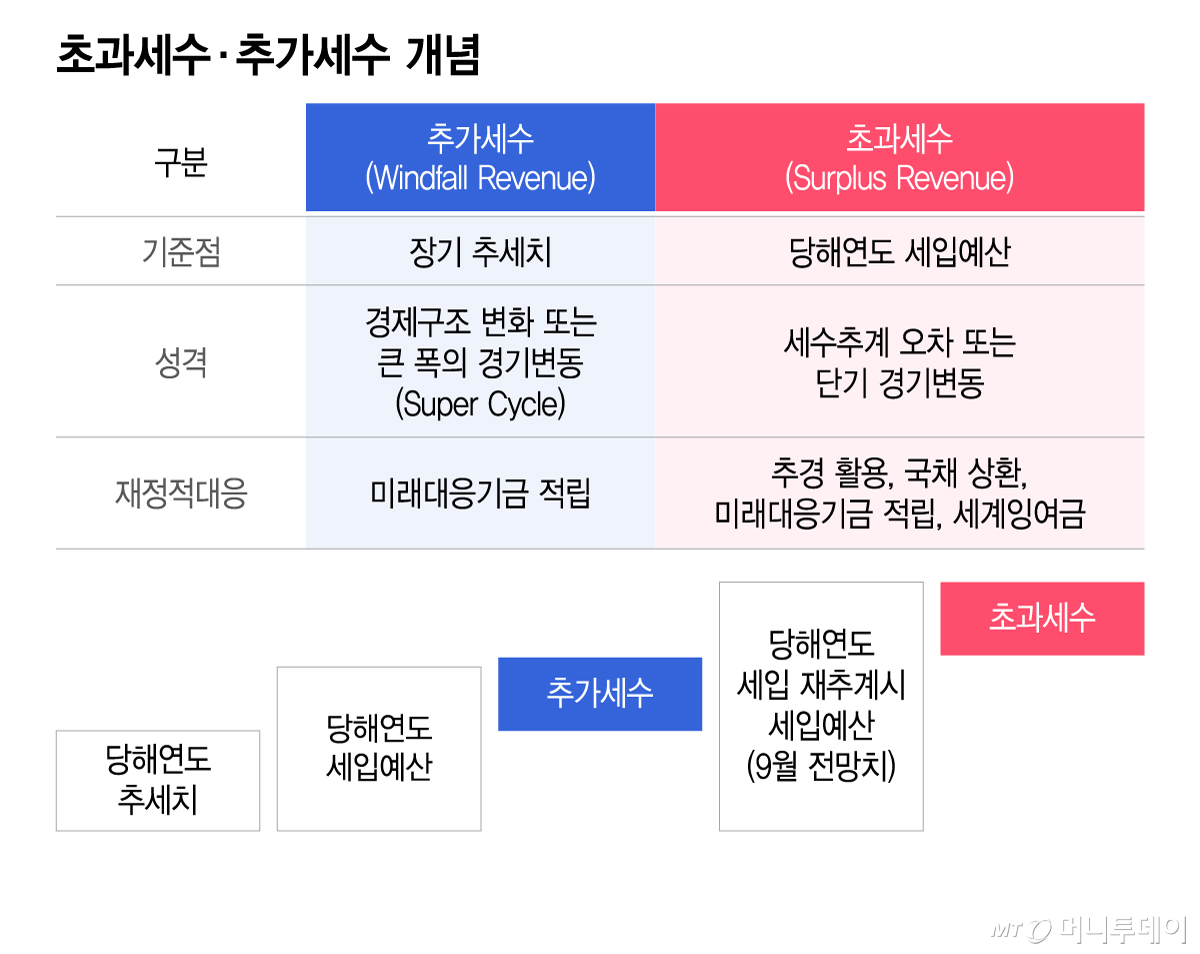
The Future Response Fund will be financed through additional revenue, excess revenue, and other sources including remaining balances of world surplus funds and returns from the operation of surplus funds. To this end, the government has clarified the previously ambiguous meanings of additional revenue and excess revenue.
Additional revenue refers to the portion by which domestic tax revenue in the next year's budget exceeds the domestic tax trend value. It applies when domestic tax revenues surpass long-term trends due to structural economic changes like a semiconductor boom or large-scale economic fluctuations, as seen this year.
Additional revenue is calculated by subtracting the trend value—determined based on the average annual growth rate of domestic tax revenues over the past 10 years—from the next year's projected tax revenue budget. The additional revenue will be accumulated by transferring it from the general account to the Future Response Fund.
Excess revenue is a term used when the revised domestic tax revenue budget, adjusted through a re-estimation of revenues, increases compared to the original domestic tax revenue budget for the current year. In simple terms, it refers to the portion exceeding the originally planned current-year tax revenue budget. It may arise from unforeseen small-scale economic fluctuations or errors in revenue projections.
In summary, additional revenue refers to the portion of tax revenues exceeding long-term trends due to structural economic changes, while excess revenue denotes the portion exceeding the current-year tax revenue budget due to projection errors. Both additional revenue and excess revenue will be used as sources for the Future Response Fund.
Additionally, remaining world surplus funds calculated after settlement procedures under the National Fiscal Act—such as adjustments in grant taxes, contributions from public fund repayment funds, and repayments of national bonds—will also be transferred to the Future Response Fund. The same applies to returns obtained from investments in promising assets such as bonds and stocks. The specific scale of fund inflows will be announced alongside the 2027 budget proposal and the National Fiscal Operation Plan, reflecting tax revenue forecasts by the Ministry of Economy and Finance.
To ensure stable funding for projects and maximize investment returns in the future, the government plans to operate surplus funds through a dedicated institutional investor framework. Through active asset management, it aims to exceed the minimum return target (3.85% yield on 3-year national bonds).

 in ECONOMY
