

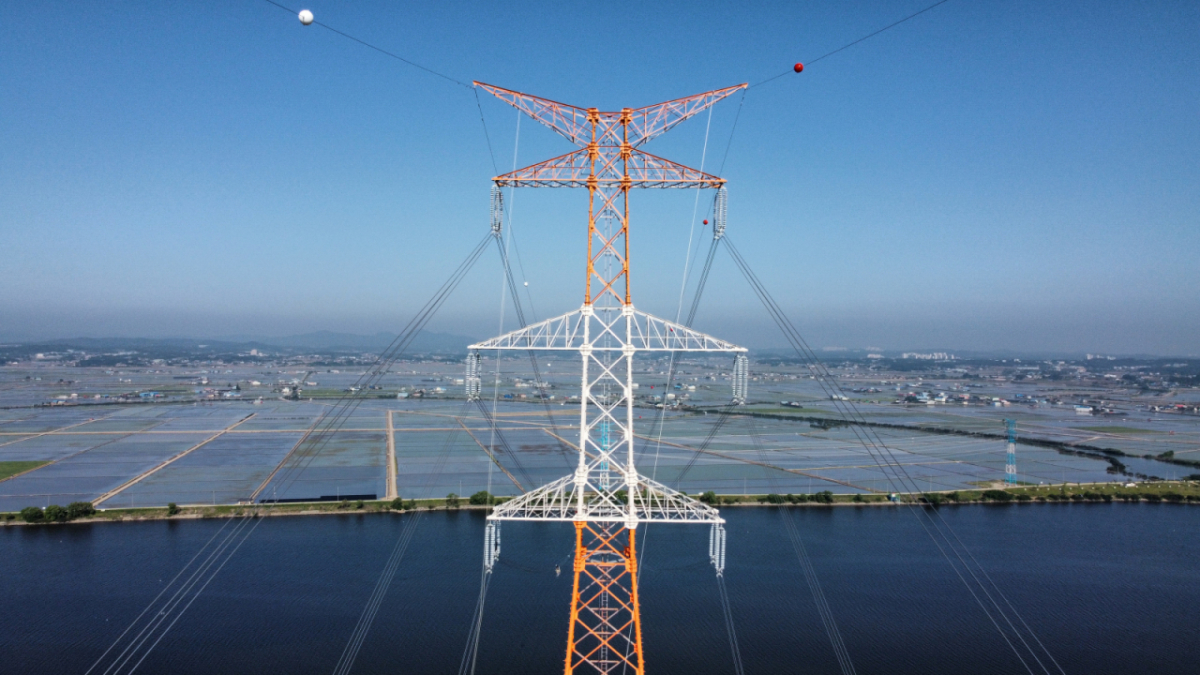
The government has confirmed the exemption of the preliminary feasibility study (PFS) for a national key power grid project worth 14 trillion won, accelerating the construction of the power grid. The PFS exemption is expected to shorten the construction period of transmission lines connecting the Honam region to the Seoul metropolitan area by approximately 18 months.
According to government sources on the 24th, the Ministry of Economy and Finance notified KEPCO earlier this month of the confirmation of PFS exemptions for 15 national key power grid projects. The plan is to accelerate these large-scale state-led projects, which will require a total investment of 14.2 trillion won, through PFS exemptions.
This project has been promoted under government leadership due to the urgent need to expand national key power grids. Since the implementation of the "Special Act on Expansion of National Key Power Grids" in September last year, the government has established a Power Grid Expansion Committee under the Special Act and designated 99 power grid projects as national key grid projects.
Among these, PFS exemptions are being pursued for 32 projects with total project costs exceeding 2 trillion won or public institutional investor contributions exceeding 100 billion won. The State Council approved the PFS exemptions in December last year. The total cost of the 32nd projects is 25.2 trillion won, marking the largest-ever PFS exemption scale (based on package projects), surpassing the 2019 National Balanced Development Project (24.1 trillion won).
The Ministry of Economy and Finance and the Ministry of Climate, Energy and Environment held joint meetings to finalize the PFS exemptions for these projects. They have confirmed PFS exemptions for 15 of the 32nd projects where route approvals were finalized. For the remaining 17 projects, the plan is to confirm PFS exemptions sequentially after completing project plan improvements such as route approvals.
The 15 projects confirmed for PFS exemption include five AC (alternating current) transmission lines, four DC (direct current) transmission lines, and six substations, totaling 14.2 trillion won in scale. These primarily target power grids connecting the Honam region to the Seoul metropolitan area.
Among these, the largest project is a 350-kilometer HVDC (high-voltage direct current) line from Shin Haenam to the West Incheon Combined Power Plant, with a total investment of 1.9 trillion won. The PFS exemption for the 290th-kilometer HVDC project connecting Shin Haenam to Dangjin Thermal Power Station (1.5 trillion won) has also been confirmed. Additionally, the Saemangeum-West Hwasung HVDC (220 kilometers, 1.2 trillion won) and Saemangeum-Yeongheung Thermal Power (210 kilometers, 1.2 trillion won) projects have been exempted from PFS.
Among AC projects, the targets include Sinpyeongtaek-Godeok (15 km), Shin Haenam-Sin Gangjin (27 km), and Shin Daesan-Dangjin TP (15.1 km). PFS exemptions have also been confirmed for the Saemangeum Substation and Shin Haenam Substation projects, each valued at 1.6 trillion won, which serve as hubs for transmission lines.
The government expects that the PFS exemption will shorten the power grid construction period from the current 10 years and 6 months to 9 years, a reduction of approximately 1 year and 6 months. This period typically corresponds to the time required for PFS investigations. It is also estimated that costs associated with PFS investigations (approximately 6 billion won) will be saved.
Through the PFS exemption, the government plans to proceed without delays in constructing power grids to enable early operation of the Yongin semiconductor cluster. In addition, the government intends to pursue PFS exemptions for power supply projects supporting semiconductor industrial complexes in the Honam region.

 in ECONOMY
