

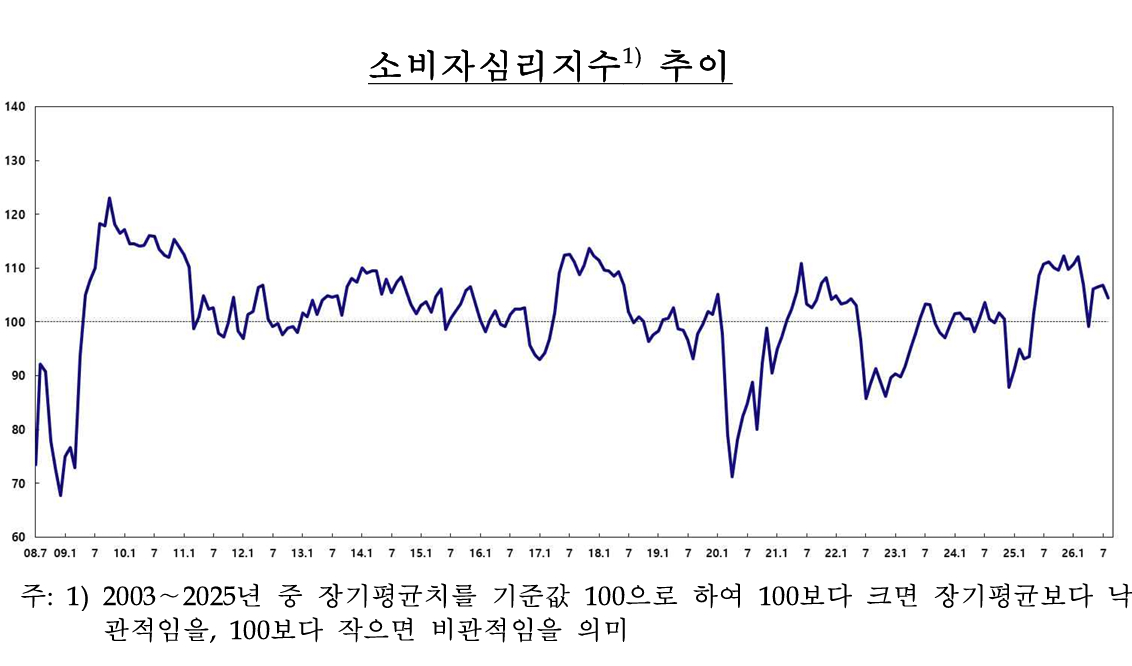
Consumer sentiment fell for the first time in four months due to adjustments in the domestic stock market and accumulated price increases. Expectations of rising housing prices also softened somewhat, influenced by government tax reforms and measures to increase housing supply.
According to the Bank of Korea's "August 2026 Consumer Confidence Survey Results" released on the 25th, the Consumer Sentiment Index (CCSI) for this month stood at 104.5, down 2.3 points from last month.
The CCSI rebounded to 99.2 in April and rose to 106.1 in May, continuing an upward trend to 106.6 in June and 106.8 in July, but fell for the first time in four months this month. A CCSI reading above 100 indicates that consumer sentiment is more optimistic than the long-term average.
The Bank of Korea analyzed that despite favorable real economic trends, adjustments in the domestic stock market and accumulated price increases have worsened consumers' perceived economic conditions.
Park Yong-min, an economist at the Bank of Korea, explained, "Although the July consumer price inflation rate dropped from 3.2% to 2.8%, daily prices had been rising sharply over time, and this cumulative effect led to a decline in perceived economic conditions."
He added, "Even if expected inflation rates fall, consumers may feel burdened when spending if the overall price level remains high." He noted that additional monitoring of respondents also revealed recent answers indicating that price levels are perceived as high.
All six indices comprising the CCSI declined simultaneously. The Current Economic Situation Index (CSI) fell to 79, a drop of 5 points from one month prior—the largest decline. This was attributed to increased consumer pessimism about the current economy amid expanding stock market volatility.
The Future Economic Outlook CSI also dropped by 3 points to 89. The Current Living Conditions CSI and Living Conditions Outlook CSI each fell by 1 point to 92 and 97, respectively. The Household Income Outlook CSI declined by 1 point to 100, and the Consumer Spending Outlook CSI fell by 1 point to 109.
The Current Household Savings CSI dropped by 3 points to 94, reaching its lowest level since May of last year. Team Leader Park stated, "In the consumer confidence survey, savings include not only bank deposits and time deposits but also stocks and funds." He added, "The decline in stock prices is interpreted as having a negative impact on current household savings."
The Employment Opportunity Outlook CSI fell by 3 points to 86. This is attributed to continued declines in employment numbers in the manufacturing and construction sectors, along with persistent youth unemployment in industries highly exposed to artificial intelligence (AI).
Team Leader Park noted, "Employment opportunity outlooks declined across all age groups, but the drop was slightly larger among those under 40." He explained, "This appears to result from a combination of factors, including companies' strengthened preference for experienced hires, post-pandemic employment adjustments, and workforce substitution due to AI."
Expectations among consumers that housing prices will rise also turned downward for the first time in five months. The Housing Price Outlook CSI fell by 2 points to 125 from last month. This index had risen sharply from 96 in March to 104 in April, 112 in May, 120 in June, and 127 in July.
The Bank of Korea analyzed that expectations for rising housing prices have softened somewhat since August, following announcements of tax reforms and measures to increase housing supply. However, the index itself remains significantly above the baseline of 100, indicating that projections of rising housing prices one year from now remain dominant.
The Interest Rate Level Outlook CSI fell by 1 point to 125. A reading above 100 indicates that more consumers expect interest rates to rise in six months compared to current levels.
The expected inflation rate, representing forecasts for the consumer price inflation rate over the next year, remained at 2.7%, unchanged from last month. While the ongoing stalemate in the Middle East conflict acted as a factor driving up prices, expectations of base rate hikes and a declining won-dollar exchange rate offset this effect. Expected inflation rates three years and five years ahead also held steady at 2.6% each, matching previous monthly levels.
Regarding the impact of stock market adjustments on consumption and prices, Team Leader Park stated, "While consumer sentiment may be affected in the short term, the current real economy is showing positive trends centered on exports and investment." He added, "It remains questionable whether these effects will constrain income and consumption spillovers."

 in ECONOMY
