

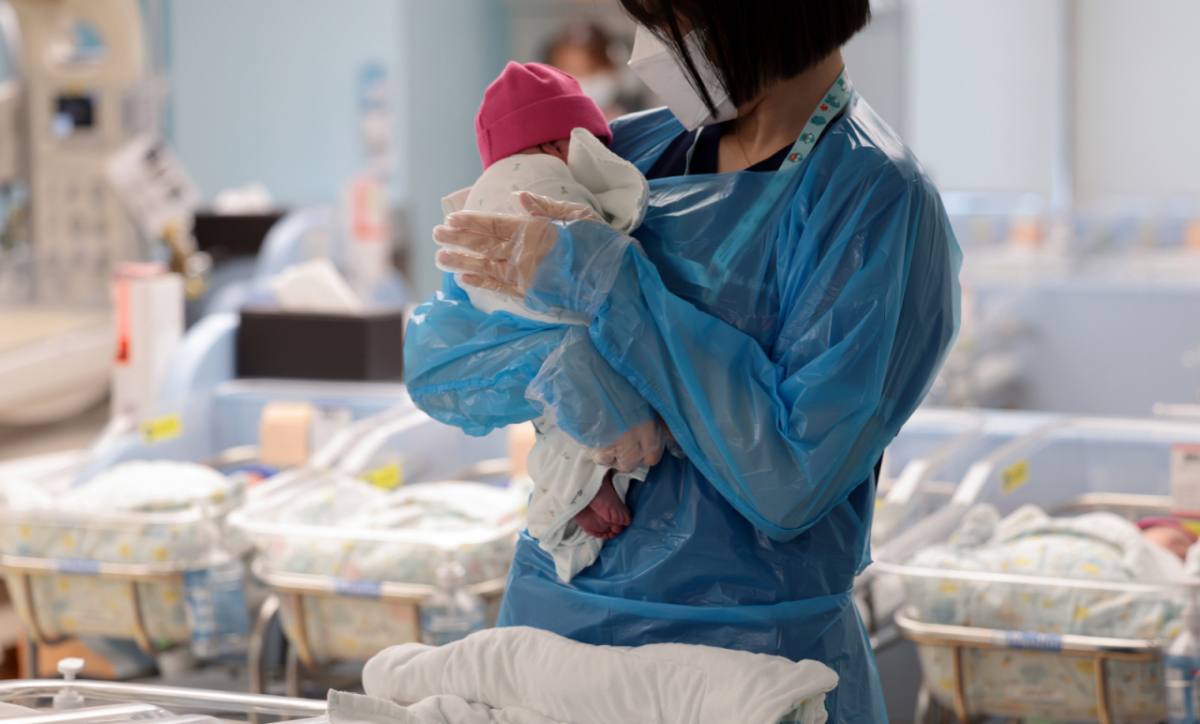
The number of births in the first half of this year recorded both the highest growth rate and the largest increase in scale ever seen, raising expectations that the total fertility rate will recover to the 0.9 range for the full year within seven years. However, experts agreed that "the recovery reflects a rebound in marriages and childbirths delayed by COVID-19," adding that "an environment must be created not only for the comfortable middle class but for all young people to choose marriage and childbirth."
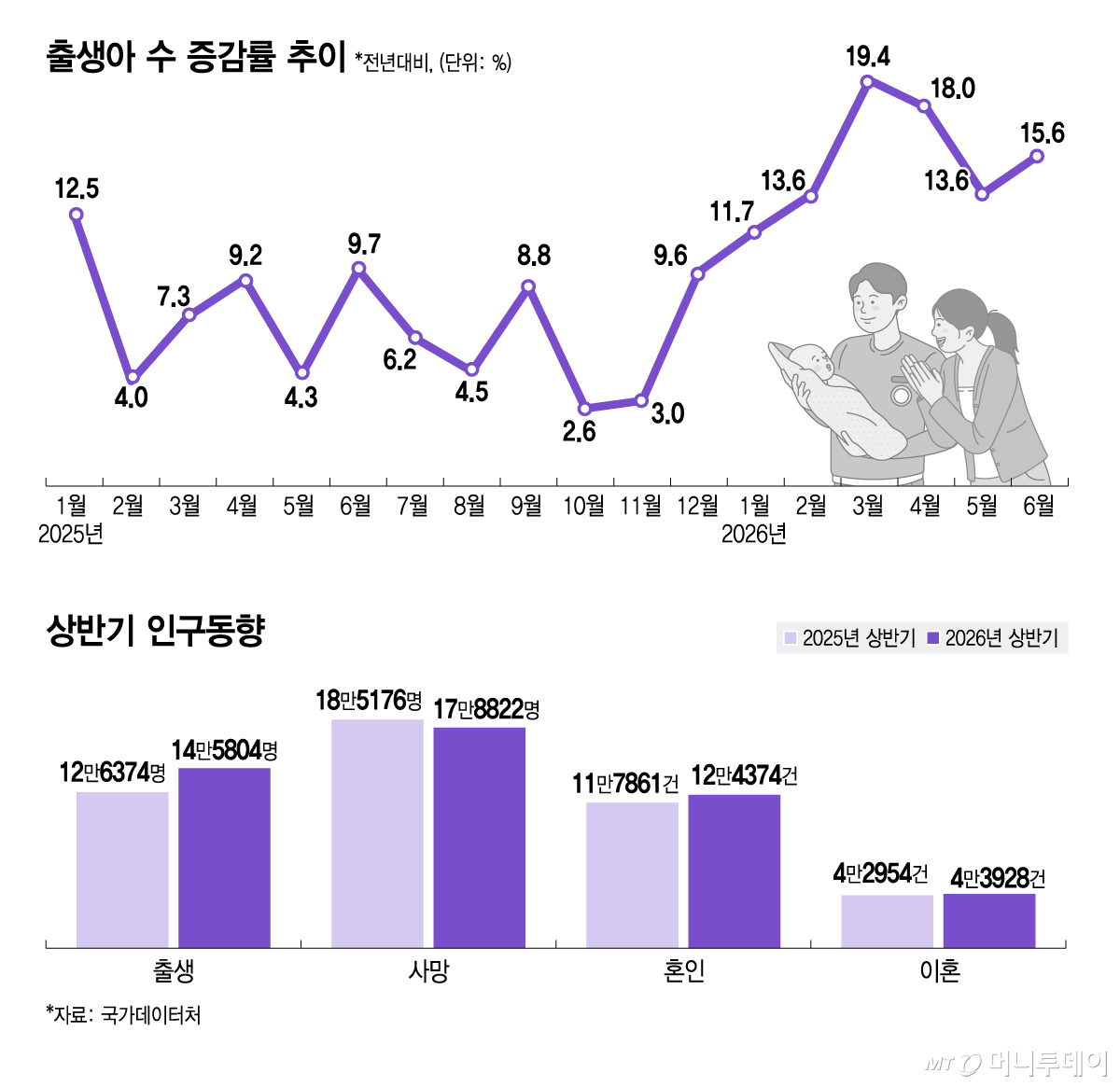
On the 26th, the National Data Administration reported that cumulative births from January to June totaled 145,804, a 15.6% (19,430) increase compared to the same period last year. Looking at the trend of this year's total fertility rate: the 0.99, the 0.93, the 0.93, the 0.93, the 0.85, and the 0.88. A simple average calculation yields 0.92.
The rebound in births this year is being driven by women in their early 30s having their first child. This reflects the effect of the "eco-boom" generation, born between 1991 and 1995, entering their early to mid-30s. The fertility rate by maternal age, representing births per 1,000 women, rose by 11 to 82.1 for women aged 30–34 (based on the second quarter), compared to the same period last year. For women aged 35–39, it increased by 10.7 to 60.2. The share of births by birth order showed that firstborns accounted for 63% in the second quarter, a rise of 1.3 percentage points.
The number of marriages also remains at a high level. Marriage registrations in the second quarter increased by 4.9% year-on-year to 62,065, marking nine consecutive quarters of growth alongside births. Increases were most pronounced among both men and women in their early 30s. Lee Sam-sik, a senior researcher at Hanyang University Jeong Chaek-hak-gwa (Prof.), analyzed that "typically, the first child is decided by the couple's choice, while policies have a greater impact on second children onward." Despite government efforts to ease marriage penalties and strengthen support for infertility treatment, experts warn that sustaining a rebound in the total fertility rate remains difficult. The annual number of births still has a long way to go to recover to 302,676 (with a total fertility rate of 0.92) as seen before the COVID-19 impact in 2019.
Lee Sang-rim, a senior researcher at the Population Policy Research Center of Seoul National University, explained that "marriages among people in their 20s are declining rapidly, and marriages overall are being delayed." She added, "While the total fertility rate is unlikely to plummet again to the 0.7 range as in the past, there are no factors driving a sharp increase either."
The senior researcher particularly noted that "it is positive that young people's perceptions are shifting from renting alone due to housing cost burdens toward building assets through marriage and childbirth; however, most who have decided to marry or give birth now belong to the middle class or above." She pointed out that social issues such as youth employment and loans for newlyweds must be addressed more urgently. In fact, the regions with the largest cumulative increase in births during the first half of this year were Seoul (18.7% growth), Gyeonggi (16.6%), and Incheon (16.3%), with the capital region at the center.
Meanwhile, South Korea is experiencing a natural population decline as the number of deaths exceeds the number of births. The number of deaths in the first half of this year was 178,822, a 3.4% decrease compared to last year, resulting in a natural population decrease of 33,018 during the period.

 in ECONOMY

