

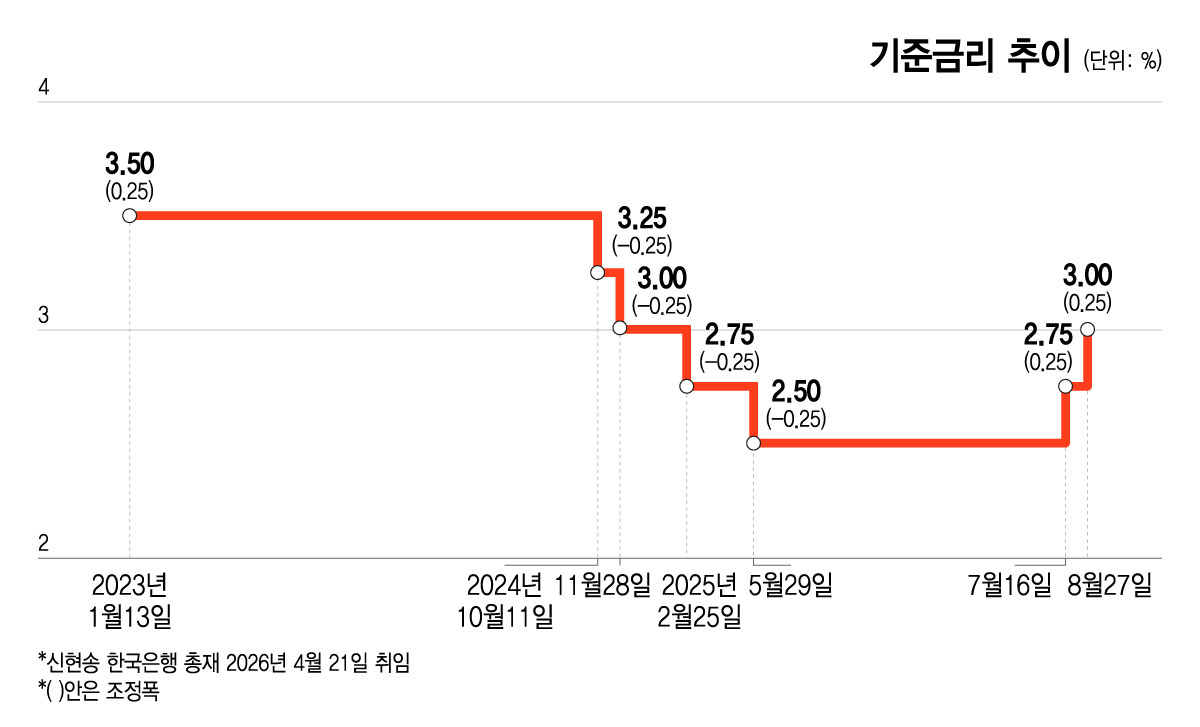
The Bank of Korea Monetary Policy Board raised the base rate to an annual 3.00%. This marks a "back-to-back" rate hike, the second consecutive month of increases. The Bank of Korea significantly raised its growth forecast for this year from 2.6% to 3.3%, judging that proactive measures are needed to address demand-side inflationary pressures and rising trends in housing prices and household loans.
On the morning of the 27th, the Monetary Policy Board held a monetary policy direction meeting at the Bank of Korea headquarters in Jung-gu, Seoul, raising the base rate from an annual 2.75% to 3.00%, a 0.25 percentage point increase.
Six members of the Monetary Policy Board, including Governor Shin Hyun-song, voted in favor of the rate hike. Commissioner Hwang Geon-il expressed a minority opinion for maintaining the rate at an annual 2.75%.
The Monetary Policy Board forecast that the domestic economy will continue to post higher-than-expected growth driven by strong exports and a recovery in domestic demand, while inflation is likely to remain above the target level for a considerable period. Accordingly, it judged that proactive measures are needed to curb the spread of rising prices and caution is required regarding financial stability risks.
The Bank of Korea raised its economic growth forecast for this year by 0.7 percentage points from 2.6% previously announced in May to 3.3%, and increased next year's forecast by 0.8 percentage points from 2.1% to 2.9%.
The upward revision of this year's forecast was most significantly contributed by the strong semiconductor market, accounting for 0.35 percentage points. Upward revisions to preliminary growth figures for last year and the first quarter of this year added 0.2 percentage points, while acceleration in investment including three major mega-projects and smaller-than-expected impacts from Middle East tensions each contributed 0.1 percentage points to the growth rate.
The forecasts for consumer price inflation this year and next year remain at 2.7% and 2.3%, respectively. Core inflation forecasts were revised upward from 2.4% to 2.5% for this year and from 2.3% to 2.5% for next year, reflecting expectations that demand-side inflationary pressures will intensify amid improved income conditions.
This year's current account surplus is forecast to reach a record high of $450 billion, driven by strong semiconductor exports. This represents an increase of $200 billion from the May forecast. Next year's forecast was also revised upward from $190 billion to $430 billion.
The steep rise in housing prices in the Seoul metropolitan area and a significant increase in household loans also supported the rate hike.
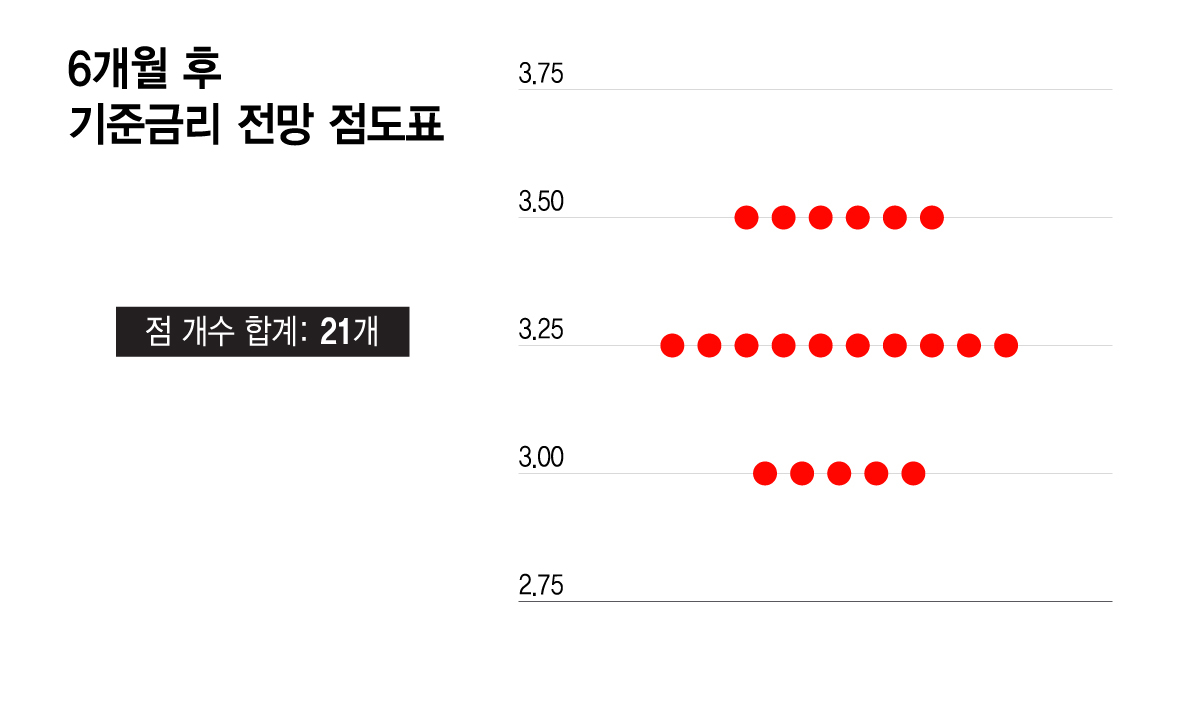
The Monetary Policy Board members' conditional forecasts for the base rate over the next six months have also risen. In the dot plot, 10 points were at an annual 3.25%, the highest number, followed by 6 points at 3.50% and 5 points at the current level of 3.00%. In May, the majority of 10 points were concentrated at 3.00%, but this time the center has shifted to 3.25%.

 in ECONOMY

