

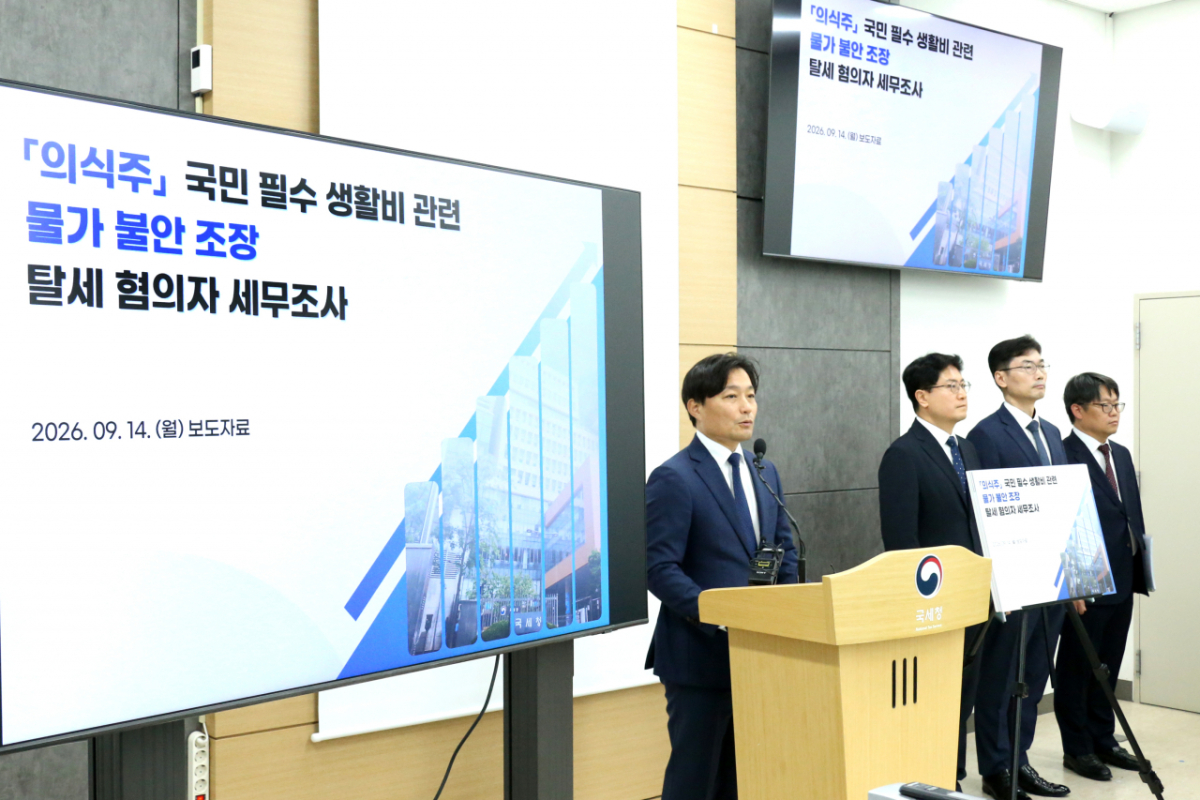
The National Tax Service has launched tax audits against 41 market-disrupting companies, including Baemin, Musinsa, and Pulmuone, suspected of tax evasion ahead of the Chuseok holiday.
On the 14th, the National Tax Service announced that it will conduct tax audits on a total of 41 companies: 38 related to food items closely tied to consumer price perceptions, such as agricultural and livestock products, processed foods, and restaurant franchises, plus three platform companies handling daily consumer goods like fashion accessories.
Instead of responding to rising raw material costs or other external instability factors by reducing production costs, these companies allegedly inflated prices, accepted false tax invoices, and fabricated cost records to intentionally understate profits. The amount suspected of tax evasion alone reaches approximately 1 trillion won.
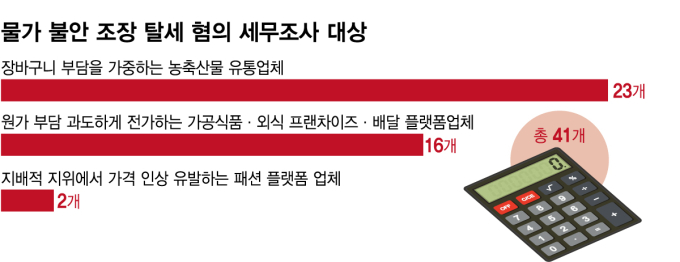
First, processed food companies, franchise headquarters of restaurant chains, and delivery platform operators that raised sales prices in response to rising raw material costs, thereby shifting the burden onto consumers, are under investigation.
Baemin, which generated profits in the range of 1 trillion won domestically by sustaining large-scale loss-leading competition to expand market share and ultimately driving up final consumer prices, is suspected of not paying taxes in the range of 100 billion won domestically by transferring these profits to its German parent company through complex capital transactions. It also faces allegations of providing free business support services to overseas related companies and improperly deducting input value-added tax.
In particular, Pulmuone, a comprehensive food company, is suspected of significantly raising processed food prices citing rising manufacturing costs such as raw materials and logistics expenses, while including costs that should be borne by domestic and foreign special-related corporations in product costs and passing them on to consumers.
It was also confirmed that the company allegedly paid expenses unrelated to business operations on behalf of related companies controlled by Pulmuone's founding family and provided large sums of money to overseas related companies without collecting interest.
In the case of sauce and dumpling manufacturers that recently raised prices for certain products, excessive fees were paid to special-related corporations established by retired executives, and logistics center usage fees for corporations controlled by the founders' children were paid on their behalf, siphoning off profits. Circumstances also emerged showing that large sums were remitted to overseas local companies where the founders' children worked as headquarters managers under the guise of investment funds, creating offshore illegal funds.
Additionally, some franchise headquarters that raised prices for key raw materials and components, thereby imposing a double burden on franchisees and consumers, were found to have engaged in lax internal management and intentional tax evasion.
One franchise headquarters with over 2,000 stores nationwide disguised the founder's personal expenses as costs related to supporting franchisees. It also unreasonably assumed losses by transferring profitable direct-operated stores within amusement parks for free to corporations controlled by the founder's children and supplying materials at low prices.
Another franchise headquarters operated stores under employees' names to distribute income, acquired three supercars worth hundreds of millions of won per unit in the corporation's name for private use, and even collected supervision service fees and various rebates from cooperating companies responsible for store interior construction, concealed them, and falsely included startup consulting costs borne by prospective franchisees as deductible expenses to underreport revenue.
Furthermore, egg-producing farms that have treated price hikes in shipments as a matter of course citing supply instability, and agricultural and livestock product distributors who privatized tariff quota benefits, were selected as audit targets for driving up holiday table prices.
While producer groups that artificially fueled price increases for eggs, now called "golden eggs," were sanctioned for collusion, it was determined that the current audit targets underreported profits in the range of tens of billions of won over a period of three to five years.
Some companies not only raised egg prices but also demanded cashless transactions without invoices from trading partners and collected sales proceeds through non-business accounts to conceal them. They transferred laying chicks at below-market prices to separate agricultural corporations with family members as representatives, distributed profits, and failed to report subsidies received from local governments as revenue.
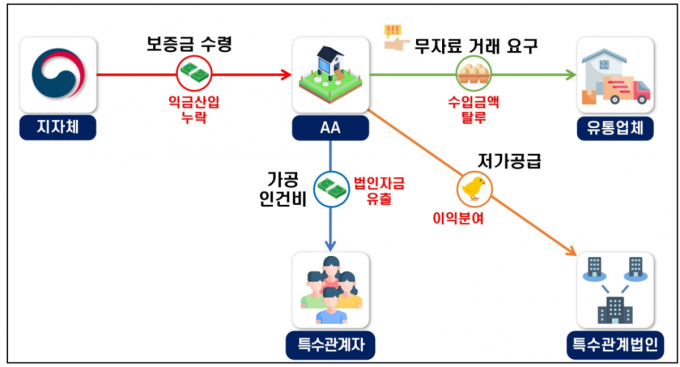
In another case, a company exploited the non-taxable provision for livestock income of farmers and fishermen by setting up a non-existent chicken farm in the name of the representative's spouse, distributed sales through it, and paid not a single won in taxes.
During this process, even though laying chicks were purchased from third parties, false invoices were exchanged as if transactions had occurred with the chicken farm under the representative's spouse's name.
Furthermore, companies that imported sesame, pineapples, and pork bellies and received tariff quota benefits are also under investigation for inflating expenses fraudulently and omitting revenue reports.
One company that imported pork at a 0% tariff rate inserted a ghost business entity in the name of the representative's child between itself and its trading partners to capture distribution margins, then closed the business shortly thereafter to steal the tariff quota benefits.
In addition, Musinsa and other fashion platform companies were included as audit targets for creating upward pressure on overall fashion market prices from a position of superiority over competitors.
Allegations were confirmed that these companies imposed high fee rates on participating businesses by leveraging their superior platform usage rates, thereby shifting the burden; intentionally omitted revenue through irregular accounting practices; paid excessive advertising and service fees to special-related corporations; inflated costs by purchasing inventory assets at high prices; and even leased high-end apartments in the corporation's name for the founder's personal residence—a typical act of private profit-seeking.
Lee Sung-geul, National Tax Service Jo Sa (Director), stated, "We will closely examine the appropriateness of production costs that justify price increases such as material and distribution expenses, whether transactions with trading partners were conducted normally, and the process by which the founding family accumulated wealth through capital outflows from corporations." He added, "If suspicions of tax crimes such as concealing profits through nominee accounts, accepting false tax invoices, or lending names are uncovered, we will immediately convert them into tax crime cases and respond resolutely."

 in ECONOMY


