

National tax revenue collected through September this year was found to be nearly 100 trillion won higher than during the same period last year. This is because corporate income tax, as well as income tax and other taxes, increased significantly compared to a year earlier, driven by improved corporate performance centered on Samsung Electronics and SK hynix.
According to the "Status of National Tax Revenue for September 2026" released by the Ministry of Economy and Finance on the 30th, cumulative national tax revenue from January to September this year stood at 385 trillion won, an increase of 95.4 trillion won compared to the same period last year.
Corporate income tax revenue was particularly notable. Corporate income tax revenue through September reached 127.8 trillion won, up 51.9 trillion won from a year earlier.
The impact of increased interim prepayment installments due to improved operating performance centered on semiconductor companies was significant.
Corporate income tax is fundamentally paid based on the previous year's operating results. In addition, business groups subject to public disclosure with assets of 5 trillion won or more must conduct an interim prepayment provisional settlement based on their first-half performance for that year. Given that the semiconductor market entered a full-fledged boom from early this year, it means that part of the strong performance by Samsung Electronics and SK hynix was reflected in this year's corporate income tax revenue.
The semiconductor super-boom also affected other tax revenues. Income tax is a prime example. Income tax revenue through September reached 110.8 trillion won, an increase of 15.7 trillion won compared to the same period last year. This was influenced by factors such as increased employment income tax due to higher performance-based bonuses and increased capital gains tax due to expanded real estate transaction volumes.
The domestic stock market situation was also reflected in national tax revenue. Securities transaction tax collected through September amounted to 9.9 trillion won, which is 7.5 trillion won more than a year ago. This is interpreted as being influenced by increased securities trading volume centered on semiconductor companies and the restoration of tax rates.
Revenue from the Rural Special Tax, linked to KOSPI securities transaction tax, also reached 16.4 trillion won, an increase of 10.3 trillion won compared to the same period last year.
In addition, value-added tax revenue collected was 67.5 trillion won, an increase of 7.4 trillion won from the same period last year, influenced by factors such as increased import values and rising private consumption.
Meanwhile, the progress rate of national tax revenue, which indicates performance against the government's target for collection over the year, recorded 92.7% through September (based on the additional budget). This level significantly exceeds last year's figure (77.5%) as well as the five-year average (78.2%).
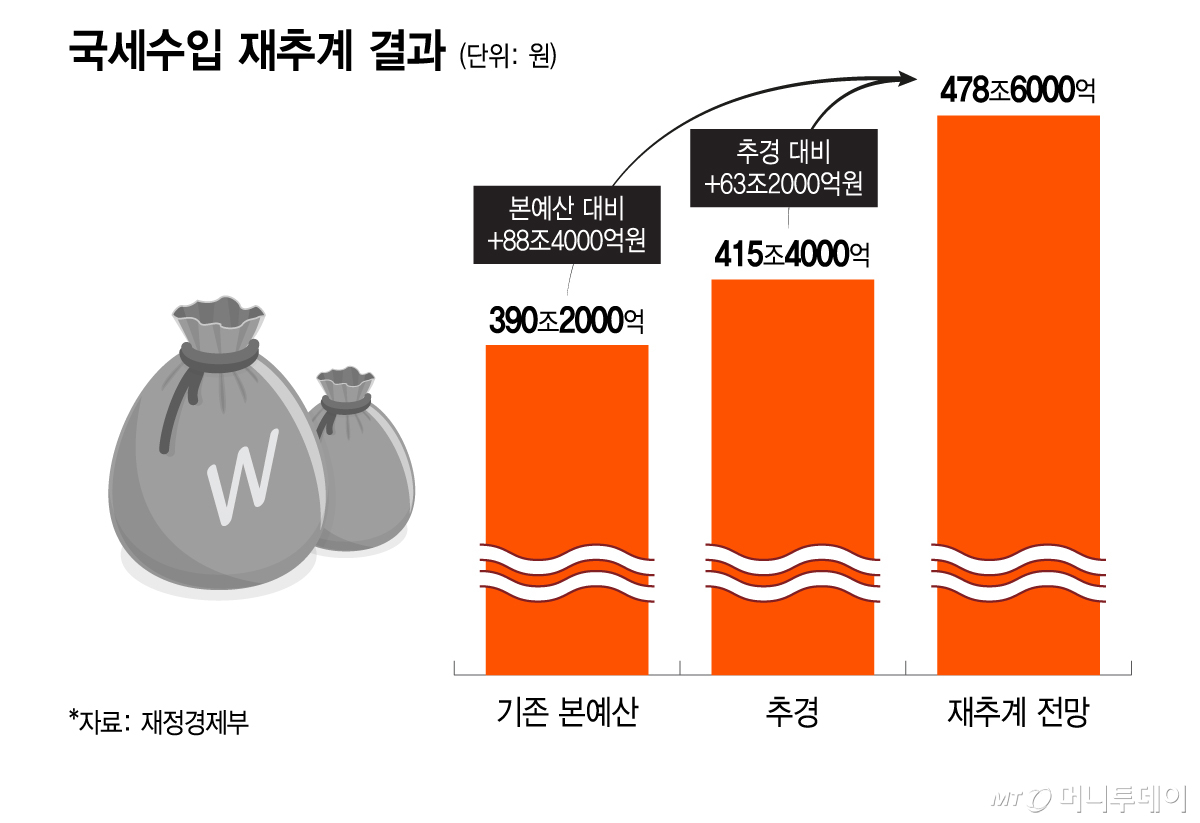
Accordingly, the government released the results of its tax revenue re-estimation at the end of last month. It newly forecast that this year's national tax revenue would reach 478.6 trillion won, which is 63.2 trillion won more than the additional budget (415.4 trillion won) passed by the National Assembly in April. Compared to this year's regular budget (390.2 trillion won), it predicts that national tax revenue will be 88.4 trillion won higher.
The progress rate of national tax revenue through September, based on the re-estimated tax revenue figure, is 80.5%.

 in ECONOMY

