

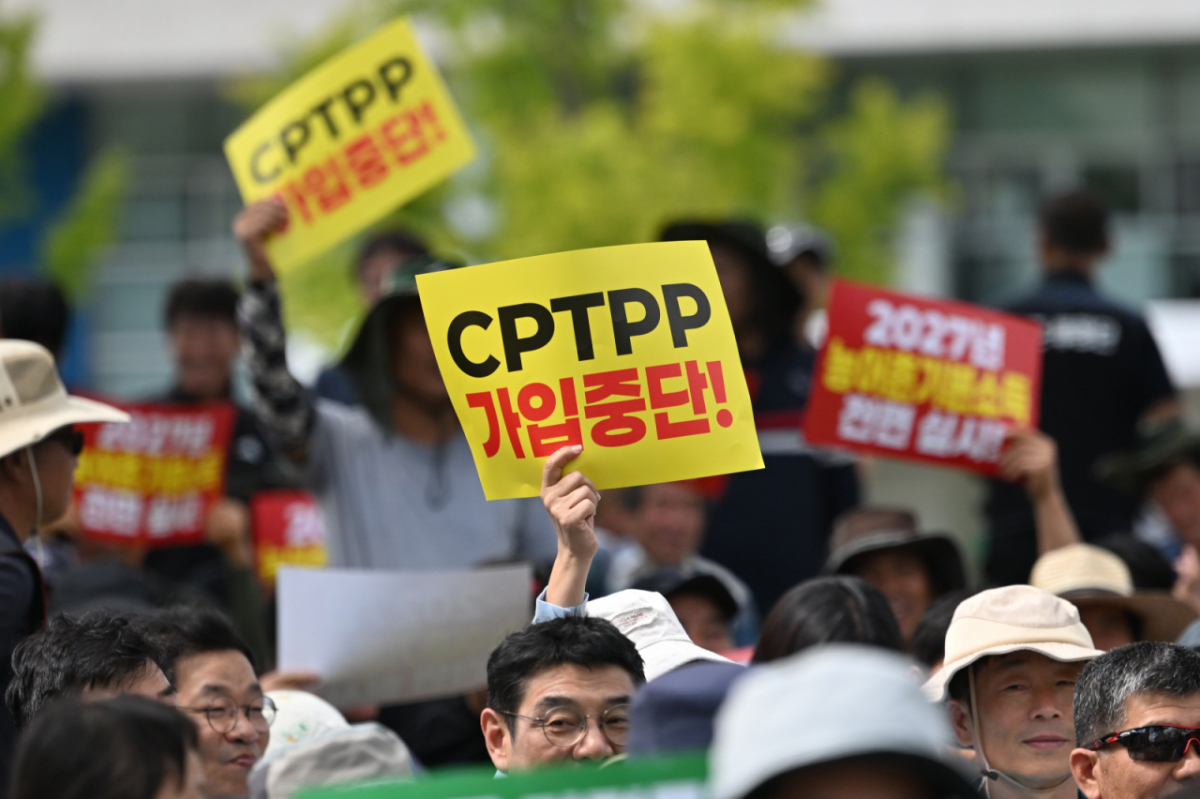
An analysis indicates that if South Korea joins the Comprehensive and Progressive Agreement for Trans-Pacific Partnership (CPTPP), which pursues extensive free trade among Pacific Rim countries, the production ripple effect on manufacturing could reach up to 6.7 trillion won annually.
It is forecasted that real gross domestic product (GDP) would rise by 0.38 percentage points compared to non-joining scenarios ten years after accession. However, due to the repercussions of market opening, a production decline of 850 billion won per year is expected in agriculture, forestry, and fisheries.
The government disclosed the results of an economic impact analysis regarding CPTPP accession on the 28th. The Ministry of Trade, Industry and Energy, the Ministry of Agriculture, Food and Rural Affairs, the Ministry of Oceans and Fisheries, and the Ministry of SMEs and Startups have been updating their previous analysis since 2021 to reflect the expansion of CPTPP membership, changes in major countries' trade policies, and shifts in domestic and international industrial and trading conditions.
The CPTPP is a multilateral free trade agreement that lowers trade barriers and promotes freer trade among member nations, officially taking effect in December 2018. Currently, 12 countries, including Japan, Canada, the United Kingdom, Australia, and Mexico, are participating. As of 2024, the combined GDP of member countries stands at $15.9117 trillion, accounting for 14.3% of global GDP.
The CPTPP covers not only tariff elimination but also broad trade norms including digital trade, state-owned enterprises and fair competition, labor, and environment. Given its pursuit of high-level market liberalization that opens all service and investment markets in principle, joining the CPTPP is expected to have a significant impact on domestic industries and the economy. The government is currently conducting social discussions and gathering opinions regarding CPTPP accession.
According to an economic effect analysis by the Korea Institute for International Economic Policy (KIEP), South Korea's real GDP ten years after the CPTPP takes effect would be 0.38 percentage points higher than if the agreement were not joined. This represents a cumulative effect over ten years.
The Korea Institute for Industrial Economics and Trade (KIET) analyzed that the manufacturing-based production ripple effect would increase by an average of 6.3 trillion to 6.7 trillion won annually over 15 years following the agreement's implementation. Among this, SME (small and medium-sized enterprise)-based effects are projected to reach 1.1 trillion to 1.2 trillion won. The production ripple effect refers to the induced production in upstream and downstream industries related to a specific sector due to tariff changes.
Conversely, according to analyses by the Korea Rural Economic Institute (KREI) and others, agriculture, forestry, and fisheries are expected to face an annual total production decline of 850 billion won over the next 15 years. This analysis raises concerns about damage to domestic agricultural and fisheries sectors due to imports of cheaper overseas agricultural and marine products. By sector, agricultural production is estimated to decrease by an average of 710 billion won annually, forestry production by 60.6 billion won, and fisheries production by 81.7 billion won per year.
These results are provisional forecasts estimated using economic analysis models based on certain assumptions. Actual impacts may vary depending on the level of item-specific opening resulting from future accession negotiations, as well as domestic and international market conditions.
Given that the government expects significant impacts on the domestic economy from CPTPP accession, it plans to gather opinions from stakeholders through seminars and roundtable discussions.

 in ECONOMY
