

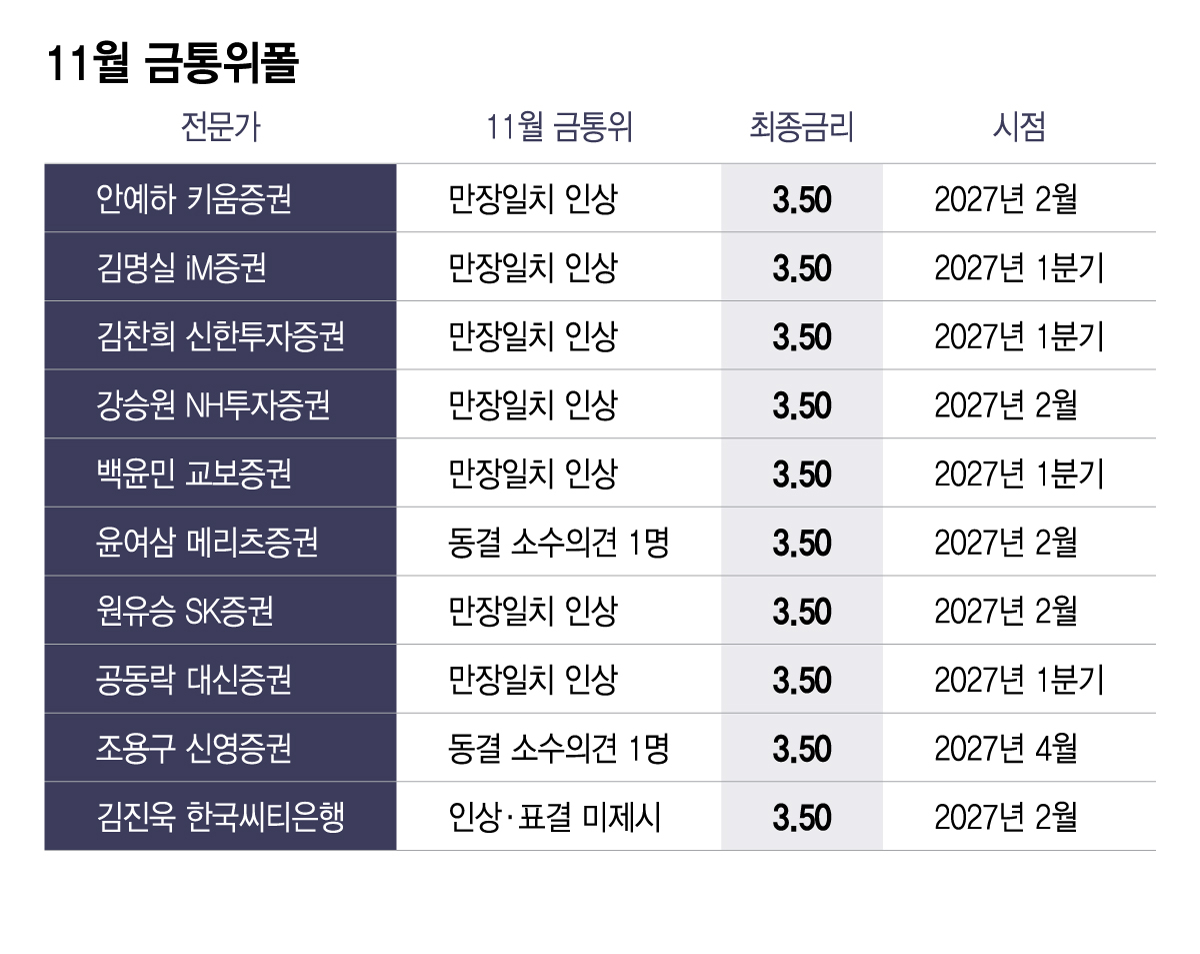
All 10 bond market experts forecast that the Bank of Korea will raise the base rate from 3.00% to 3.25% per annum at its Monetary Policy Board meeting on the 26th. This judgment reflects the view that additional tightening is inevitable, as strong exports centered on semiconductors continue while inflationary pressures persist.
All 10 experts predicted that one more rate hike next year will bring the terminal rate of this tightening cycle to 3.50% per annum. Most expect the rate-hiking cycle to conclude in the first quarter of next year.
According to a survey of 10 bond market experts compiled by Money Today on the 22nd, all 10 anticipated a 0.25 percentage point increase in the base rate at the Monetary Policy Board meeting on the 26th. Among them, seven forecasted a unanimous decision to raise rates.
Gong Dong-rak, an economist at Daishin Securities, stated, “We expect a base rate hike, considering that inflation remains above target despite rapid improvements in real economic conditions that are sufficient for a significant upward revision of the growth rate.” He also cited the Bank of Korea’s proactive signaling of a rate hike at last October’s Monetary Policy Board meeting as grounds for this expectation.
Forecasts for economic growth rates this year and next are also expected to be significantly revised upward. Experts anticipate that the Bank of Korea will raise its growth forecast for this year from 3.3% to between 3.7% and 3.9%. Forecasts for next year’s growth rate varied, ranging from the low 3% range to levels approaching 4%, up from the previous estimate of 2.9%.
The dot plot, which indicates Monetary Policy Board members’ future interest rate outlooks, is also expected to be revised upward. Experts predicted that the mode for the base rate forecast six months out will concentrate at 3.50% per annum, with some members leaving open the possibility of a hike to 3.75%.
The first quarter of next year is seen as the most likely timing for an additional rate hike. Nine out of the 10th experts expect the base rate to reach a terminal level of 3.50% per annum in the first quarter of next year. The outlook suggests that authorities will proactively raise rates to respond to strong semiconductor exports and inflationary pressures, then assess the effects of tightening and the state of domestic demand recovery.
Jo Yong-gu, an economist at Shin Young Securities, forecasted an additional rate hike in April next year. He judged it appropriate to raise rates after reviewing factors such as the impact of performance bonuses, dividends, and government transfer payments on private consumption; core inflation trends; whether the Federal Reserve System (Fed) will implement further hikes; and conditions in the stock and real estate markets and liquidity. Uncertainty surrounding artificial intelligence (AI) investment was also cited as a reason to delay the timing of the final hike.
Cautious forecasts predominated regarding the possibility that the terminal rate could exceed 3.50% per annum. This is because, although the semiconductor boom is boosting growth rates, it remains uncertain whether this will translate into domestic demand recovery and demand-side inflation.
Yoon Yeo-sam, an economist at Meritz Securities, said, “We view 3.50% as a tightening zone that exceeds the neutral rate,” adding, “Domestic demand and perceived economic conditions are not very good, so additional hikes should be approached with caution.”
The contraction in consumption due to recent sharp stock price declines is also considered a variable. Kim Jin-wook, an economist at Citibank Korea, estimated that household stock valuation losses in the second half of this year will reach approximately 563 trillion won. He analyzed that the downward pressure on consumption and prices resulting from these losses could have an effect similar to raising the base rate by 0.50 to 0.75 percentage points.
Won Yu-seung, an economist at SK Securities, stated, “Compared to past tightening periods, growth expectations have risen, but strong demand-side inflationary pressure driven by wage increases is not emerging.” He forecasted that after the base rate reaches 3.50% per annum in February next year, a freeze will continue through the end of the year.

 in ECONOMY
