

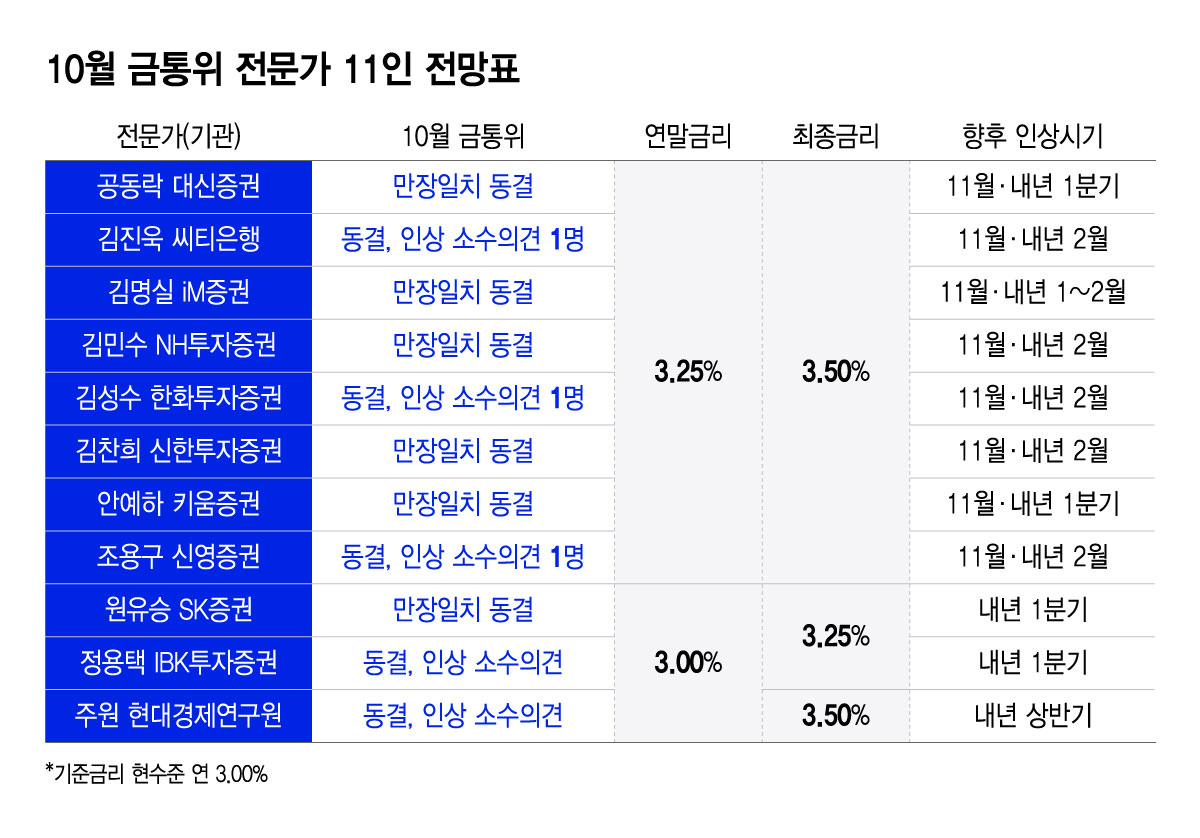
All 11 bond market experts surveyed projected that the Bank of Korea will hold its base rate at 3.00% per annum at its Monetary Policy Board meeting on the 22nd. This outlook reflects expectations that the central bank will pause after two consecutive rate hikes in July and August to assess the effects of its policy.
However, experts anticipated that the trend toward further hikes would be maintained as inflationary pressures and strong economic conditions persist. Of the 11th experts, eight predicted an additional rate hike in November, while nine forecasted a final rate of 3.50% per annum for the current tightening cycle.
According to a survey conducted by Money Today on the 18th, which gathered forecasts from 11 bond market experts, six predicted a unanimous decision to hold rates at the Monetary Policy Board meeting on the 22nd, while five suggested the possibility of a minority opinion favoring a rate hike. Regarding the base rate by year-end, eight experts projected 3.25% per annum, and three projected 3.00% per annum.
Jo Yong-gu, an economist at Shin Young Securities, explained, "After responding preemptively with consecutive hikes in July and August, it is necessary to review the effects of rate increases, economic conditions, and financial circumstances." He added, "The stable trend in exchange rates and September inflation figures indicate that further hikes are not urgent." However, he predicted that Monetary Policy Board member Jang Yong-seong would issue a minority opinion favoring a hike.
Market expectations favored the resumption of rate hikes in November. Analysts judged that there is room to raise the base rate further, considering strong growth, concerns about demand-side inflation, and the need for financial stability. Many observers predicted two more hikes by the first quarter of next year, bringing the final rate to 3.50% per annum.
Gong Dong-rak, an economist at Daishin Securities, stated, "While real economic conditions are improving rapidly enough to warrant a significant upward revision in growth rates, and inflation is expected to remain above target for a considerable period, the trend of base rate hikes or the cycle itself remains valid."
Kim Seong-su, an economist at Hanwha Investment & Securities, identified inflation as the most critical variable. Economist Kim noted, "Even if oil prices fall to the $80 mark, it will not be until early next year at the earliest that oil prices begin to exert downward pressure on inflation on a year-on-year basis," forecasting that price stabilization would proceed slowly.
Additional rate hikes by the Federal Reserve System (Fed) were also cited as a variable. Joo Won, Yeon Gu-bon (Director) at the Hyundai Economic Research Institute, presented a base case of holding rates for the remainder of this year but noted that if Fed officials strongly signal a December hike, the Bank of Korea could raise rates in November.
Conversely, Won Yu-seung, an economist at SK Securities, judged that while Korea had previously tended to follow U.S. rate hikes when exchange rate volatility spiked sharply, the need for further hikes is currently low given that won/dollar exchange rate volatility has stabilized.
The possibility of a higher final rate was also raised if inflationary pressures prove stronger than expected. Ahn Ye-ha, an economist at Kiwoom Securities, projected, "Currently, we are looking at 3.50%, but if the high oil price situation persists for a while longer, there is a possibility it could reach 3.75%."
On the other hand, some forecasts suggested that the tightening cycle would conclude with a single hike in the first quarter of next year, without any additional hikes this year. Economist Won Yu-seung and Jung Yong-taek, an economist at IBK Investment & Securities, both projected a final rate of 3.25% per annum.
Economist Jung Yong-taek stated, "As exchange rates decline and the economy adjusts to oil prices, inflation-related burdens will gradually ease." He added, "As we move from this year into next, concerns about the economic outlook are likely to increase somewhat." He also mentioned the possibility that the direction of monetary policy could shift after mid-next year.

 in ECONOMY
