

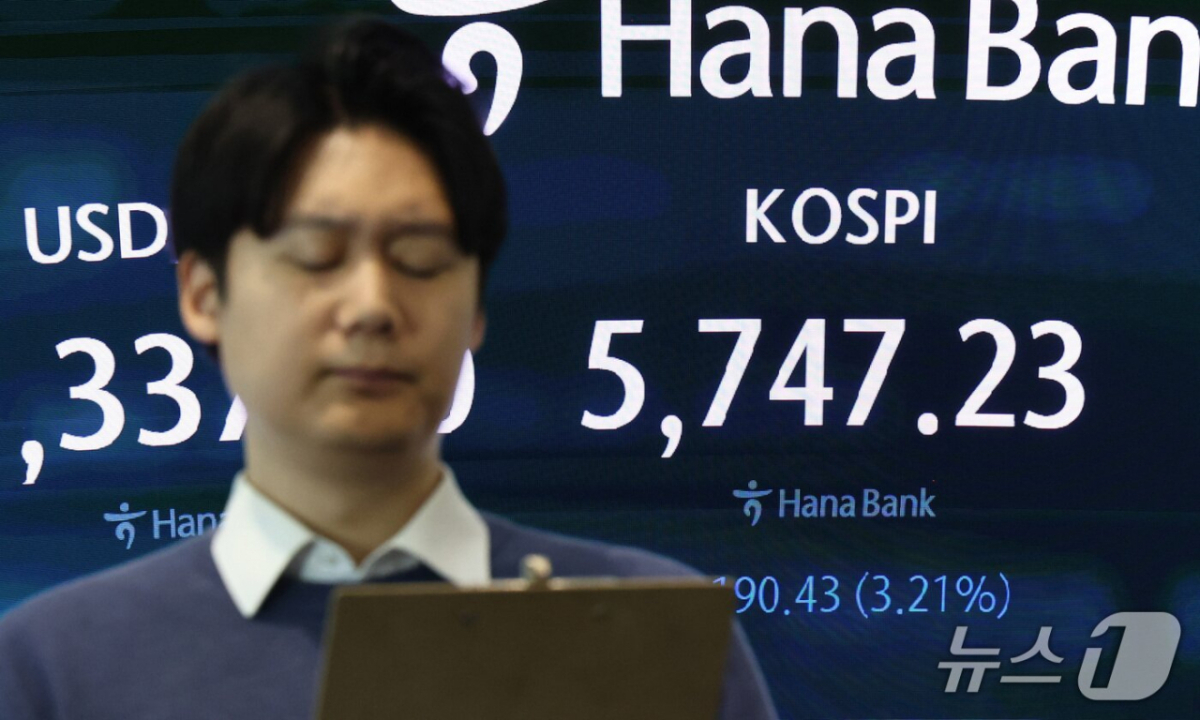
The sell-side sidecar was triggered in the KOSPI market as representative domestic semiconductor stocks plunged, following a drop of more than 12% for Google in the U.S. stock market overnight.
The Korea Exchange announced at 10:04 a.m. on the 30th that it had temporarily suspended the validity of program trading sell orders (sell-side sidecar) in the KOSPI market. This is the 55th sidecar triggered in the KOSPI market this year, and the 28th time a sell-side sidecar has been activated.
At the time of the sidecar activation, the KOSPI 200 futures index stood at 887.92, down 47.92 points (5.12%) from the previous trading day's close. At the same time, the KOSPI index was at 5655.41, down 282.25 points (4.75%).
A sidecar is a market stabilization mechanism that suspends the validity of program trading orders for five minutes. The KOSPI sidecar is triggered when the price of KOSPI 200 futures rises or falls by more than 5% from the previous day's closing price and remains in that state for at least one minute.
Alphabet, Google's parent company, announced on the 29th (local time) in its third-quarter earnings announcement that it had posted a free cash flow (FCF) deficit for the second consecutive quarter. As a result, Alphabet shares plunged for two consecutive days. Earnings from AI-related companies such as Amazon and Intel, released after the close of the New York stock market, were also weaker than expected. In particular, Amazon reported that its FCF had deteriorated compared to the previous quarter, similar to Google.
Amid the fallout, Samsung Electronics and SK hynix showed weakness from the pre-market session. At the time of the sidecar activation, Samsung Electronics was down 11,750 won (5.06%) from the previous trading day to 220,250 won, while SK hynix fell 128,000 won (8.45%) to 1,397,000 won.

 in STOCK
