

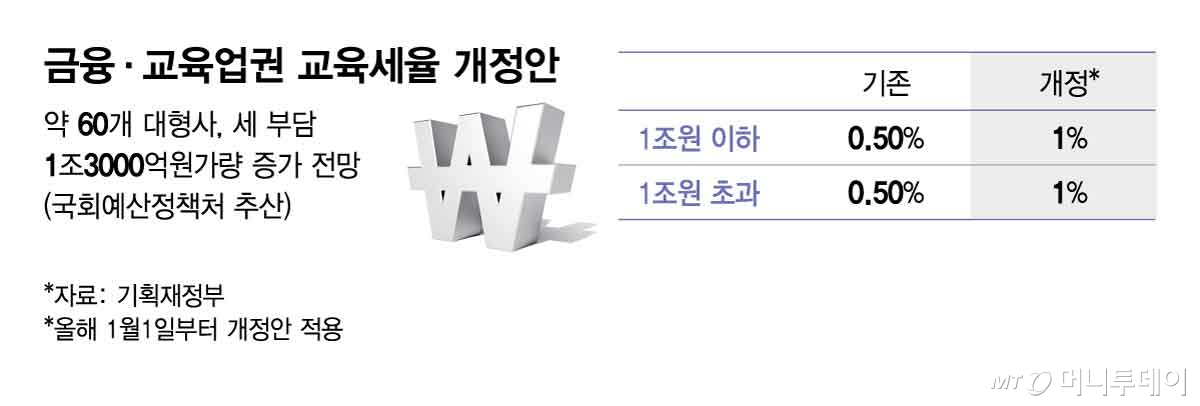
The anticipated sharp increase in education tax burdens for major financial groups this year stems from the government's hike in education tax rates combined with rising operating profits driven by a booming KOSPI market.
Under the revised tax law effective January 1 this year, the education tax rate for financial and insurance companies with annual operating income exceeding 1 trillion won has been raised from 0.5% to 1%. This introduces a two-tier system: a single rate previously applied uniformly now includes an additional tier for income above 1 trillion won, doubling the rate for that portion. The National Assembly Budget Policy Office estimated last year that this increase would raise total tax burdens across the financial sector by approximately 1.3 trillion won annually.
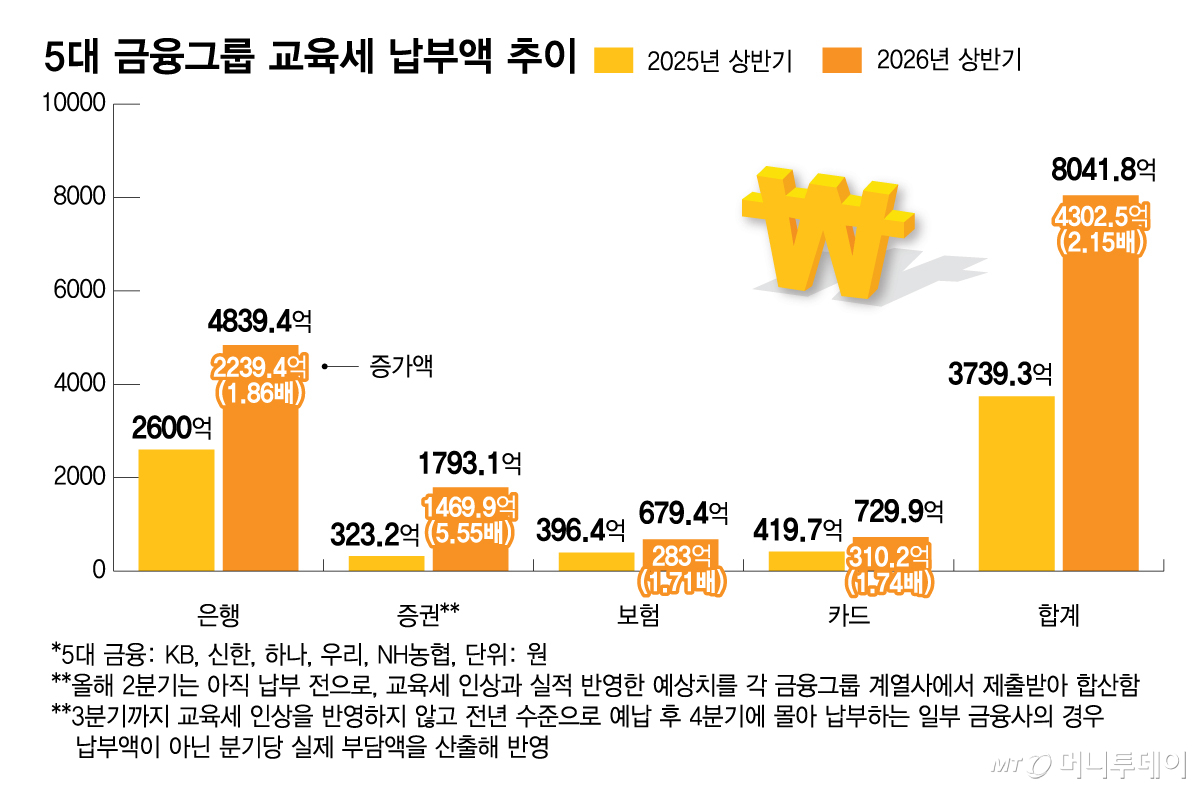
In reality, the situation proved even more severe. The five major financial groups (KB Financial, Shinhan, Hana, Woori, and NH Financial) are expected to face an education tax "bomb" exceeding 800 billion won in the first half of this year—2.2 times their previous year's payment amount. Although the taxable threshold was set at 1 trillion won or more, securities firms not eligible for loss-offset treatment saw increases exceeding sevenfold compared to last year.
According to data from the five major banks, these institutions paid a total of 497 billion won in education taxes last year based on their finalized annual performance. Financial companies calculate and pay their full-year education tax by February of the following year using confirmed annual results. Based on first-half figures from last year, they had paid 260 billion won in education taxes. This year, they are projected to pay 483.9 billion won in just the first half alone.
Experts argue that beyond the sheer surge in education tax payments due to rate hikes, the fundamental issue lies in the weak rationale for the original tax increase and the unreasonable structure of the tax calculation system.
The education tax is levied to secure funding necessary for education, aiming to expand facilities for improving educational environments and enhance teacher welfare. However, controversy persists over the lack of any direct link between bank and insurance profits and educational funding needs. Meanwhile, due to declining birthrates and shrinking school-age populations, demand for educational fiscal resources has decreased, while carryover amounts and unused funds in local education budgets have reached 6 trillion won annually.
The government explained its rationale for the revision by stating that since the introduction of the education tax in 1981, there had been no changes to the taxation system, so it considered factors such as growth rates in the financial and insurance sectors. The logic was that higher growth in these industries justified raising tax rates, drawing criticism over the flimsy basis for taxation. Within the financial sector, the move has been widely perceived as part of a government crackdown on financial institutions, leading to remarks describing it as "a punitive education tax worse than windfall profits."
Critics also point out that applying an progressive structure to what is essentially a value-added tax-like levy on the financial sector is problematic. Professor Kim Woo-cheol of the Department of Taxation at the University of Seoul stated, "The education tax was introduced as a de facto substitute for value-added tax in the financial sector, yet there is no instance where a progressive structure has been applied to VAT. This is an extremely inappropriate structure."
There are also calls for the financial sector to have taken a more proactive stance against the government's unreasonable tax reforms. The sharp rise in education taxes for securities firms stems not merely from the rate increase itself but from structural flaws in how taxable income is calculated, particularly the lack of loss-offset provisions. Insurance companies similarly hold exposure to managed assets in securities markets, sharing some of these same structural deficiencies.
Professor Kim added, "If a progressive structure was to be adopted, there should have been firm demands for taxation based on net profit after applying loss offsets. When the tax reform plan was released last July, the financial sector should have more actively shaped public opinion and pushed for systemic improvements. It is questionable whether they moved proactively enough. Raising concerns only after the bill passed the plenary session and when payment deadlines approached makes it difficult for such issues to be addressed."
The opposition has proposed amendments to normalize excessive education tax burdens, but given the current minority ruling majority opposition parliamentary situation, it remains uncertain whether this will lead to actual systemic reform. Representative Choi Eun-seok of the People Power Party introduced a bill last month to completely abolish the 1st trillion won or more taxable income bracket (currently taxed at 1.0%) and revert to applying a uniform 0.5% rate across all brackets, as before. Choi (Rep.) stated, "In a situation where educational funds are already in surplus, imposing punitive tax rate hikes solely on the financial and insurance sectors lacks justification."

 in FINANCE

