

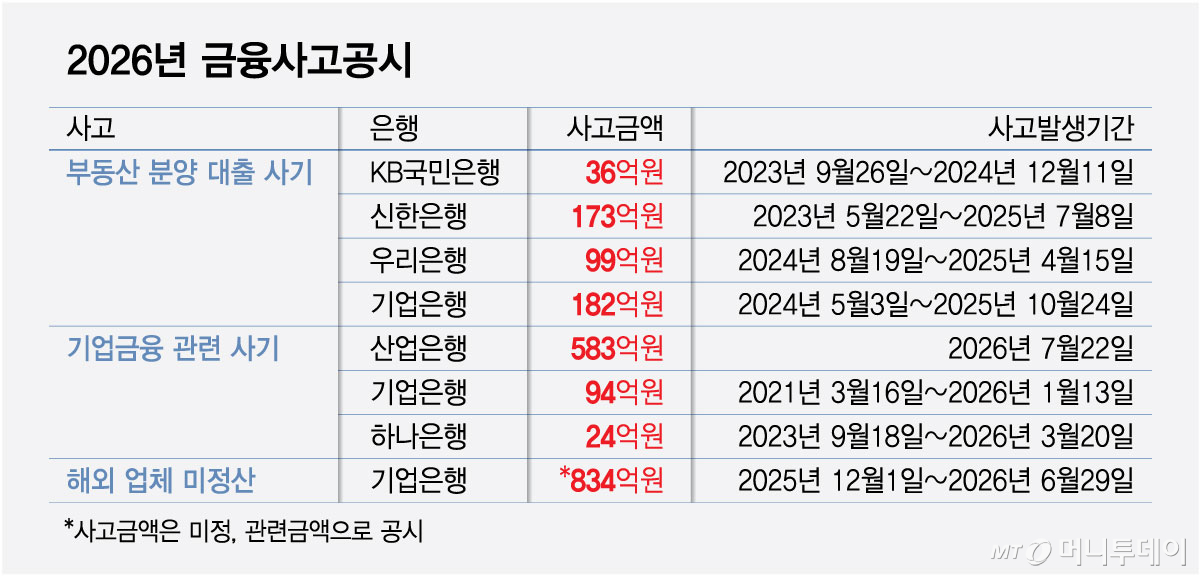
Since the introduction of the accountability structure last year, incidents have continued to occur in the banking sector, drawing attention to who will be the first target of sanctions. In particular, the Industrial Bank of Korea China subsidiary incident is cited as a likely case because it involved an 834 billion won loss and failure to recognize warning signs, necessitating an examination of whether internal controls were neglected. However, since this incident originated from external fraud, there are also concerns about whether executive liability can be assigned under the accountability structure.
According to financial sector sources on the 27th, the Financial Supervisory Service is reviewing whether to conduct on-site inspections regarding the recent Industrial Bank of Korea China subsidiary incident and real estate pre-sale fraud targeting commercial banks. Both cases are currently under investigation by local investigative authorities and police, so the decision on inspection will be made after the allegations are confirmed as criminal facts.
At Industrial Bank of Korea, an incident occurred while the China subsidiary executed non-face-to-face loans with local companies from December last year through June this year. The local loan platform failed to properly settle repayment funds returned by borrowers with Industrial Bank of Korea, causing problems in principal and interest recovery. The scale of the incident is estimated at 834 billion won.
The real estate loan fraud targeting commercial banks was discovered during a search and seizure operation by the National Police Agency. The amounts disclosed by KB Kookmin Bank, Shinhan Bank, Woori Bank, and Industrial Bank of Korea total 490 billion won. Recently, an incident also occurred where a company received loans by overstating its sales. The combined disclosure amount from Korea Development Bank, Industrial Bank of Korea, and Hana Bank that extended loans to this company reached a total of 701 billion won.
With financial incidents occurring in rapid succession recently, the financial sector expects that internal control responsibilities under the accountability structure will be clarified one after another. The accountability structure is a system that assigns tasks to each executive individually and imposes identity-related sanctions on responsible executives when incidents occur due to their negligence; it is often referred to as the "financial version of the Major Accident Punishment Act." Although introduced in January 2025 for financial holding companies and banks, there has been no case yet where sanctions were imposed for violation of management obligations under the accountability structure.
According to the operational guidelines for the accountability structure prepared by the Financial Supervisory Service, if it is determined that any one of the following detailed criteria was violated — major customer losses, serious impairment of soundness, failure to fulfill management obligations, executive approval or encouragement/neglect of instructions, organized illegal acts, or long-term or repeated illegal acts — a responsibility clarification procedure will be initiated. Subsequently, sanctions will be calibrated considering whether the actor exercised considerable care and the severity of the outcome.
In particular, the Industrial Bank of Korea China subsidiary case is frequently mentioned as a likely candidate for responsibility clarification because the incident amount was over 800 billion won and warning signs existed, yet the fraud was not recognized. A financial sector official stated, "Not only is the severity of the matter significant, but it also raises questions about why local institutional investors took measures such as removing private companies from their cooperation lists in March and April, yet failed to recognize this; it could lead to issues regarding whether internal control systems were properly established at the time."
Some raise doubts about whether assigning responsibility under the accountability structure is appropriate for incidents caused by external fraud. The argument is that if it is determined that even with considerable attention paid to internal controls, recognizing fraud was not easy due to external deception, holding someone accountable under the accountability structure would be difficult. A Financial Supervisory Service official said, "No judgment has yet been made regarding recently disclosed incidents."

 in FINANCE
