


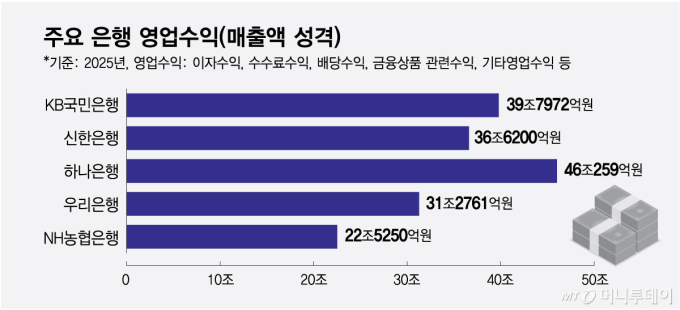
Twelve financial institutions, including banks, insurance companies, and card issuers, are likely to face fines in the trillions of won for violating the Credit Information Act. The 2020 revised "Act on the Use and Protection of Credit Information" (hereinafter the New Credit Information Act) imposes a base penalty based on 3% of sales revenue, and unlike other laws, it lacks separate detailed criteria, meaning even minor violations could result in "bomb-like" fines.
According to the financial sector on the 14th, the Financial Supervisory Service conducted on-site inspections to determine whether major commercial banks and internet-only banks violated the New Credit Information Act. Some banks will be subject to additional scrutiny during regular inspections in the second half of the year. The Financial Supervisory Service focused intensively on verifying whether multiple banks utilized customer information for marketing or transmitted advertising-related information without prior consent.
It is not just banks; other industries are also tense over penalties for violating the New Credit Information Act. It has been reported that around 12 financial institutions have undergone inspections or face imminent sanctions. Following Dongyang Life Insurance, which received a fine on the 9th, Shinhan Life and Lina Life were also caught by the Financial Supervisory Service for transferring customer information to GA (corporate agencies) without prior consent.
The problem is that if violations of the New Credit Information Act are confirmed, financial institutions could face fines in the trillions of won. The New Credit Information Act sets a cap on penalties at 3% of sales revenue and imposes a base penalty of 50%, 75%, or 100% according to the Financial Supervisory Service's inspection and sanction regulations. Banks with sales revenue (operating income) reaching 20 trillion to 40 trillion won could face fines in the trillions under Financial Supervisory Service sanctions. The only way for penalties to be reduced is if the Financial Services Commission grants "discretionary mitigation."
Unlike the Personal Information Protection Act or the Financial Consumer Protection Act, the New Credit Information Act lacks detailed criteria for penalties, making it impossible to predict the exact amount even for minor violations. A financial sector official pointed out, "There is significant room for dispute over whether checking customer information internally for asset management purposes constitutes a violation of the Credit Information Act, and excessive fines that do not correspond to the degree of violation are difficult for financial institutions to accept."

 in FINANCE

