

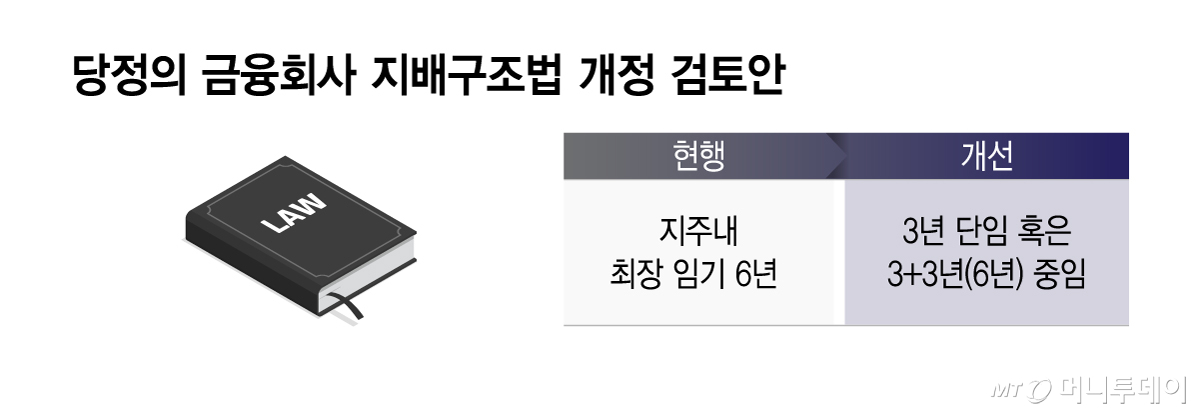
The ruling party and the government are considering a plan to transition the term of independent directors at financial holding companies to either a three-year single-term system or a six-year two-term system, which allows one extension after an initial three-year term (3+3 years). Currently, independent directors at financial holding companies serve up to four consecutive terms for a maximum of six years, based on a '2+1 year' structure. This discussion follows criticism that, in the process of being re-evaluated annually, independent directors act as a buffer for the holding company chairman to secure their own reappointment rather than checking the chairman's power.
According to political circles on the 20th, it is reported that the Democratic Party of Korea and financial authorities discussed a plan to transition the term of independent directors to either a three-year single term or a six-year two-term (3+3 years) during a party-government consultation on improving the governance of financial companies. This was not included in the financial company governance improvement proposal announced by the party and government on the 12th, and is being strongly considered as a supplementary measure to ensure the independence of independent directors.
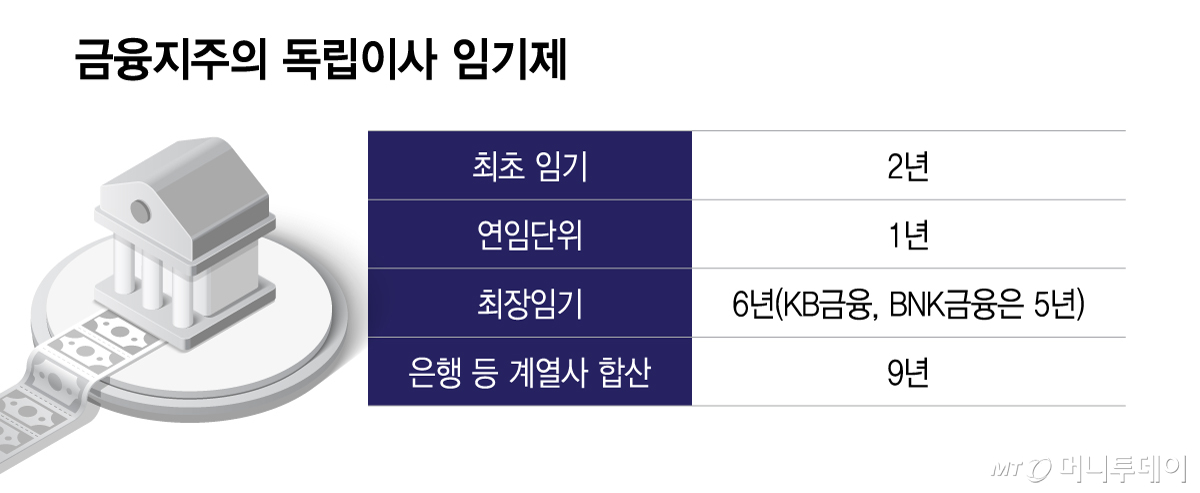
Under the current Financial Company Governance Act, the term for independent directors is up to six years, or up to nine years if subsidiaries are included. However, KB Financial Group and BNK Financial Group have set a maximum of five years by internal regulations. Typically, they serve an initial two-year term and can be reappointed up to four times in one-year increments. Independent directors must undergo evaluation for reappointment, but most receive the highest rating, resulting in them serving until the statutory limit of six years in the majority of cases.
The issue is that independent directors may build their own buffer not to check the financial holding company chairman, but to extend their own terms. It is pointed out that structurally, they must be mindful of the holding company chairman's mood because they are evaluated annually on whether to reappoint them. Accordingly, it is reported that a majority of ruling party lawmakers and Lee Chan-jin, Governor of the Financial Supervisory Service, have expressed opinions that a transition to a 'three-year single-term system' or a '3+3 year two-term system' is necessary.
If a three-year single-term system is introduced, independent directors can raise independent opinions without being constrained by reappointment. However, counterarguments arise that there are no cases among advanced overseas financial companies that set the term of independent directors as a single term, meaning it does not align with global standards. Consequently, an alternative mentioned is changing the number of reappointments from four times in one-year units to a three-year two-term system (one extension).
A plan to substantively grant the right to recommend independent directors to major shareholders is also under additional review. The improvement proposal disclosed on the 12th included a plan to grant the right to recommend independent directors to 1,131 shareholders holding '0.1% or more of shares for six months or more.' However, since the standing candidate pool for independent directors at eight bank holding companies averages 132 people per company, the possibility that an independent director recommended by a shareholder will actually be appointed is slim. The shareholder recommendation right could become meaningless.
The party and government are considering granting more substantive authority to major shareholders holding, for example, a shareholding level of 3% to 5% or more. It is mentioned that when narrowing down the average pool of 132 independent director candidates into a long list or short list, independent directors recommended by major shareholders would be prioritized for inclusion. In the case of Woori Financial Group, where pluralistic shareholders hold shares, if a shareholder holding 4% or more of shares recommends a candidate, they are automatically appointed as an independent director.
The reason the party and government are additionally reviewing the independence of independent directors and strengthening shareholder recommendation rights is that the authority of independent directors will become powerful when selecting future financial holding company chairmen. Going forward, it will be impossible for a financial holding company chairman to be reappointed or serve a third term without obtaining consent from at least three-quarters of the Executive Candidate Recommendation Committee, which consists entirely of independent directors. If there are seven independent directors, the proposal is rejected if two oppose it.
Although the authority of independent directors may become powerful, concerns have been raised that the improvement proposal announced by the party and government on the 12th alone is insufficient to ensure the independence of independent directors. The party and government plan to submit a bill to amend the Governance Act after additional discussions and finalize it within the year.

 in FINANCE

