

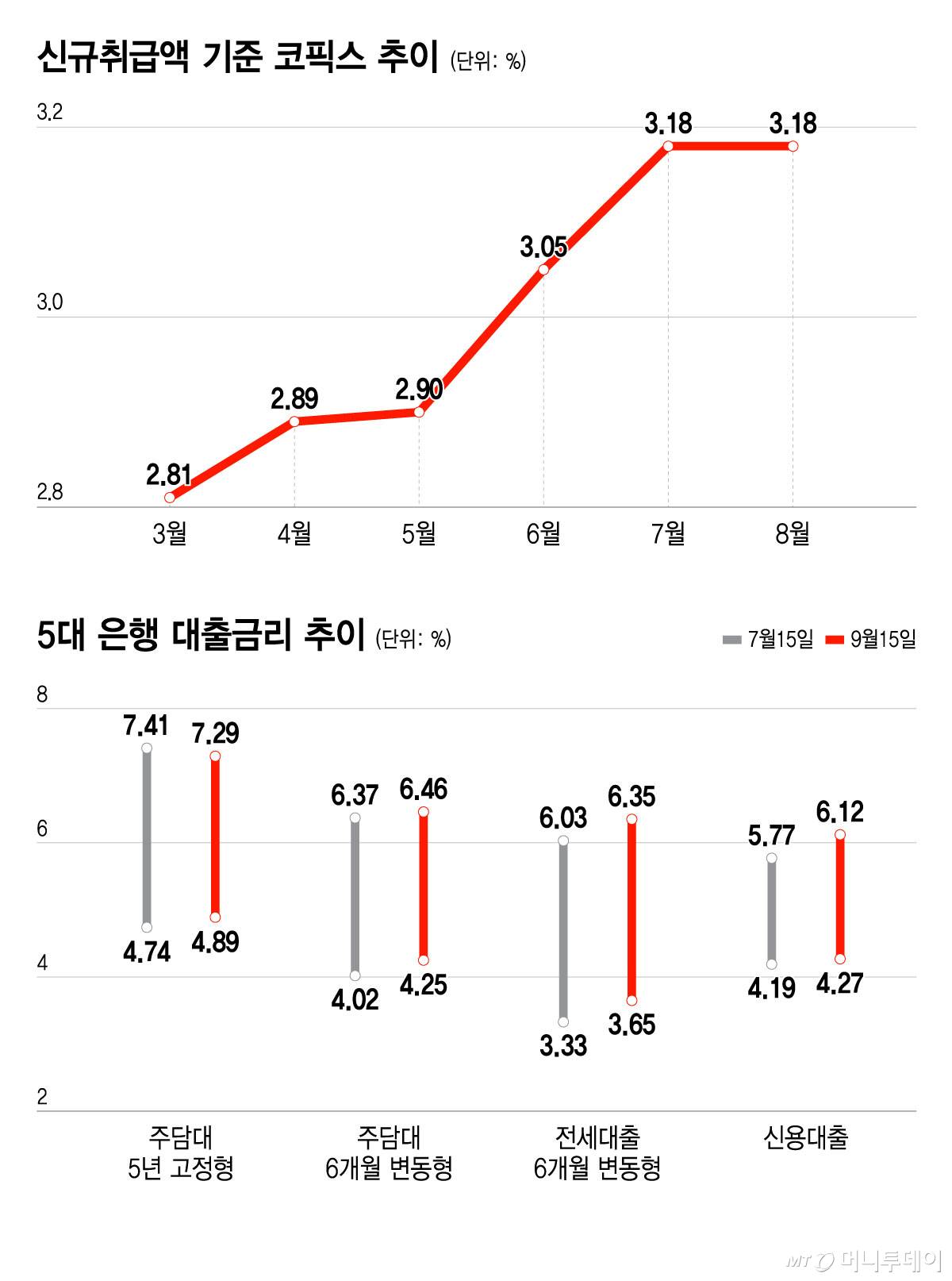
The COFIX (COFIX·Cost of Funds Index), which serves as the benchmark for variable-rate loans in the banking sector, rose for four consecutive months before pausing temporarily. However, loan rates are expected to continue climbing. With banks across the board raising deposit rates since September and mounting pressure from rising U.S.-origin bond yields, the likelihood of further loan rate increases has grown.
The Banking Association announced on the 15th that COFIX based on new transaction volume in August stood at 3.18%, matching the previous month’s level. COFIX is a cost indicator calculated as a weighted average of deposit rates raised by eight domestic banks and directly determines interest rates for six-month variable-rate housing mortgage loan products.
COFIX based on new transaction volume rose for four consecutive months from April to July but halted its upward trend in August. This occurred despite the rate-hiking cycle, as some banks secured large volumes of low-cost deposits through institutional investors, corporations, and corporate treasuries.
Although COFIX has paused temporarily, housing mortgage loan rates in the banking sector are already on an upward trajectory. As of this day, variable-rate mortgage rates at five major banks (KB Kookmin, Shinhan, Hana, Woori, NH NongHyup) ranged from 4.25% to 6.46%, representing a 0.23 percentage point (pp) increase in the lower bound and a 0.09 pp rise in the upper bound compared to two months ago (4.02%–6.37%).
The same trend applies to other loans. Six-month variable-rate personal loan rates rose from 4.19%–5.77% to 4.27%–6.12% over the same period, with lower and upper bounds increasing by 0.08 pp and 0.35 pp, respectively. Six-month variable-rate tenant loan rates also jumped from 3.33%–6.03% to 3.65%–6.35%, with both lower and upper bounds rising by 0.32 pp each.
The issue is that pressure on loan rate increases may intensify starting in September. Major banks have uniformly raised fixed deposit rates by approximately 0.1 to 0.6 percentage points this month. As the cost for banks to raise funds through deposits has increased, COFIX based on new transaction volume in September is also likely to rise again.
Market interest rates that drive up fixed-rate mortgage loan rates are also climbing sharply. The five-year corporate bond yield—the primary reference rate for five-year fixed-rate mortgage products—reached 4.578% on the 11th, marking its highest level since March 2023. It remained at a high level of 4.577% on the 14th as well.
Five-year fixed-rate mortgage rates at five major banks rose from an annual range of 4.74%–7.41% two months ago to 4.89%–7.29% today, with the lower bound increasing by 0.15 pp. Although the upper bound fell by 0.12 pp, this was due to a rate cut specific to NH NongHyup Bank. All other four banks (excluding NongHyup Bank) raised their rates compared to two months ago.
Pressure from rising U.S. interest rates is triggering further increases in domestic loan rates. The yield on the 10th-year U.S. Treasury bond briefly hit 5.030% today, reaching its highest level since July 2007. Moreover, with growing possibilities of additional tightening by the Federal Reserve System (Fed), upward pressure on interest rates across the global bond market is intensifying.
While loan rates are rising, household loans in the banking sector have shown a declining trend since September. As of the 14th, outstanding household loans at five major banks stood at 781 trillion 793.2 billion won, down 326 billion won from the end of last month (782 trillion 119.2 billion won). In particular, outstanding housing mortgage loans fell by 589.3 billion won to 620 trillion 683.8 billion won over the same period, leading the overall decline in household loans. This is interpreted as being driven by factors such as rising interest rates and strengthened household loan management efforts by banks, which have constrained loan demand.

 in FINANCE
