

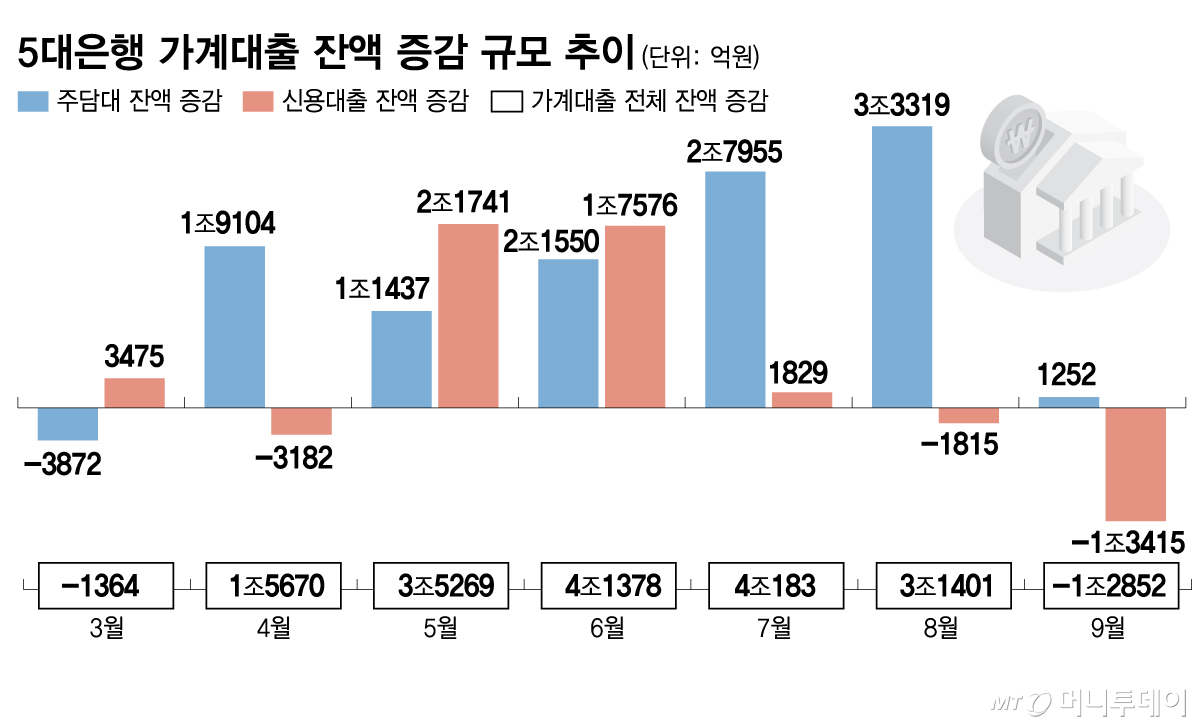
Although the government expanded the total volume cap for household loans, the household loan balance at the top five banks (KB Kookmin, Shinhan, Hana, Woori, and NH Nonghyup) actually decreased by nearly 1.3 trillion won last month. This was due to a slowdown in loan demand resulting from fewer housing transactions and rising loan interest rates. In contrast, corporate loans increased by more than 8 trillion won in a single month, marking the largest increase in two years and five months.
According to financial industry sources on the 1st, the household loan balance at the top five banks at the end of last month was 780.834 trillion won, down by 1.2852 trillion won from the end of the previous month (782.1192 trillion won). Mortgage loans increased by only 1.252 billion won during the same period, while credit loan balances decreased by a net amount of 1.3415 trillion won.
Mortgage loans had increased by trillions of won each month from April through August, with an increase of 3.3319 trillion won in August, but the upward trend reversed last month. Credit loans also showed an increase in the range of 2 trillion won in May and June, followed by a net decrease of 181.5 billion won last month, further widening the decline.
The government expanded the financial sector’s target for household loan growth this year from the previous 1.5% to around 3% through the the 13th measures, yet actual household loans decreased. Banks had already consumed 94% of the expanded target (approximately 7.11 trillion won) by the end of last August and exceeded the target in mid-September, leading them to continue conservative loan management.
In particular, mortgage demand slowed as housing transactions themselves declined recently. According to the Ministry of Land, Infrastructure and Transport, Seoul apartment transaction volume in August was 4,589 cases, a 30.1% decrease from the previous month (6,564 cases). This is about half the level of May last year, when 8,962 transactions occurred ahead of the expiration of the surtax exemption for capital gains on multi-home owners.
Among mortgage loans, group loan balances increased by only 455.1 billion won. While the handling of balance payment loans, which became exempt from total volume regulations after the the 13th measures, increased, mid-term payment and relocation cost loans, which are affected by new construction starts and sales volumes, decreased, limiting the overall increase.
Rising loan interest rates also impacted the decline in loan demand. In particular, credit loans, which are sensitive to interest rate changes, reflected a decrease in funding demand for stock investments and other purposes, as well as a reduction in minus account balances due to bonus payments ahead of the Chuseok holiday. As of that day, credit loan interest rates at the top five banks ranged from 5.14% to 6.33% annually, with the lower and upper bounds increasing by 0.95 percentage points (p) and 0.57%p, respectively, compared to three months prior (4.19% to 5.76%).
However, the decrease in total household loan balances also significantly reflected the temporary removal of policy loans from bank books. Policy loans such as Home Mortgage Loans are executed by banks and then securitized to the Korea Housing Finance Corporation after a certain period, excluding them from bank loan balances. As the proportion of mid-to-low-priced homes was high among transactions made ahead of the expiration of the surtax exemption for capital gains on multi-home owners in May last year, the handling of Home Mortgage Loans increased, and it is known that a significant portion of these was securitized last month.
Unlike the decrease in household loans, corporate loans increased substantially. The corporate loan balance at the top five banks rose from 878.3862 trillion won at the end of August to 886.4813 trillion won at the end of last month, an increase of 8.0951 trillion won in one month. This is the largest monthly increase since April 2024, when it was 10.894 trillion won.
The upward trend was led by large corporations. The corporate loan balance for large corporations increased from 195.9746 trillion won to 201.4634 trillion won, a rise of 5.4888 trillion won, surpassing the 200th trillion won mark for the first time. The increase in loans to large corporations was also the largest since April 2024, when it was 6.1377 trillion won.
A banking industry official stated, "Amid household loan regulations, banks are actively expanding corporate finance, and this is influenced by growing funding demand from companies." The official added, "Rising market interest rates recently have increased the burden of raising funds through corporate bonds, leading large corporations to shift some of their funding sources to bank loans, which also contributed to the increase in loans to large corporations."

 in FINANCE
