

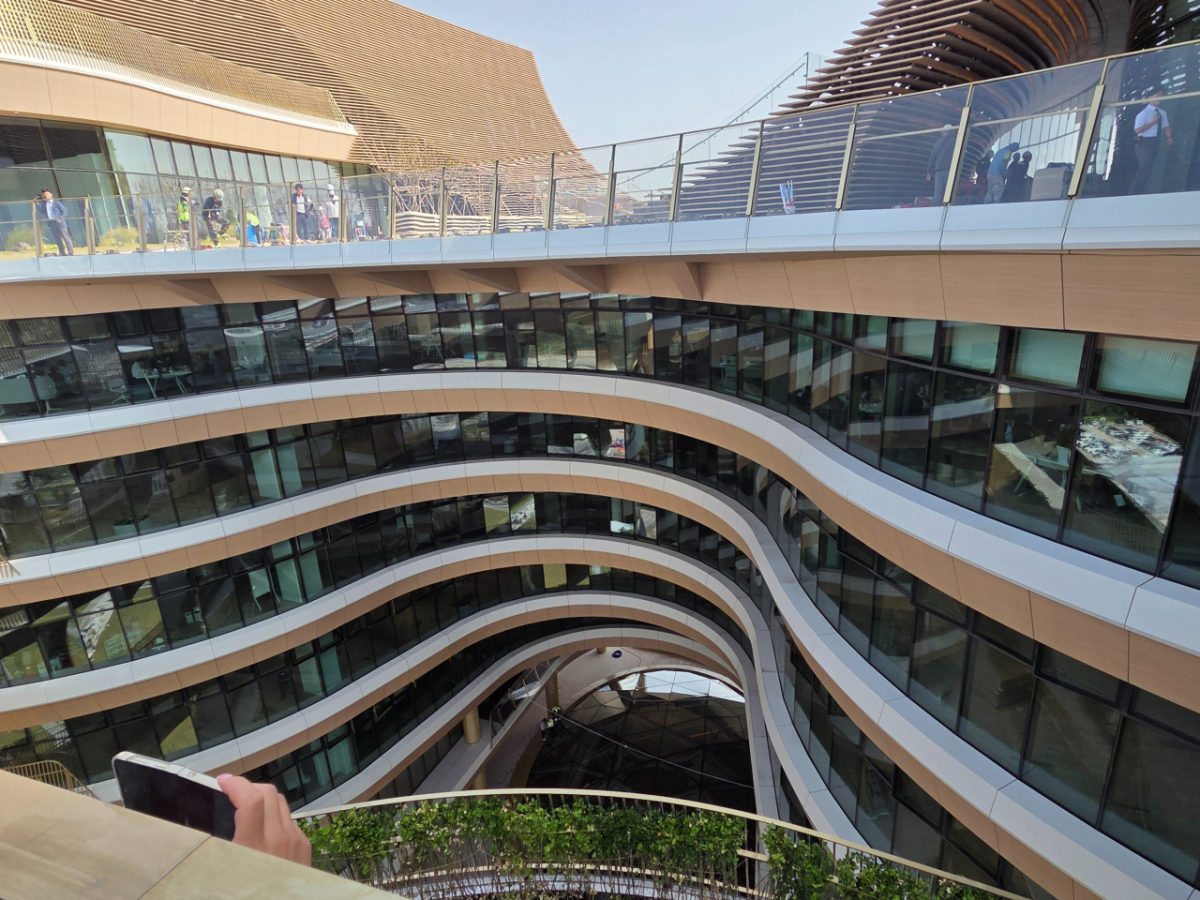
The Cheongra era for Hana Financial Group has officially begun. After formulating the Hana Dream Town plan in 2012 and building an integrated data center in 2017, the group opened its headquarters this year. By the end of the year, a total of 4,000 employees from 10 group companies will relocate to Cheongra, Incheon. It is not merely a change in geographic location from Seoul to Incheon. Moving away from the traditionally rigid atmosphere of financial institutions, the group created a space optimized for “connection” and “communication” through 5G infrastructure. The workspace was designed to lower physical barriers between affiliated companies and departments, allowing employees to encounter one another naturally.
According to industry sources on the 30th, Hana Financial has been relocating its holding company and affiliates to Cheongra since the 14th. In the first phase, all employees of Hana Financial Holdings, along with some staff from Hana Bank and Hana Financial TI, moved. In the second phase, all employees of Hana F&I relocated to Cheongra.
Next month, Hana Bank and Hana Capital will move, followed by Hana Life, Hana Securities, Hana Fund Service, Hana Card, and Hana Savings Bank sequentially starting in November. By the end of the year, approximately 2,200 executives and employees from 10 affiliated companies will move to Cheongra. Including the existing 1,800 data center staff, a total of 4,000 personnel will work in Cheongra.
The Cheongra Headquarters spans seven basement levels and 15 above-ground floors, boasting an area of 128,503 square meters. The dedicated floor area is approximately 1,100 pyeong (about 3,630 square meters), roughly three times that of the previous Myeong-dong headquarters. The first-floor lobby was bustling with preparations for the ceremony marking the headquarters opening, scheduled for the 2nd of next month.
Floors 3 through 7 will house Hana Bank, floor 10 will be occupied by Hana F&I and Hana Financial TI, floor 11 by Hana Securities, Hana Capital, and Hana Fund Service, and floors 12 through 13 by Hana Card. Employees of Hana Financial Holdings will occupy floors 14 and 15, with Ham Yeong-ju (Chairman)’s office located on the 15th floor.
Upon entering the building, what catches the eye first is not the office spaces divided by affiliated company, but the circulation paths connecting the entire structure. An external ramp links the first floor to the rooftop terrace on the 15th floor. The design allows natural light entering through the 15th-floor terrace to reach down to the first basement level, and internal staircases connect floors 3–7 and 10–14 within the building. Although floors are designated by affiliated company, the layout enables employees to move between levels and encounter one another naturally.
Flexibility has been increased so that work can be done anywhere with just a laptop. The Smart Work Center on the 7th floor features Korea’s first 5G wireless environment in the financial sector, creating a laptop-based work setup. Employees can perform their duties without being tied to their desks by utilizing cloud PCs, messengers, and softphones, even when away from their assigned seats.
A Hana Financial official stated, “Teams can work more freely and hold meetings,” adding, “We have prepared a physical environment with an autonomous seating system and cloud technology that allows work to be done anywhere.”
Since commercial infrastructure such as restaurants in the vicinity is not yet sufficient, many employees used the on-site cafeteria during lunch hours. As lunchtime arrived, employees were seen taking photos with the outdoor scenery outside the windows as a backdrop at the cafeteria located on floors 8 and 9. After finishing their meals, employees descended to the first basement level to use cafes or fitness facilities for the remainder of their lunch break. Hana Financial also enhanced convenience by providing wellness spaces, including four sports massage rooms and 60 capsule rooms.
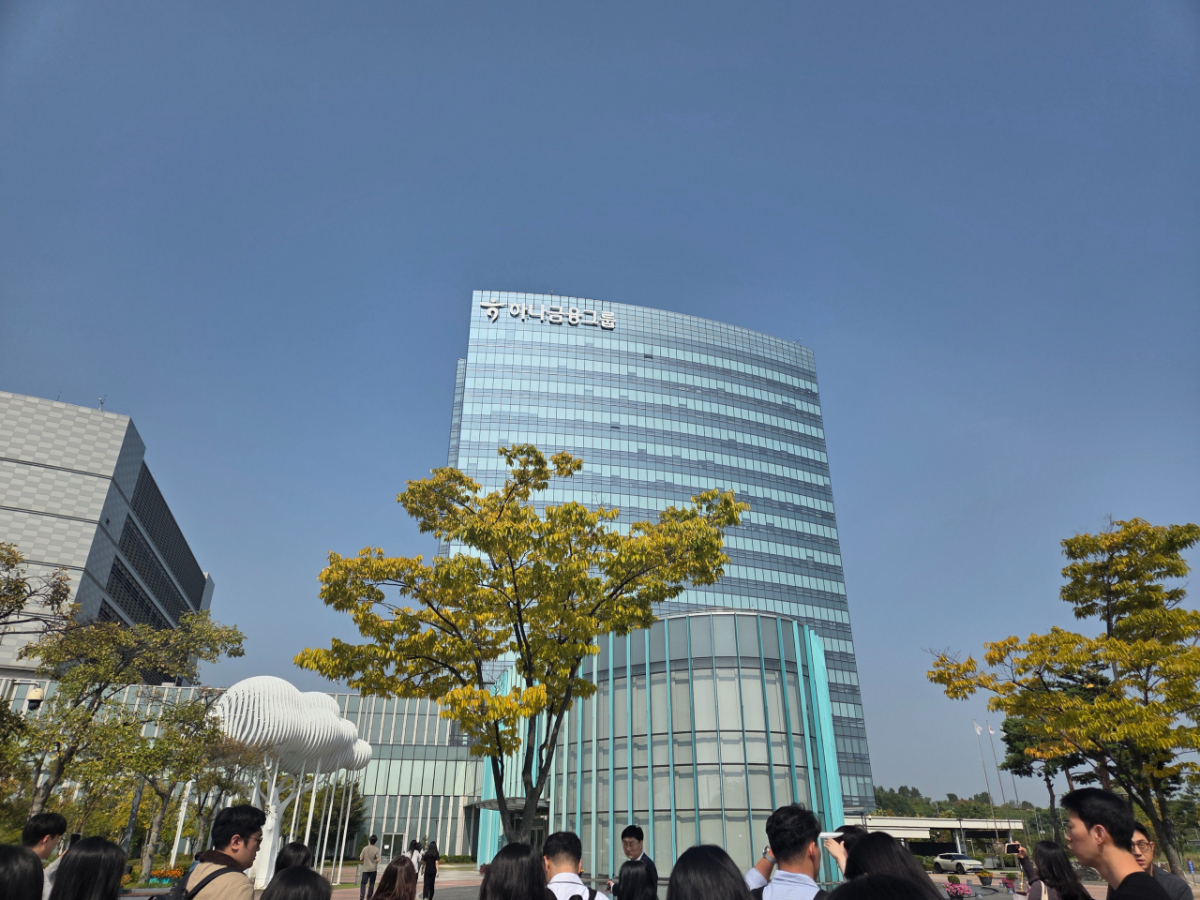
Across one street from the headquarters lies the Integrated Data Center. Built in 2017, the data center spans one basement level and 16 above-ground floors, covering an area of approximately 66,000 square meters. It consolidates the IT systems of affiliated companies, including banks, securities firms, and card issuers.
While electrical rooms that supply power to data centers are typically located in basements, Hana Financial placed its on the ground level. This was done to prepare for the possibility of flooding from natural disasters such as tidal floods, considering the characteristics of the Incheon region. The computer rooms are located on floors 3 through 6. Each floor has an area capable of accommodating 650 racks. On the 7th floor, GPU servers have been installed to establish an AI data center.
Hana Financial manages key facilities such as power, fire protection, and mechanical systems 24 hours a day through a state-of-the-art IBS system. Key infrastructure has been duplicated, and an uninterruptible power supply (UPS) system was built to ensure continuous power supply even if issues arise at KEPCO.
The Integrated Security Monitoring Center was established in 2012 due to the need for a joint group response as hacker organizations backed by North Korea, China, and Russia became more active, and it was relocated to Cheongra in 2017. Currently, 35 experts at the center work in two shifts around the clock to monitor the security status of 22 affiliated companies, including overseas subsidiaries. The dashboard displays real-time attack attempts and traffic from affiliated companies. A Hana Financial official explained, “We currently collect an average of one billion data points per day and block 100 hacking attacks through precise analysis.”
Hana Financial Convergence Technology Institute, the group’s AI think tank, independently researches and develops core technologies required for the financial industry, including data analysis, AI investment strategies, natural language processing, image and document recognition, and blockchain. These are being applied to actual services such as customer-tailored asset management, credit evaluation, consultation automation, and financial document processing.

 in FINANCE

