

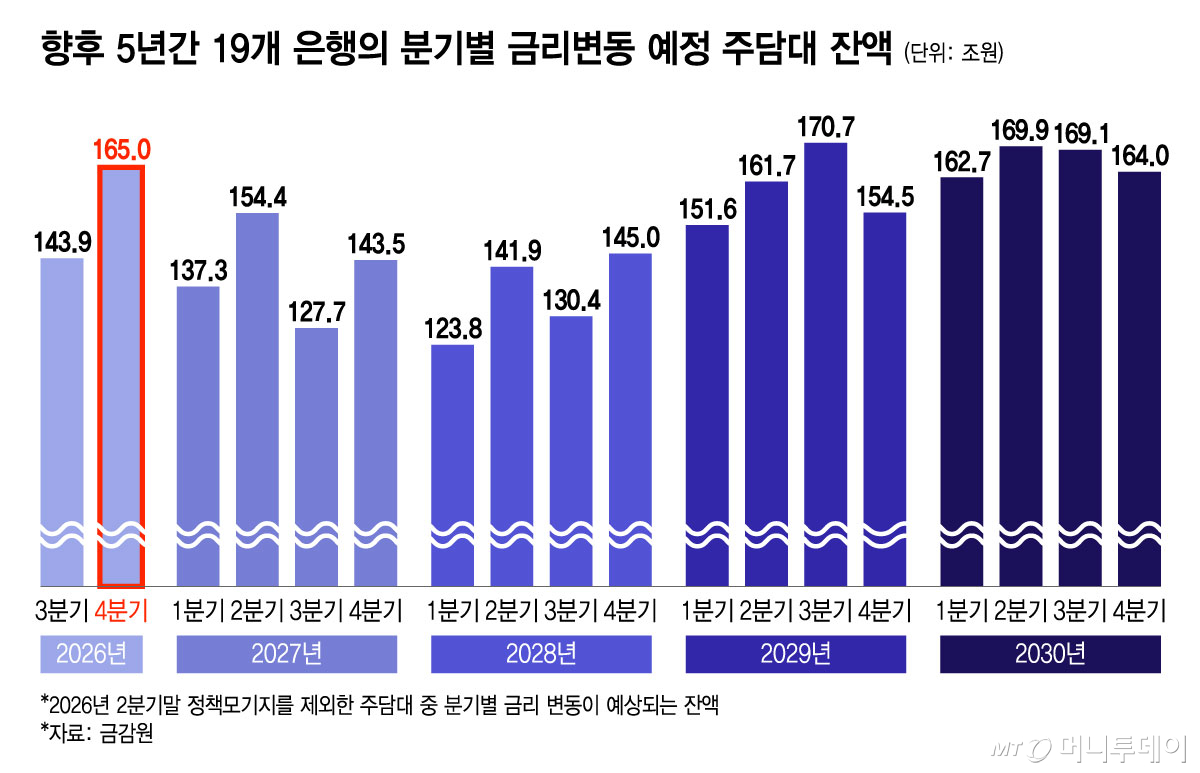
The outstanding balance of bank housing loans facing an interest rate change in the fourth quarter of this year reached 165 trillion won. This is the largest amount among those scheduled for quarterly interest rate changes over the next five years. Concerns are emerging that household principal and repayment burdens could snowball as the timing for recalculating interest rates for borrowers who purchased homes at low rates during the pandemic coincides with recent rising interest rates. With more than 80% of new mortgages also concentrated in variable-rate products, it was confirmed that the Task Force (TF) on long-term and fixed-rate housing loans launched by the government last year is currently not operational.
According to data submitted by the Financial Supervisory Service to the office of Rep. Han Chang-min of the Social Democratic Party, a member of the National Assembly's Political Affairs Committee, on the 7th, the outstanding balance of loans scheduled for an interest rate change in the fourth quarter this year among housing loans at all 19 domestic banks, excluding policy mortgages, was tallied at 165 trillion won. This is an increase of 21.1 trillion won from 143.9 trillion won in the third quarter.
Housing loans facing interest rate recalculations will continue to exceed 120 trillion won each quarter going forward. The amounts are 137.3 trillion won in Q1 next year, 154.4 trillion won in Q2, 127.7 trillion won in Q3, and 143.5 trillion won in Q4. In 2028, quarterly amounts of 123 to 145 trillion won will face interest rate changes, while in 2029, the scale is 151.6 to 170.7 trillion won. In 2030, it is at a level of 162.7 to 169.9 trillion won.
In particular, as the period for interest rate adjustments arrives for borrowers who purchased homes at ultra-low rates during the pandemic, repayment burdens are expected to grow. Based on the Bank of Korea's weighted average interest rate for deposit banks, the housing loan interest rate rose by 1.56 percentage points from 2.70% in Q2 2021 to 4.26% in Q2 this year. Assuming that the entire 165 trillion won scheduled for an interest rate change in Q4 this year consists of five-year cycle loans handled at that time, the principal and repayment burden would increase by 14.34 billion won per month and 17.212 trillion won annually on a 30-year equal principal and interest repayment basis.
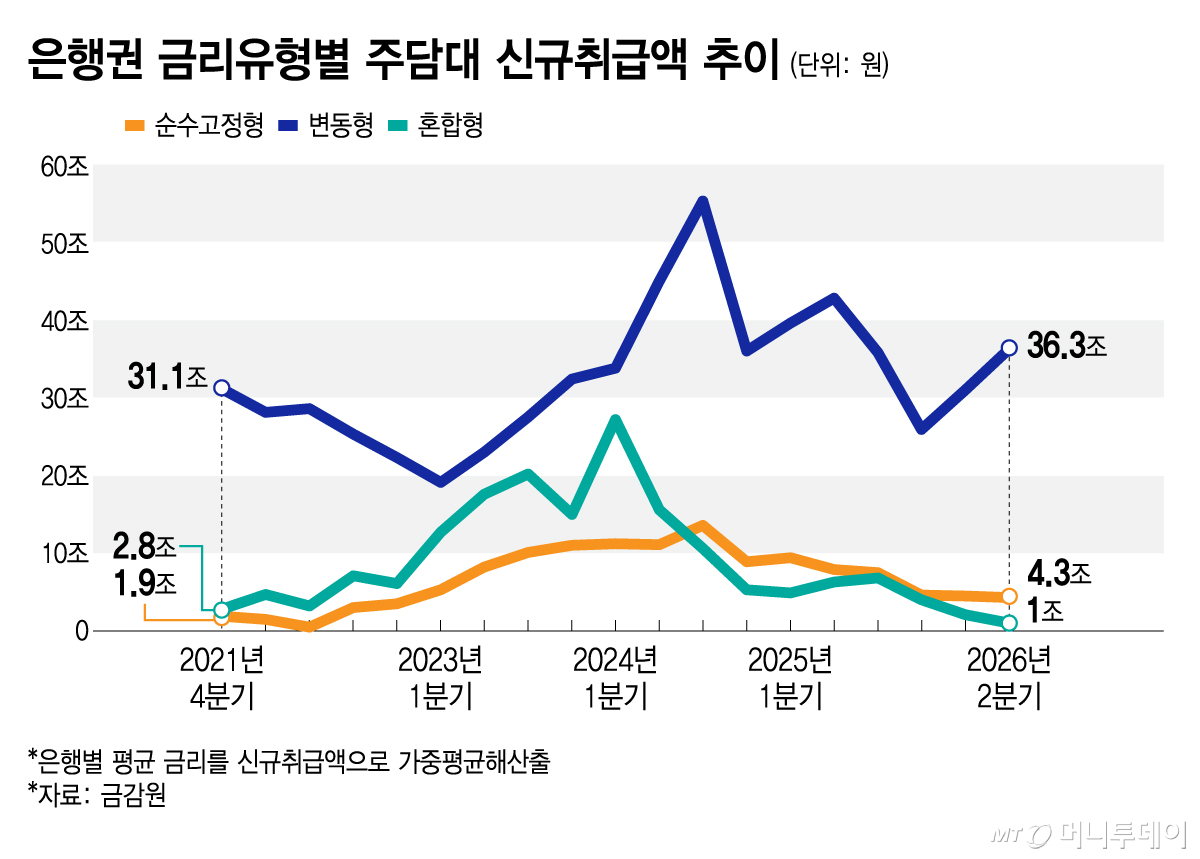
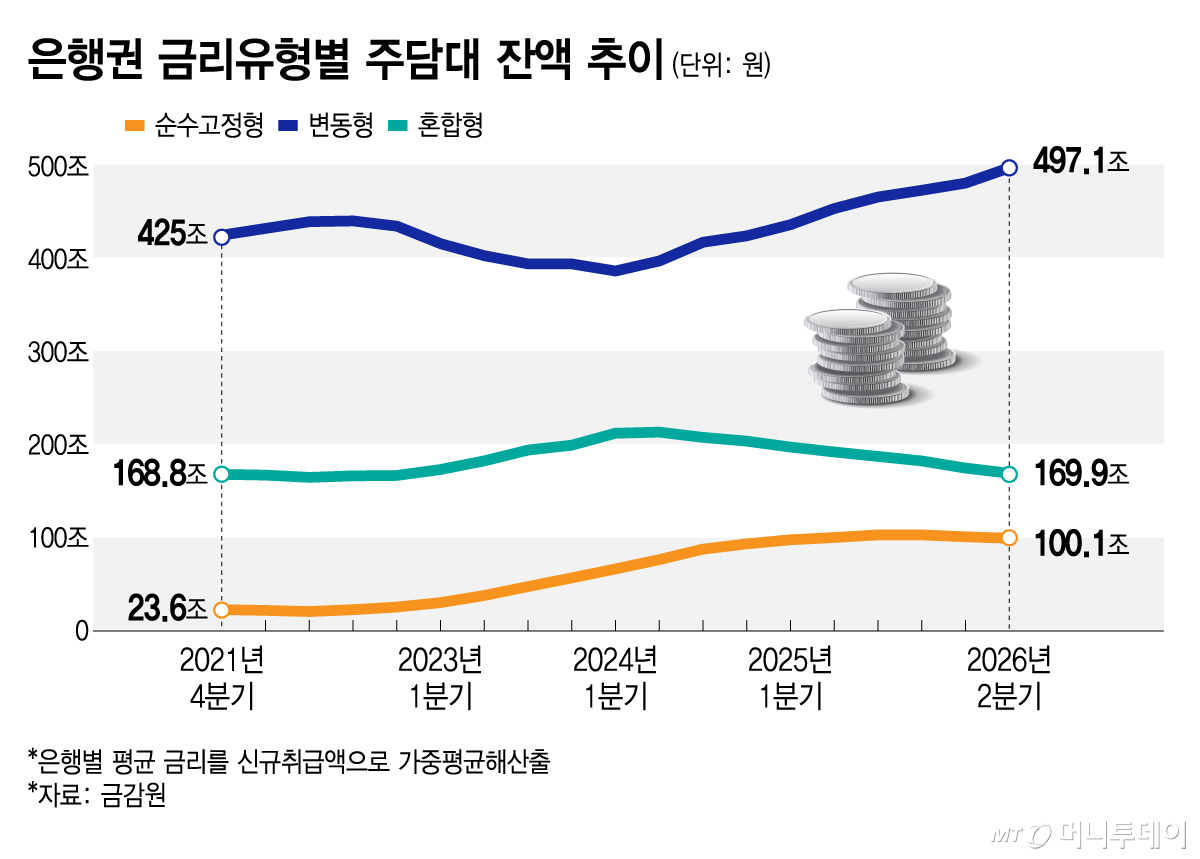
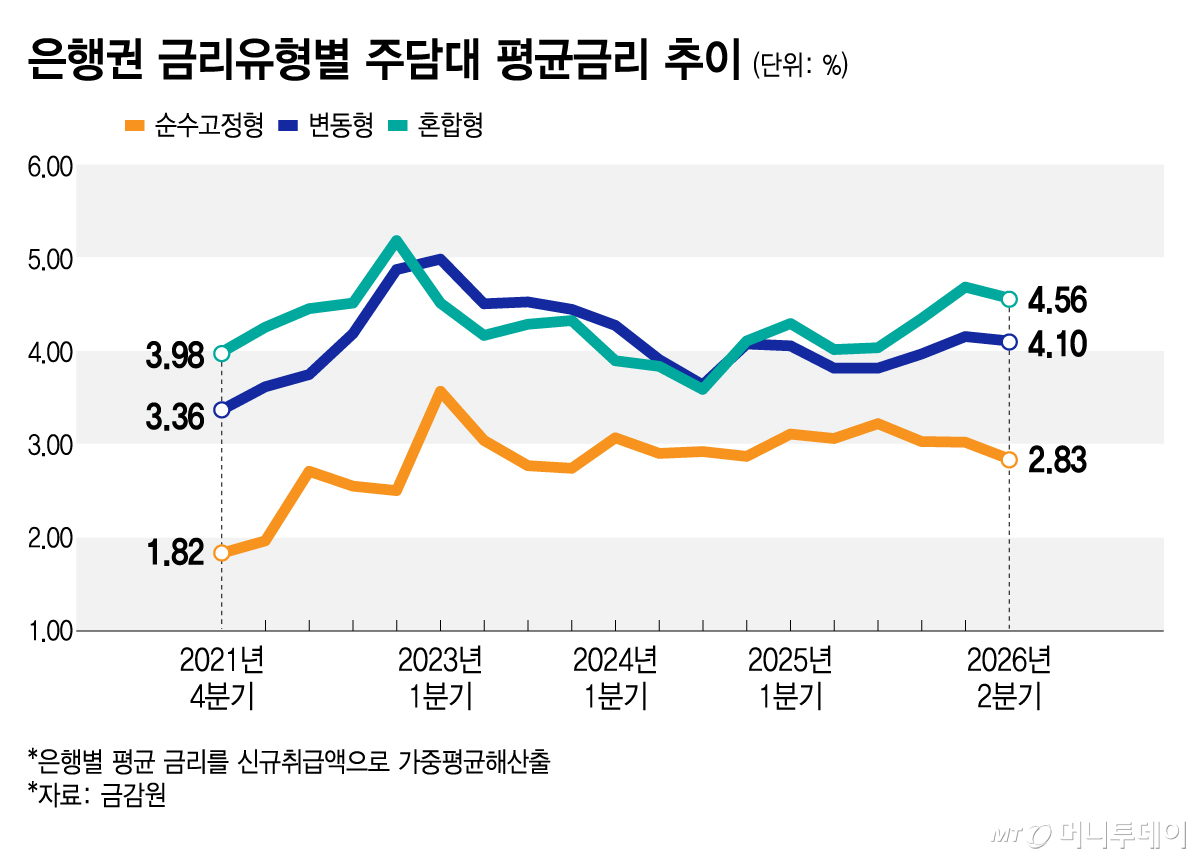
The problem is that the loan structure, which fully exposes housing loan borrowers to interest rate fluctuation risks, continues. According to the Financial Supervisory Service, among 41.5 trillion won in new bank housing loans excluding policy mortgages in Q2 this year, variable-rate loans accounted for 36.3 trillion won, or 87.5%. Pure fixed-rate loans were 4.3 trillion won (10.4%), and mixed-type (fixed-rate) loans were only 1 trillion won (2.4%). Even in the total outstanding housing loan balance at the end of Q2 (767 trillion won), variable-rate loans reached 497.1 trillion won, accounting for 64.8%. Notably, during the same period, the average interest rate for new disbursements was 4.10% for variable-rate, which was 1.27 percentage points higher than pure fixed-rate (2.83%), while mixed-type reached 4.56%.
The government has been promoting the expansion of fixed-rate housing loans to improve the qualitative structure of household debt since 2011. The Financial Services Commission formed a separate long-term/fixed-rate TF last year and held its first meeting on May 30, and at last month's household debt review meeting, urged banks to launch long-term fixed-rate housing loans. However, in response to inquiries from the lawmaker's office regarding the progress of the TF, the Financial Services Commission replied that "the long-term fixed-rate TF is not currently operational and is under internal review."
The funding structure lies behind banks' reluctance to supply long-term/fixed-rate housing loans. This is because banks that raise funds on a short-term basis must bear the risk associated with rising interest rates if they fix loan rates for 20 to 30 years. A research commission conducted by the Financial Services Commission at the Korea Financial Research Institute also analyzed that while long-term/fixed-rate housing loans can reduce borrowers' repayment burdens and banks' credit risks during periods of rising interest rates, supply is sluggish due to banks' funding costs and interest rate risk burdens. The institute estimated that if core deposits of domestic commercial banks are utilized, there is room to replace at least 31.6 trillion won of existing housing loans with long-term/fixed-rate loans.
The Financial Research Institute proposed activating MBS (Mortgage-Backed Securities) and covered bonds as a solution to increase the supply of long-term/fixed-rate products. In the short term, it suggested expanding MBS securitization through the Housing Finance Corporation, and in the medium to long term, growing the market where banks issue covered bonds using housing loans as collateral to raise long-term funds. Indeed, the Housing Finance Corporation is providing payment guarantees for banks' covered bonds to supply long-term/fixed-rate housing loans and has signed related agreements with nine banks as of last April.
Han Chang-min (Rep.) emphasized that "the government has made multiple efforts to expand long-term/fixed-rate housing loans but has repeatedly failed," and stated that "policy efforts, such as expanding the issuance of MBS and covered bonds, must be made to reduce the proportion of variable-rate loans that shift interest rate fluctuation risks onto borrowers."

 in FINANCE


