

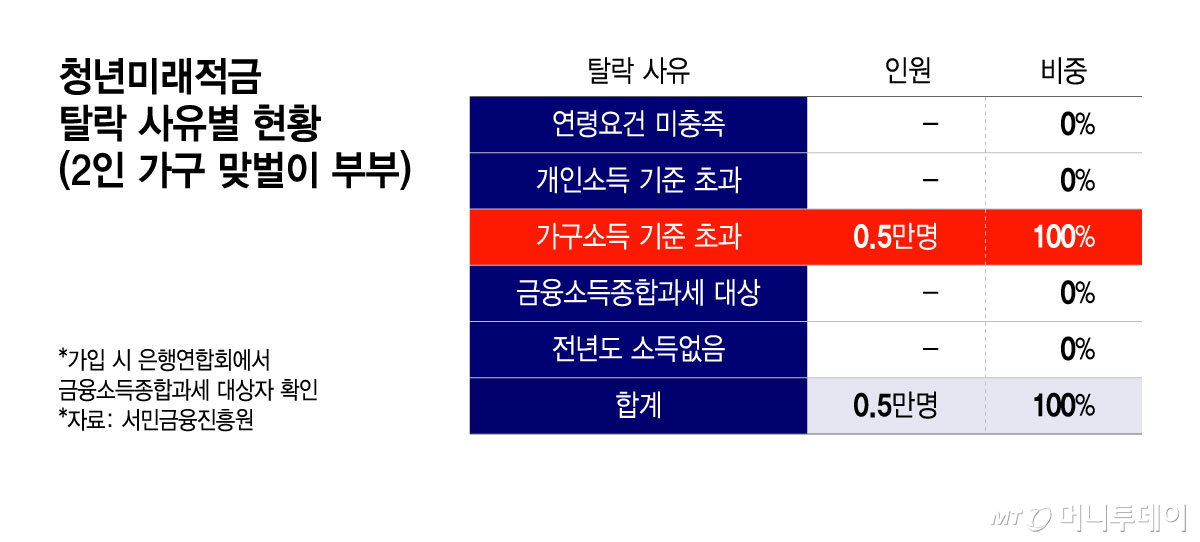
As the government accepts second-round applications for the Youth Future Savings Account, which offers a real return rate of up to 19.4% annually, approximately 5,000 young dual-income couples who had maintained Youth Savings Accounts failed to qualify when attempting to switch to the Youth Future Savings Account due to household combined income criteria. Spouse income, which did not affect the maintenance of existing accounts, became a hindrance in the process of switching to the new product. It is pointed out that so-called "marriage penalties" still remain in the youth asset formation support system.
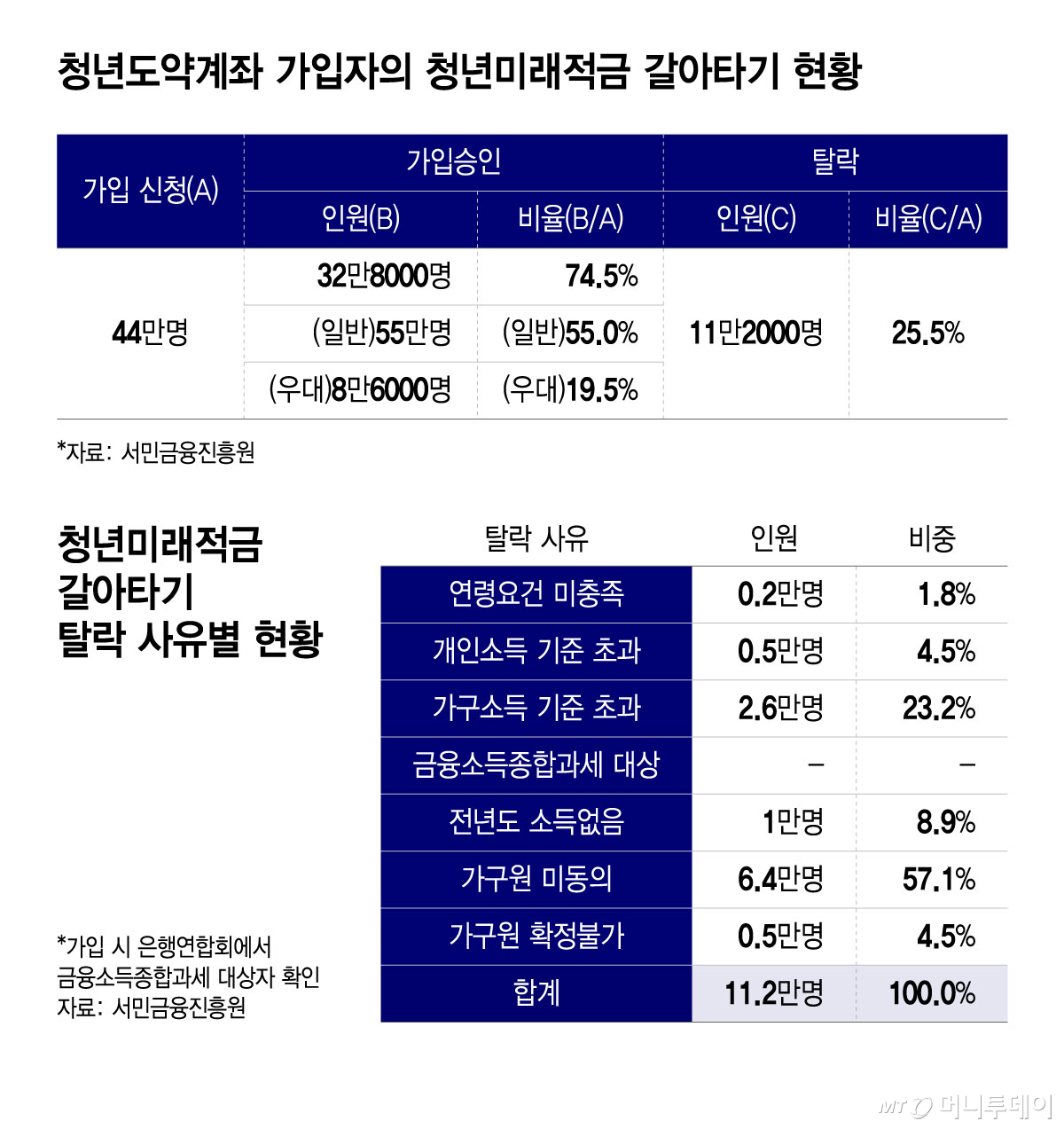
According to documents submitted by the Financial Supervisory Service to the office of Democratic Party of Korea lawmaker Park Min-gyu, a member of the National Assembly's Political Affairs Committee, as of August 7, 440,000 young people applied to switch from Youth Savings Accounts to the Youth Future Savings Account. Of these, 328,000 (74.5%) received approval for enrollment. The remaining 112,000 (25.5%) were rejected for failing to meet the eligibility requirements.
In particular, among those who applied to switch, approximately 5,000 dual-income two-person households were recorded as having been rejected due to exceeding household income criteria. No other rejection reasons, such as exceeding individual income limits, were recorded for these individuals.
The household income review methods for the Youth Savings Account and the Youth Future Savings Account differ. The Youth Savings Account checks whether household income is at or below 250% of the median income at the time of initial enrollment, but subsequent annual maintenance reviews only check individual income. Even if a participant marries after enrollment or their spouse's income increases, the maintenance of the existing account is not restricted on grounds of household income.
On the other hand, switching to the Youth Future Savings Account requires undergoing a new household income review. Even for young people who have maintained a Youth Savings Account, if their spouse's income is combined after marriage and exceeds the household income criteria, they are structurally unable to enroll in the new product.
The government also considered this issue and relaxed the household income criteria for dual-income two-person households by 50 percentage points each: from 200% to 250% of median income for the standard type, and from 150% to 200% for the preferential type. However, even with the relaxed criteria applied, enrollment restrictions based on combined spousal income still occur.
In fact, if a couple each earns an annual income of 50 million won, their combined income is 100 million won. This amount exceeds the preferential type income criterion for dual-income two-person households, which is 200% of median income (94.38 million won), making it impossible to enroll in the preferential type due to household income requirements.
Marriage penalties can also occur with the standard type. For example, if a young person earning an annual income of 50 million won enrolls in a Youth Savings Account and receives government support, but then marries a spouse earning approximately over 68 million won annually, their combined spousal income will exceed 250% of median income (117.98 million won). While the Youth Savings Account can be maintained as is, switching to the Youth Future Savings Account becomes impossible. Even if individual income remains unchanged, they are effectively excluded from policy financial support targets due to marriage.
The enrollment threshold for the Youth Future Savings Account is not an issue limited only to dual-income couples. Out of 2.343 million total applicants, 796,000 (34.0%) were rejected. By reason for rejection, lack of consent from household members was the most common at 378,000 (47.4%), followed by 182,000 young people (22.9%) who were rejected because they had no income in the previous year.
The government verifies income to check payment capacity and whether income requirements are met; since income is finalized in July, it uses the previous year's income as the baseline. Consequently, a blind spot arises where young people who started working for the first time this year and actually generated labor income are excluded from eligibility due to having no income in the previous year. The Financial Supervisory Service stated, "We are reviewing improvement measures regarding the marriage penalty issue and the blind spots caused by using the previous year's income as the baseline."
To improve such enrollment restriction issues, the government is pushing a plan to abolish individual and household income requirements for the standard type of Youth Future Savings Accounts starting next year. However, the preferential type, which receives relatively larger government contributions, will maintain household income reviews. This means that enrollment restrictions based on combined spousal income may continue in the preferential type. The reform plan is expected to be finalized after going through National Assembly budget deliberations and other processes.
Park (Rep.) stated, "While the government is pushing the resolution of marriage penalties as a major policy task and presenting related improvement tasks such as loans, housing subscriptions, and tax systems, it is necessary to improve disadvantages arising from marriage in the Youth Future Savings Account as well," adding, "When recruiting for the Youth Future Savings Account next year, issues such as exclusion from support targets solely due to combined spousal income must be improved."

 in FINANCE

