

The Financial Services Commission, which oversees financial policy, will relocate to Sejong in the second half of next year. This marks a change in location from Seoul to Sejong after 19 years since its establishment in 2008. Along with the FSC's move to Sejong, the possibility of relocation for public institutions including the Financial Supervisory Service has also been raised. The financial sector is in an uproar ahead of the announcement of the second phase of public institution relocations as early as next month.
The Ministry of the Interior and Safety announced on the 13th that it had finalized and announced a total of 44 institutions (9,929 people), including the FSC, as targets for the "Second Phase Central Administrative Institution Relocation." The FSC is a ministry that can be relocated without legal amendments, so its relocation in the second half of next year has been confirmed. The FIU (Financial Intelligence Unit) under the FSC will also relocate to Sejong during the same period and set up base at the temporary office building.
The FSC, which was launched as an expanded reorganization of the Financial Supervisory Commission in 2008, has consistently been located in Seoul. The FSC and FIU have staff quotas of 340 and 80, respectively, meaning that more than approximately 400 FSC civil servants will need to pack their belongings. Since the FSC has carried out licensing for financial companies as well as financial policy and financial supervision policies, this relocation decision is expected to have a significant impact on the financial sector.
Public financial institutions located in Seoul include national policy banks such as the Korea Development Bank, IBK Industrial Bank of Korea, and Export-Import Bank of Korea, as well as the Korea Deposit Insurance Corporation, the Credit Guarantee Fund, and the Financial Services for the Underprivileged Promotion Agency. There are also related institutions such as the Financial Supervisory Service and Securities Finance. Excluding the Korea Exchange, the Depository and Custody Bank of Korea, and the Housing Finance Corporation, most are located in Seoul. A financial sector official said, "Major public institutions that move according to financial policy may find it difficult to collaborate smoothly if the FSC relocates," adding, "Financial companies will also have to frequently travel to Sejong for communication regarding licensing and other matters."
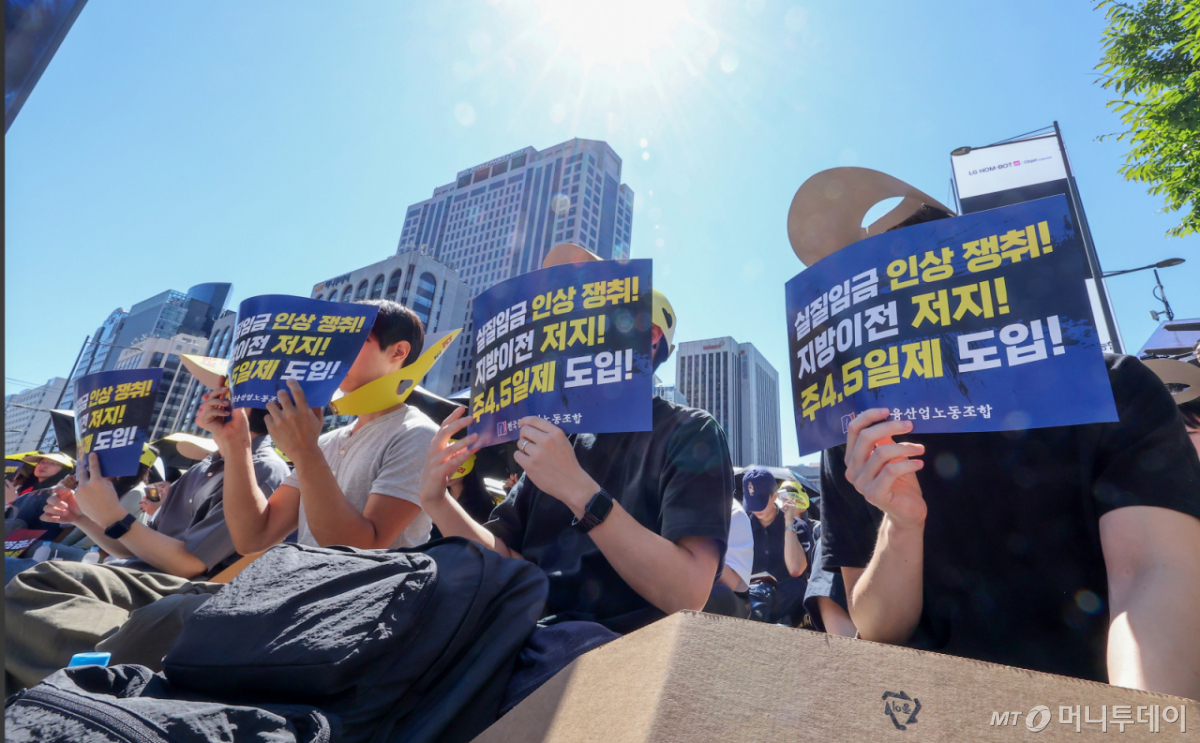
FSC civil servants are also in turmoil. Initially, as Seoul was highlighted as an "economic capital," there were expectations that the FSC would remain in Seoul. As one of the few ministries located in Seoul, the FSC is a popular ministry among "ace" civil servants. An employee affiliated with the FSC said, "There are already not many 'mid-level' employees at the section chief level or below who have to do a lot of work, so we are concerned that a larger gap will arise after the relocation to Sejong." As cases of civil servants at the section chief level or below in major ministries including the FSC moving to private companies increase, the scale of departures could expand due to the decision to relocate to Sejong. Some employees are also considering commuting from Seoul to Sejong for reasons such as their children's education.
With the FSC's relocation confirmed, the possibility of relocation for other public financial institutions has further increased. On this day, Kim Ha-gyun, Headquarters Director of the Ministry of the Interior and Safety, said, "The Financial Supervisory Service is in the form of a special purpose corporation, and along with that, we are separately reviewing the overall matter regarding the relocation of public institutions." The government plans to announce the second phase public institution relocation plan as early as next month, or at the latest by the end of this year. Specific relocation target locations will also be disclosed together.
Accordingly, strong backlash is centered on employees of national policy banks such as KDB, KEB, and EXIM Bank located in Seoul. The Deposit Insurance Corporation and the Financial Supervisory Service are also in an uproar. Although not public institutions, entities mentioned as relocation targets, such as Nonghyup, Suhyup, and Saemaul Geumgo, are also on edge.
Some argue that with the FSC's relocation to Sejong, there is a possibility of organizational restructuring in the medium to long term between domestic finance (FSC) and international finance (Ministry of Economy and Finance), as well as between supervision policy (FSC) and supervision execution institutions (Financial Supervisory Service). The Lee Jae-myung administration, in its early days, pushed for a plan to dissolve the FSC and integrate domestic financial policy with the Ministry of Economy and Finance. A proposal to combine supervision policy and supervision execution to return to the former Financial Supervisory Commission model was also discussed but fell through last year.
A financial sector official predicted, "If the FSC relocates to Sejong, the plan for integration with the Ministry of Economy and Finance will resurface," adding, "Discussions on restructuring the supervision system may continue in line with that."

 in FINANCE
