

After a prolonged negotiation, Shinhan Financial Group has acquired Lotte Insurance for approximately 900 billion won, embarking on structural improvements to its insurance business, which had long been a weak point. The deal was struck at a level that does not undermine the "value-up program 2.0" strategy emphasized by Shinhan Financial, as the valuation of Lotte Insurance, which once exceeded 2 trillion won, has declined. Shinhan Financial aims to expand its insurance division to narrow the gap in non-bank competitiveness with KB Financial and leap forward as a leading financial group.
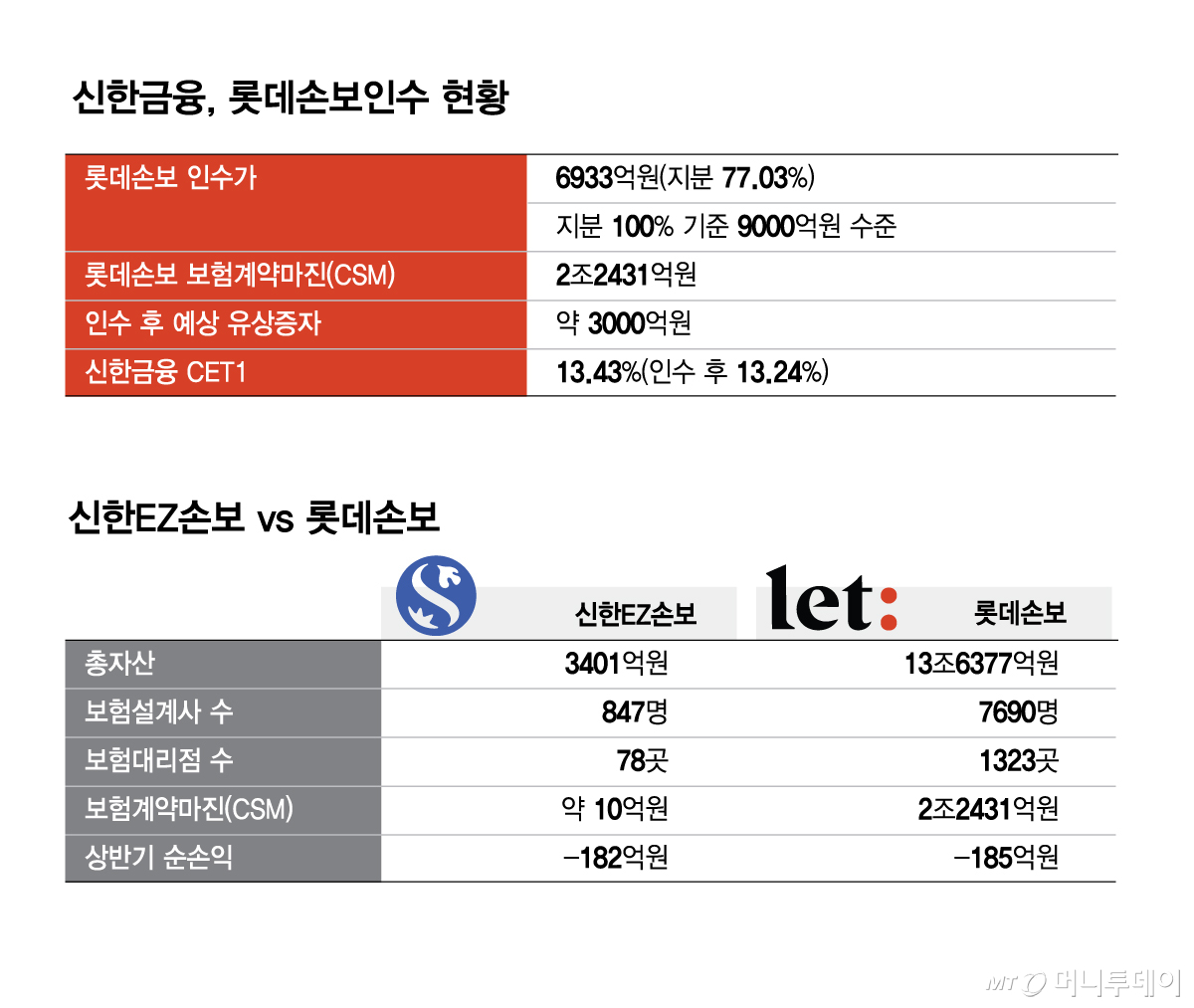
According to financial industry sources on the 13th, Shinhan Financial held a board meeting that day and approved the acquisition of Lotte Insurance. Shinhan Financial will acquire a 77.04% stake in Lotte Insurance held by JKL Partners for 693.3 billion won and plans to secure the remaining 22.96% after completing necessary procedures, including regulatory approval. Based on 100% of equity value, the deal is valued at approximately 900 billion won.
The transaction is assessed as a result of Shinhan Financial's insistence on an upper limit for the acquisition price. It is known that Shinhan Financial calculated an appropriate price considering Lotte Insurance's financial soundness issues and the burden of additional capital injection post-acquisition. Even after exclusive negotiations conducted until last July broke down, Shinhan Financial kept the possibility of acquisition open while not yielding on price. As negotiations dragged on, the price expectations of the seller and buyer converged, leading to the deal's completion.
Above all, a strong sense of urgency that strengthening insurance competitiveness was unavoidable in order to narrow the gap with KB Financial, currently the leading financial group, played a major role. While KB Financial has secured KB Insurance as a key profit source, Shinhan Financial effectively lacks an insurance affiliate capable of competing with it, leading to the notion that the performance gap between the two groups is driven by their insurance businesses. It was also painful that the annual net income scale of KB Insurance expanded from the previous 500 billion won to the 1st trillion won level following the introduction of IFRS17.
Shinhan EZ Insurance, Shinhan Financial's insurance affiliate, has assets of only 340.1 billion won. In contrast, Lotte Insurance's assets reach 1.4 trillion won. Although Shinhan Financial poured capital into Shinhan EZ Insurance, including a rights offering (paid-in capital increase) of 100 billion won last year, the company continued to struggle, recording a loss of 18.2 billion won in the first half of this year.
Shinhan Financial is estimated to require an additional capital injection of approximately 300 billion won into Shinhan EZ Insurance over the next five to six years. The judgment was that if capital had to be invested anyway, it would be more efficient to invest in Lotte Insurance, which already has an established business foundation. Accordingly, following the acquisition, Shinhan Financial plans to pursue a rights offering (paid-in capital increase) of approximately 300 billion won into Lotte Insurance to enhance the profitability of its insurance business. Shinhan Financial intends to fully integrate Lotte Insurance as a wholly-owned subsidiary and then proceed with a merger with Shinhan EZ Insurance.
Shinhan Financial views that since Lotte Insurance holds an insurance agent organization of approximately 7,000 people, normalizing its sales capabilities, which had been weakened by prolonged sale delays and financial soundness burdens, and combining them with Shinhan Life's insurance sales expertise and the group's asset management know-how offers significant potential to boost profitability. The company also expects synergies such as cross-selling through "Super SOL," Shinhan Financial's integrated financial platform.
A Shinhan Financial official stated, "Even if we inject capital after the acquisition, this is a more efficient approach than continuing to pour capital into existing insurance businesses." They added, "Normalizing Lotte Insurance's business foundation will allow us to increase the group's non-bank profit contribution."
This acquisition also aligns with the "value-up program 2.0" strategy being pursued by Shinhan Financial. Shinhan Financial is focusing its management not merely on increasing net income scale but on improving return on equity (ROE). To this end, the company has decided to pursue inorganic growth through mergers and acquisitions (M&A) when necessary, in addition to organic growth of existing businesses.
Shinhan Financial believes that with annual net income reaching several trillion won, it is difficult to dramatically improve ROE by merely increasing non-interest income by hundreds of billions of won from existing businesses. On the other hand, if the group acquires a profitable company using existing capital without issuing new shares at the group level, it can increase earnings per share (EPS) without diluting existing shareholders' equity.
Another background factor is that, unlike past acquisitions such as LG Card or Orange Life, the group's capital scale has grown large enough to handle a certain scale of M&A without external capital increases. Shinhan Financial estimates that the acquisition of Lotte Insurance will lower its Common Equity Tier 1 (CET1) ratio by approximately 0.19 percentage points and is believed to have judged that this burden can be managed through existing capital capacity and future profit generation.
However, it is expected to take time before the acquisition of Lotte Insurance translates into actual ROE improvement, as profits must be generated sufficient to offset the acquisition price and additional capital injection burdens. A financial industry official analyzed, "For Shinhan Financial, normalizing its insurance business was an essential goal. Since capital would inevitably have to be invested in normalizing Shinhan EZ Insurance anyway, they judged that proceeding with Lotte Insurance together would be better in terms of capital efficiency."

 in FINANCE

