

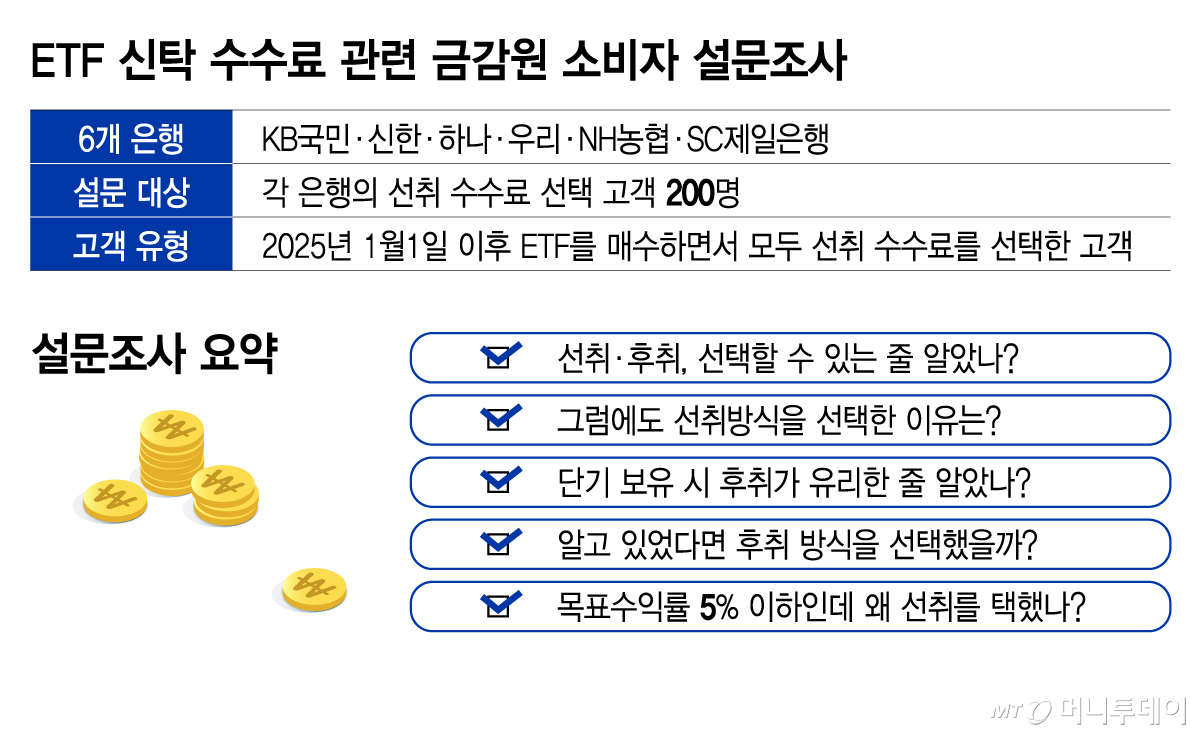
The Financial Supervisory Service has launched a survey targeting up to 1,200 trust subscribers to verify the sales practices of trust fees for exchange-traded funds (ETFs) at banks. Following on-site inspections of six banks, this move aims to directly confirm with consumers whether they were properly informed about fee differences and chose the upfront fee method accordingly. As the survey results could lead to a determination of violations of disclosure obligations, the banking sector is closely monitoring the outcome.
According to the banking sector on the 13th, six banks—KB Kookmin Bank, Shinhan Bank, Hana Bank, Woori Bank, NH Nonghyup Bank, and Standard Chartered Bank Korea—recently received a request from the Financial Supervisory Service to conduct a survey of ETF trust subscribers by the end of this month. The banks are currently surveying a total of 1,200 customers, comprising 200 individuals each who purchased ETFs on or after January 1 last year and selected the upfront fee method. This is the first time a bank has directly conducted a consumer survey at the request of the Financial Supervisory Service.
Bank ETF trust fees are divided into two methods: an upfront method, which requires a one-time payment of 1% upon subscription, and a deferred method, which charges 1.2% per year, calculated on a pro-rata basis according to the holding period. While the deferred method is more advantageous for short-term holdings, a significant portion of bank customers chose the upfront method. If customers had selected the most favorable fee structure, bank fees would have amounted to approximately 54.5 billion won, but the actual fees received by banks were 394.8 billion won, more than seven times higher.
The survey presented by the Financial Supervisory Service to the banking sector consists of eight items in total. It asks whether respondents knew they could choose between the upfront and deferred methods, whether they understood the fee differences based on the holding period, whether recommendations from bank staff influenced their fee selection, and whether they were aware that, in addition to lump-sum investments, installment investments can be operated virtually identically without additional contributions or amount restrictions.
The survey also investigates why respondents did not recognize the fee differences. It asks whether there was no time to read the Key Facts Statement during consultations with bank staff, or whether they could not read it because bank staff did not inform them of the fee differences. Typically, bank ETF Key Facts Statements include a table detailing the advantages and disadvantages of upfront and deferred fees based on the investment period.
“Did They Explain?” vs. “Did They Understand?”…Diverging Views on Interpretation of the Financial Consumer Protection Act
Interpretations suggest that the background of this survey lies in the differing perspectives between the Financial Supervisory Service and the banking sector regarding disclosure obligations under the Financial Consumer Protection Act. Article 19, Paragraph 1 of the Act stipulates that important matters concerning financial products must be explained “in a manner understandable to general financial consumers.” The authorities interpret this to mean that it is necessary to examine whether explanations were provided in a way that ensured substantive understanding, even if procedures such as signing contracts or providing explanatory materials were completed. The direct survey of consumers is interpreted as an effort to verify the fulfillment of such disclosure obligations.
Banks maintain that they have faithfully fulfilled their disclosure obligations. They state that they specified the advantages and disadvantages of fees based on investment periods in the Key Facts Statements and obtained customer signatures. For elderly customers aged 65 and above, audio recordings are also secured. Banks believe it is difficult to acknowledge a violation of disclosure obligations solely because consumers answer that they did not understand the fee structure after the fact, given that records from the time of sale, such as electronic contracts, audio recordings, CCTV (closed-circuit television), and happy calls, remain available.
Counterarguments also emerge that the investment tendencies of bank customers should be considered. Setting a low target return rate does not necessarily indicate an intention to sell in the short term; rather, it may reflect the characteristics of bank customers who prefer stable returns.
The sector views reviewing institutional improvements based on inspection results and imposing sanctions for regulatory violations as separate issues. There is a view that if sanctions follow, legal disputes will be inevitable. This argument is also backed by the fact that NH Nonghyup Bank recently won its second-instance ruling in civil lawsuits related to incomplete sales of Equity-Linked Products (ELs) linked to the Hang Seng Index.
The authorities and the banking sector may diverge in their judgments on whether a lack of consumer understanding can be recognized as a violation of disclosure obligations during the actual sales process. A financial industry official said, “If there are areas for improvement based on inspection results, they can be improved,” while adding, “Banks possess materials showing that they fulfilled disclosure obligations, such as contract signatures and audio recordings. If it is deemed that disclosure obligations were not met solely because consumers answered that they did not fully understand after the fact, it appears to leave room for dispute.”

 in FINANCE
