

As artificial intelligence (AI) cyberattacks targeting the financial sector have become a reality, there are calls to expand the size of the Financial Security Institute, which serves as the statutory integrated security monitoring center and incident response body.
In particular, as AI hacking has made vulnerabilities easier to expose than before, the roles of the Financial Security Institute, including security monitoring, hacking training, and post-incident response, are expected to grow more significantly than ever.
According to industry sources on the 14th, the Financial Security Institute will begin consultations with member companies regarding next year's budget by the end of this month, aiming to finalize the budget and scale in early December.
The Financial Security Institute has 220 financial institutions as members and secures its budget through contribution fees paid by these institutions. Thirty-nine representative companies, including 13 banks, nine financial investment firms, eight insurance companies, seven small and microfinance institutions, and two financial-related bodies, vote to approve business plans and budgets/settlements.
Both inside and outside the financial sector view an increase in next year's budget for the Financial Security Institute as unavoidable. Currently, the institute has 311 staff members, falling short of its authorized headcount of 354. Budget shortages are cited as a key reason why additional hiring has been difficult. As AI hacking vulnerabilities have emerged as a security threat to the financial sector, the role of the Financial Security Institute is gaining prominence. It is expected that budget allocations for staffing and operating AI security-related infrastructure will increase.
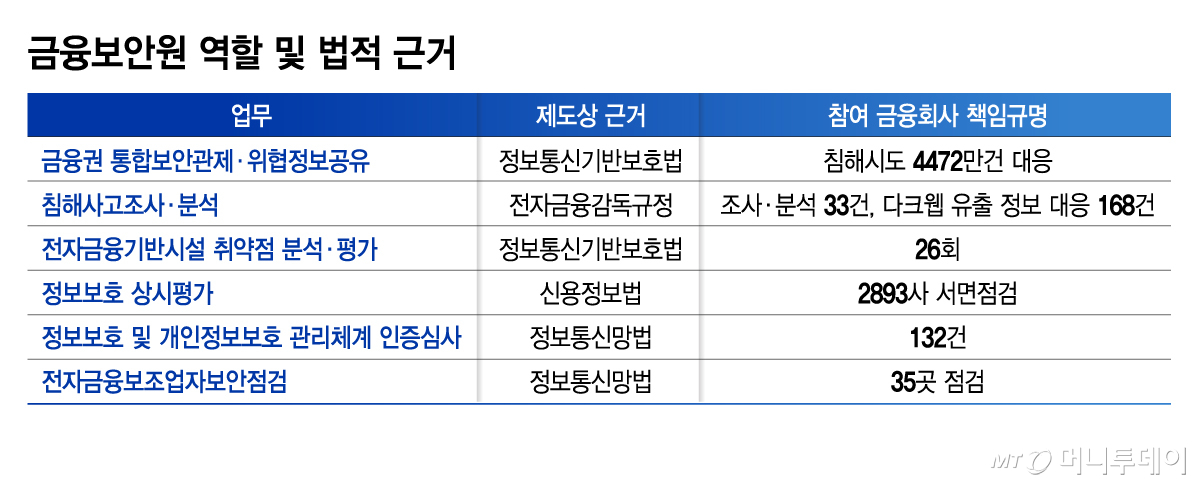
First, under the Information and Communications Infrastructure Protection Act, the Financial Security Institute is responsible for integrated security monitoring in the financial sector and sharing threat information. Last year, through integrated monitoring, it responded to 44.71 million intrusion attempts and collected 270,000 pieces of malware, which were shared with financial institutions.
It also inspects vulnerabilities in electronic finance infrastructure—such as systems, software, hardware, and networks—that attackers could exploit as infiltration routes; such inspections were conducted 26 times last year.
The institute also conducts hacking preparedness training, including joint blind mock drills for the financial sector. Last year, it carried out 869 training sessions targeting a total of 205 institutions. It also performs regular assessments to inspect the status of personal information management at financial companies in accordance with the Credit Information Use Act. Written inspections were conducted on 2,893 companies last year.
When actual hacking or other security incidents occur, it is also responsible for post-incident response. It shares the role of incident investigation and analysis with the Financial Supervisory Service. Last year's performance included 33 investigations/analyses, and dark web data leak monitoring was conducted 168 times. In addition, it handles security-related education and certification.
As cyber threats utilizing high-performance AI agents intensify, the roles undertaken by the Financial Security Institute are steadily increasing. For example, as threats from high-performance AI agents such as U.S.-based Toss have become visible this year, authorities increased joint blind mock drills for the financial sector from once to twice a year, with the Financial Security Institute leading these exercises.
With the adoption of AX and the relaxation of network separation, verifying the absence of security vulnerabilities has also become an area that the Financial Security Institute must oversee. Since last year, it has begun evaluating the security of AI models and assessing security measures for the use of generative AI linked to innovative financial services. It has also introduced AI red teaming, which proactively explores inherent flaws and vulnerabilities in AI systems from an attacker's perspective.
The banking sector, which had previously shown a negative stance toward increasing contribution fees to the Financial Security Institute, finds it difficult to ignore demands for budget increases. The recent AI agent hacking targeting the financial sector could have resulted in reduced damage or prior prevention because the Financial Security Institute received the incident report from Shinhan Bank and shared it with all financial institutions, prompting them to conduct self-inspections.
In particular, given that small and mid-sized firms lack the capacity to invest in security, there is a consensus that expanding the joint security system is necessary. A senior executive at a financial holding company stated, "The role of immediately disseminating information when hacking occurs at one financial institution to prepare for vulnerabilities is significant," adding, "There are inevitably differences in security levels among financial institutions, and this helps raise them to a uniform standard."

 in FINANCE
