

Despite making diligent repayments on policy microfinance loans, borrowers are experiencing a decline in their credit assessment scores. Medium- and low-credit-score borrowers who fully repaid policy microfinance loans posed a lower risk of default than typical bank customers, yet this repayment capacity was not reflected in their credit assessments. The Korea Microfinance Promotion Agency is currently developing an alternative credit scoring model that can adequately reflect the repayment capacity of medium- and low-credit-score borrowers.
According to documents submitted by the Korea Microfinance Promotion Agency and Korea Credit Bureau (KCB) to Democratic Party of Korea lawmaker Park Min-gyu on the 18th, the delinquency rate among policy microfinance graduates who used bank loans in the KCB credit score range of 701 to 740 was 1.60%. This is half the 3.13% delinquency rate for general bank borrowers in the same score bracket. A “graduate” refers to a customer who opened a policy microfinance product and subsequently closed it without any incidents.
Even in the bottom 10% score range of 100 to 675, the delinquency rate among policy microfinance graduates was 14.06%, lower than the 28.02% delinquency rate for all bank borrowers. The same trend was observed across all segments in the bottom 50% of credit scores. This suggests that there is room to open up bank loan opportunities for medium- and low-credit-score borrowers with a history of normal repayments on policy microfinance products.
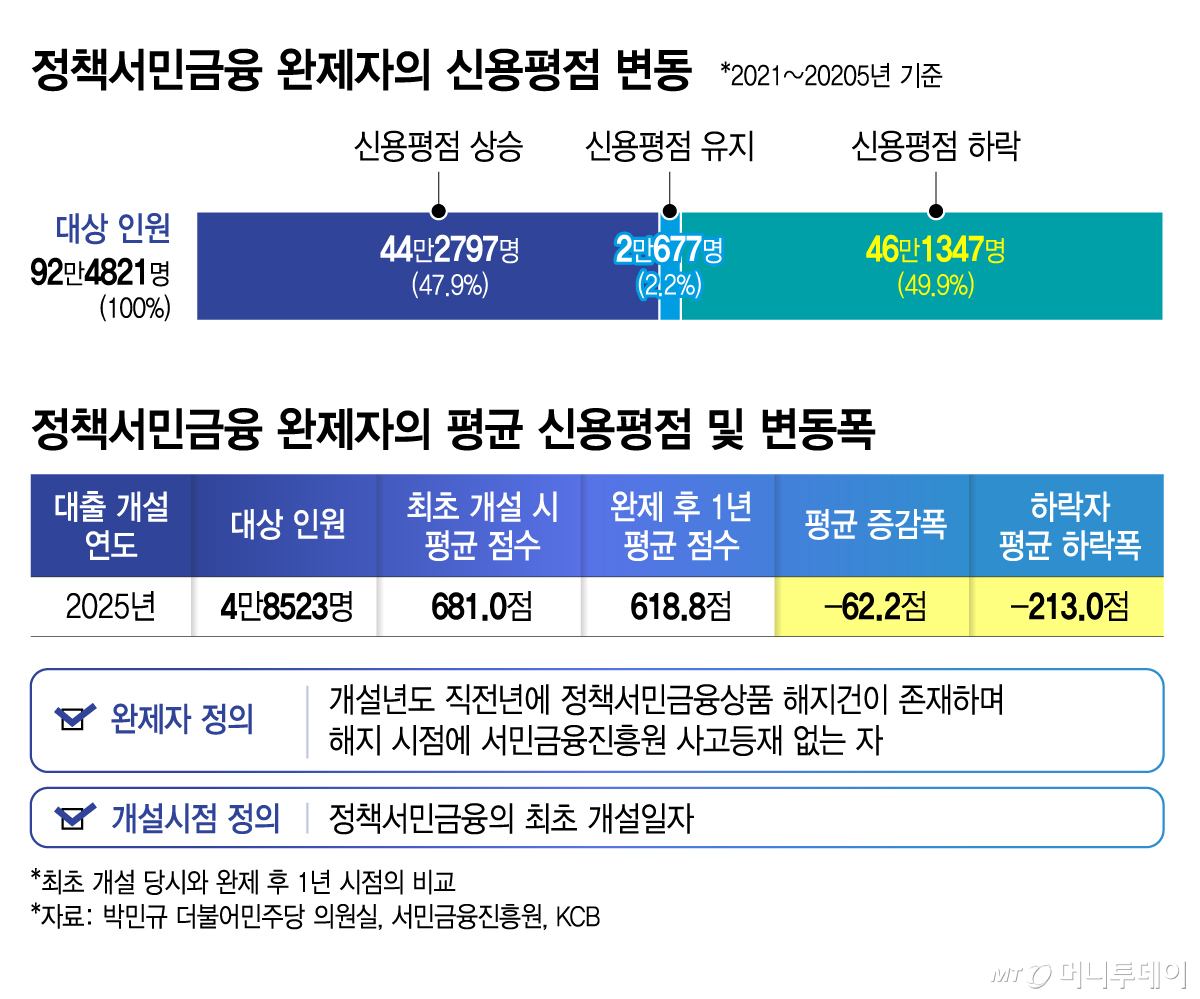
However, a record of normal repayment did not lead to credit recovery. Among the 48,523 graduates who opened their first policy loan account last year, the average credit score dropped from 681 points at the time of borrowing to 618.8 points, a decrease of an average 62.2 points. The average credit scores for groups that opened accounts between 2021 and 2024 and subsequently made normal repayments also declined by 28.3 to 49.5 points.
From 2021 through last year, a total of 924,821 individuals opened policy microfinance accounts and successfully repaid them. Of these, 461,347 (49.9%) actually saw their credit assessment scores fall compared to before. The number of people whose credit scores remained unchanged was 20,677 (2.2%). More than half of all graduates (52.1%) failed to see any improvement in their credit scores despite diligently repaying policy microfinance loans.
The Korea Microfinance Promotion Agency is promoting “credit building” to help borrowers who have diligently repaid policy loans transition to bank loans. However, when normal repayment records do not sufficiently translate into improved credit scores, the bridge connecting public and private finance also struggles to fulfill its role.
Park (Rep.) pointed out that “not only financial product development but also reform of the credit assessment system is needed so that diligent repayment of policy microfinance leads to credit recovery, which in turn leads to access to bank loans.”
In fact, the Korea Microfinance Promotion Agency is developing an alternative credit scoring model for graduates or diligent repayors. The agency plans to establish a first-phase model by the end of this year and apply it to microfinance products in the first half of next year. It is also considering ways to provide the model to commercial banks. The goal is to recommend diligent repayors and graduates to banks, connecting them with medium-interest-rate loans or dedicated products.
A Korea Microfinance Promotion Agency official said, “Even though completing a microfinance loan demonstrates a willingness to repay, bank internal assessments and credit rating agency systems barely reflect this, citing reasons such as the data not being properly analyzed or verified.” The official added, “The repayment capacity and willingness demonstrated by fully repaying policy microfinance loans should be properly reflected in credit assessments.”

 in FINANCE
