

A bill has been introduced to strengthen consumer benefits differentials by payment method. If consumers use a payment method with lower fees than credit cards, they would be able to receive greater benefits, such as point accumulation, compared to standard card payments. The card industry is expressing concern that mobile payment providers offering various "pay money" and other prepaid top-up fund services will stand to benefit the most.
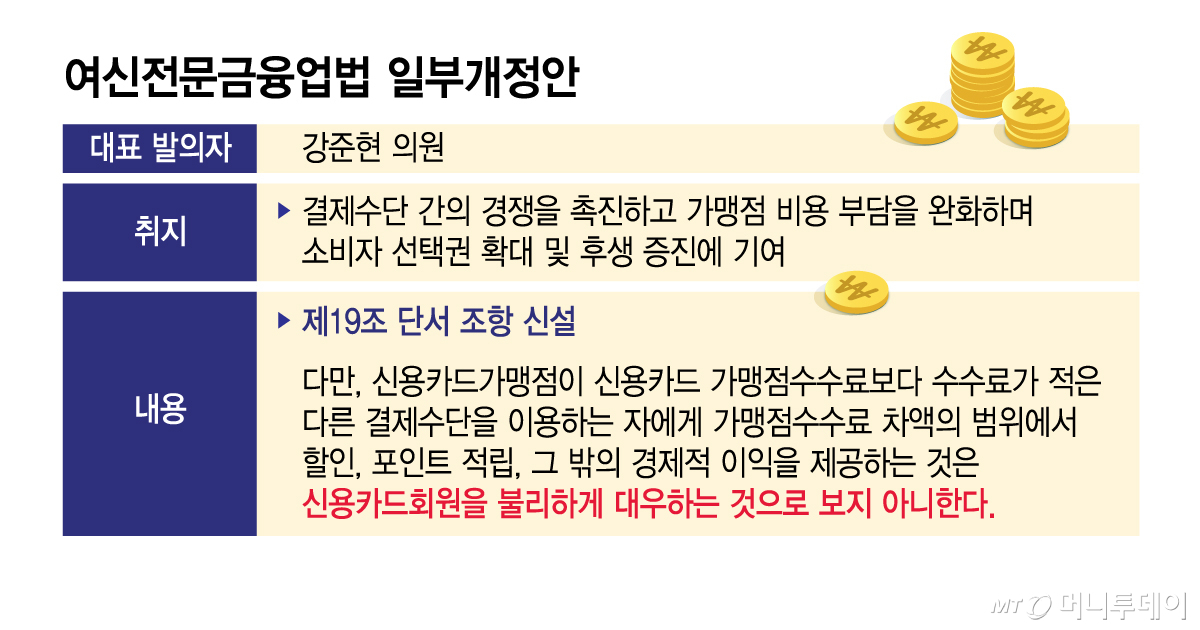
According to financial sources on the 20th, Democratic Party of Korea lawmaker Kang Jun-hyun introduced a bill to amend the Credit Card Act (Credit Card Act) at the beginning of this month containing such provisions.
Article 19, Paragraph 1 of the current Credit Card Act stipulates that credit card merchants must not refuse customers' card payments or treat card-paying customers unfavorably. This is known as the "mandatory card acceptance" provision.
The amendment adds a proviso to Article 19 stating that "providing discounts, point accumulation, or other economic benefits within the range of the fee difference to users who employ payment methods with lower fees than credit cards shall not be deemed unfavorable treatment of card members."
In other words, while merchants are still prohibited from refusing card payments, they would be legally permitted to offer additional benefits for cheaper payment methods. This can be seen as a partial relaxation rather than the abolition of the mandatory card acceptance system.
If the amendment is passed, consumers will be able to receive greater benefits by using bank transfers, check cards, or prepaid top-up funds instead of credit cards. The Financial Services Commission had previously issued an authoritative interpretation stating that providing higher point accumulation or other benefits for payment methods other than credit cards would violate Article 19 of the Credit Card Act; this issue would be resolved.
Even now, some merchants offer "10% discount for cash payments," but strictly speaking, this is illegal. The Financial Services Commission explicitly lists "discounts for cash payments" as a target for unfair treatment reports.
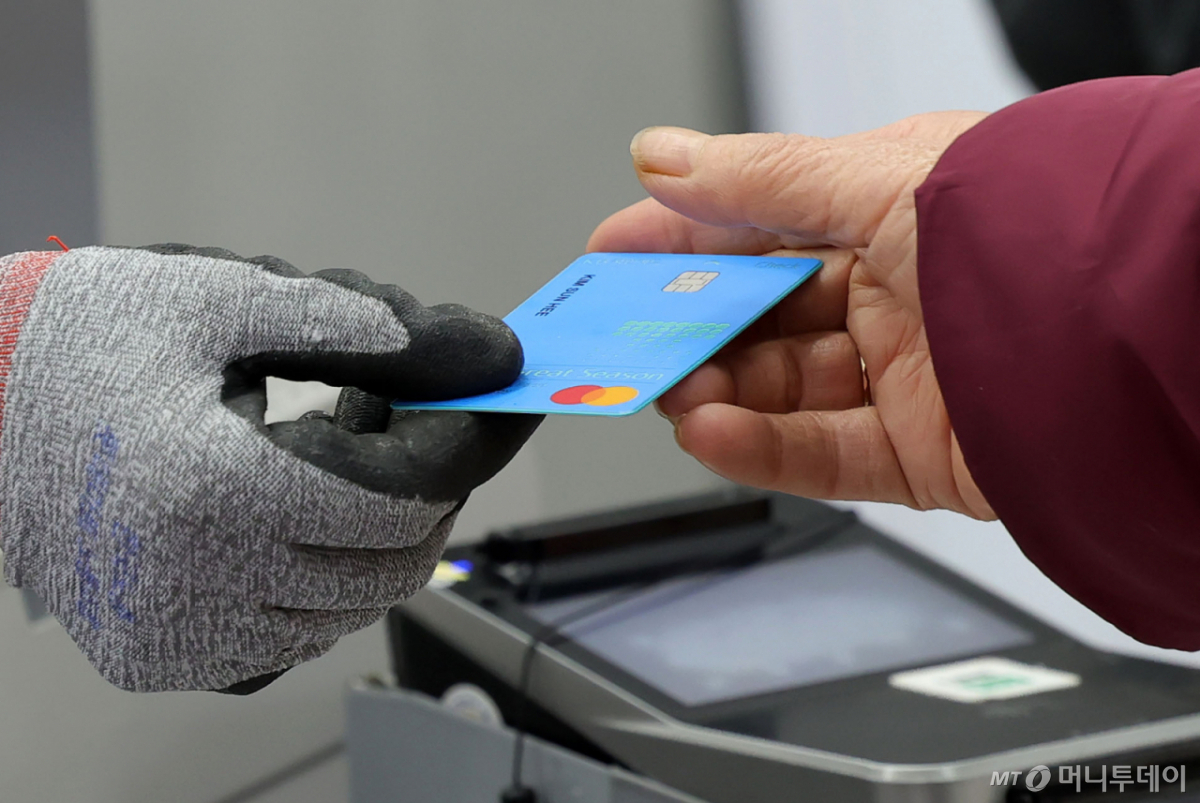
The Korea Credit Card Association is currently gathering opinions from member companies regarding this amendment. Card companies are closely monitoring the bill due to concerns that credit card usage rates may decline. They anticipate that mobile payment enterprises providing prepaid top-up funds will be the biggest beneficiaries if the amendment is passed.
The Financial Services Commission had already pushed for the abolition of the mandatory card acceptance system in 2018, citing the goal of promoting growth in the innovative payment services industry. At the time, Jeon Hae-cheol (Rep.) also introduced a Credit Card Act amendment with content similar to the current Kang (Rep.) bill. The National Assembly's Political Affairs Committee even issued a positive review report on the amendment introduced by Jeon (Rep.), stating that it "establishes an institutional environment allowing companies providing new payment services to attract users through discounts and point accumulation."
However, after backlash arose citing consumer harm such as merchants refusing card payments, the Financial Services Commission postponed the abolition of the mandatory acceptance system as a medium- to long-term task.
There are also arguments that offering different benefits based on fee differences between payment methods would not have a significant effect. According to the Fintech Association, the difference in fees between prepaid top-up funds and card payments for major mobile payment providers (Naver Pay, Kakao Pay, Toss) is only 0.02% to 0.56 percentage points. For small merchants, prepaid top-up fund fees are sometimes even higher than card payment fees.
A source in the card industry said, "Merchants could induce customers to use specific payment methods by offering better benefits as bait," adding, "There is doubt whether not using credit cards would actually result in greater benefits for consumers."

 in FINANCE

