

A controversy has erupted after banks, which have been reducing household loan supply due to the financial authorities' aggregate lending regulations, faced criticism during the National Assembly's audit for shrinking preferential interest rates and thereby increasing borrowers' interest burdens. The banking industry counters that changes in the proportion of different loan products may have contributed to the decline in the overall average preferential rate.
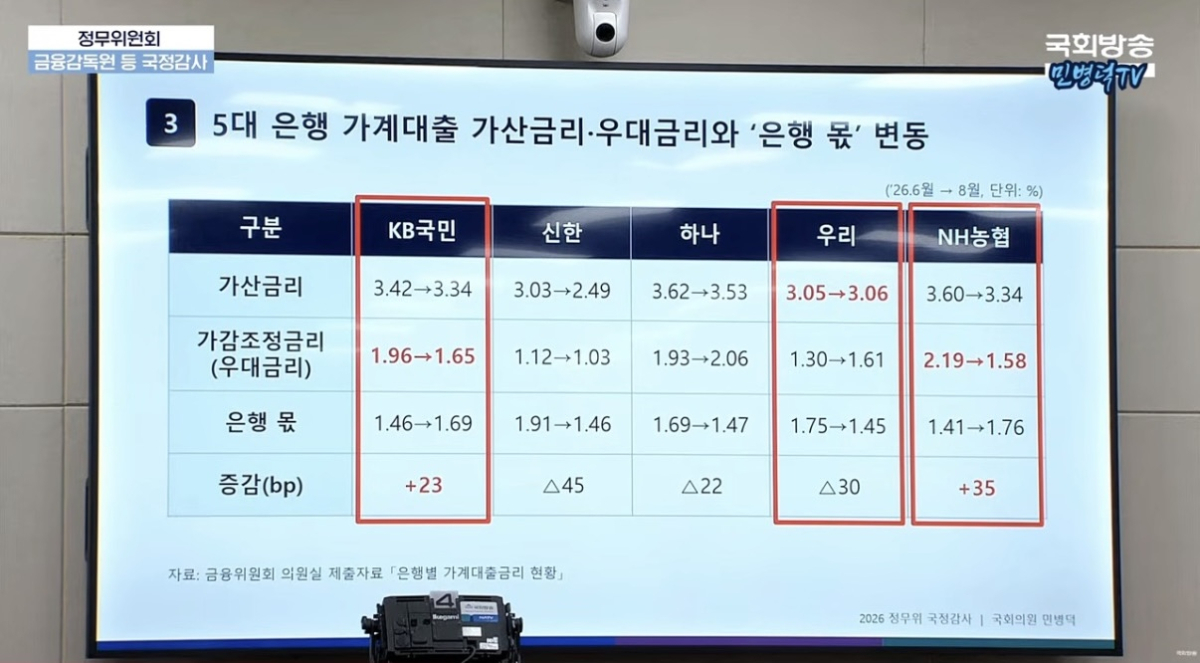
According to financial industry sources on the 21st, Democratic Party of Korea lawmaker Min Byung-deok pointed out during the National Assembly's Political Affairs Committee audit of the Financial Supervisory Service on the 19th that banks had offset the effect of loan interest rate cuts by reducing preferential rates instead of lowering add-on rates.
The revised Banking Act, which took effect on July 1, prohibits reflecting reserve requirements and deposit insurance premiums in add-on interest rates. It also stipulates that contributions to guarantee funds may not be reflected, either partially or fully, depending on the loan type. Additionally, increases in education tax rates are barred from being passed on to loan interest rates.
According to materials presented by Min (Rep.), KB Kookmin Bank's add-on rate fell by 0.08 percentage points (P), from 3.42% in June to 3.34% in August. However, during the same period, its preferential rate was cut by 0.31 P, from 1.96% to 1.65%, effectively offsetting the benefit of the lower add-on rate. In the case of NH NongHyup Bank, the add-on rate decreased by 0.26 P, from 3.60% to 3.34%, while the preferential rate was reduced by 0.61 P, from 2.19% to 1.58%. Min (Rep.) pointed out that as a result, the portion of interest retained by the bank actually increased by 0.35 P.
Critics argue that banks have nullified the effects of the legal mandate to lower add-on rates by shrinking preferential rates.
However, the banking industry believes that shifts in the mix of loan products may have influenced the overall average preferential rate. Generally, mortgage loans (hereinafter referred to as mortgages) tend to offer larger preferential rate discounts compared to other household loan products. For instance, even if the preferential rate for mortgages remains at 2.5 P and that for other household loans stays at 0.5 P, a drop in the share of mortgages from 80% to 50% would cause the overall average preferential rate to fall from 2.1 P to 1.5 P. This means that even if the preferential rate conditions for individual products remain unchanged, a shift in loan composition can make it appear as though the average discount has narrowed. In fact, NongHyup Bank significantly reduced its handling of household loans, including mortgages, in July and August to meet its household lending targets.
In particular, the banking industry maintains that household loan interest rates are not unrelated to aggregate lending management. In practice, banks frequently use interest rate hikes as a tool to manage new demand when they are required to restrict household loan supply.
A financial industry official stated, "Adjusting interest rates is partly for profitability, but the aspect of demand management is very significant. Yet, in reality, we cannot openly discuss this."
This creates a conflict between policy demands to curb the growth of household loans and calls to lower loan interest rates. It has been consistently pointed out that due to the authorities' aggregate regulations, banks have been so preoccupied with suppressing household loan demand that "price competition" (interest rate cut competition) among banks to attract customers has disappeared.
A commercial bank official stated, "The core of the problem is that while corporate loans face intense competition, even leading to negative margins, household loans are prevented from operating under a free competitive system due to the authorities' aggregate regulations."

 in FINANCE
