

The government is pushing to strengthen criminal penalties for illegal lenders charging 'ultra-high interest rates' exceeding 60% annually, up to a maximum of 10 years in prison and a fine of 500 million won. President Lee Jae-myung ordered that support for low-income finance must also be significantly expanded alongside the strengthened penalties. In particular, regarding the government's 1 million won small-scale loan policy, he stated it is "too weak" and demanded "more bold financial support measures."
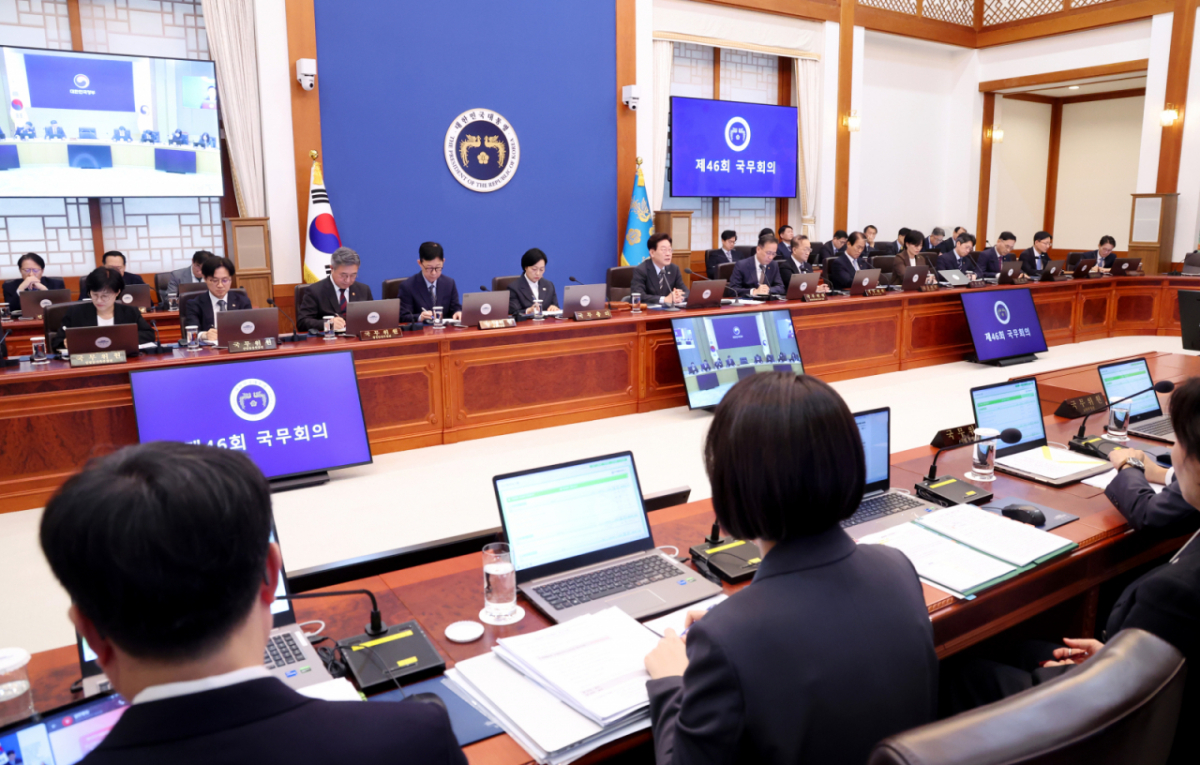
At the State Council meeting at Cheong Wa Dae on the 27th, chaired by President Lee, Shin Jin-chang, Vice Chair of the Financial Services Commission, stated, "Civilly, the principal and interest are invalidated for interest rates exceeding 60%, but there is also a need to strengthen criminal penalties against illegal financial operators who receive such payments." He added, "We have completed consultations with the Ministry of Justice on measures to significantly raise the penalty to up to 10 years in prison or a fine of up to 500 million won, and plan to submit a legislative proposal to the regular National Assembly session soon."
Under the current Loan Business Act, the statutory maximum interest rate is 20% annually. With the implementation of the revised Loan Business Act last July, ultra-high-interest loan contracts exceeding 60% annually are void regarding both interest and principal. However, criminal penalties currently apply up to 5 years in prison or a fine of up to 200 million won for violations of the maximum interest rate, with the intent being to establish separate aggravated penalty provisions for the act of receiving interest rates exceeding 60% annually.
President Lee pointed out that alongside strengthening penalties for illegal finance, support measures are also needed for vulnerable groups who cannot borrow money from formal financial institutions. President Lee said, "The government must take responsibility for the problem where people have no choice but to borrow at 100% interest because they have no money," adding, "Support for low-income finance is too weak."
He continued, "What do we do about desperate people who cannot borrow from financial institutions and, because loan sharks are being punished, will not lend to them, saying 'I must borrow even at 30%'?" He added, "If we block this institutionally, we must take responsibility for it."
Vice Chair Shin stated, "The difficulty is that those using illegal finance generally have payment delays and find it difficult to access the financial sector." He noted, "We have reflected a program in this year's government budget proposal where one can receive a 1 million won loan with a 10-year maturity, requiring repayment of about 10,000 won per month."
He explained further, "If these individuals make diligent repayments for six months or a year, we will increase the loan amount from 1 million won to 0.2 billion won." He added, "As repayment records accumulate, we aim to expand the limit to 0.5 billion won and then 10 million won, while gradually expanding access channels to banks."
In response, President Lee said, "Considering the national capacity or fiscal capacity of the Republic of Korea, it seems too weak in my view." He asked, "How dire must one's situation be to use emergency funds at several hundred percent interest?" He pointed out, "While it is difficult to generalize measures for cases where one feels they must use even 100% emergency funds, financial countermeasures should be prepared more boldly."

 in FINANCE
