

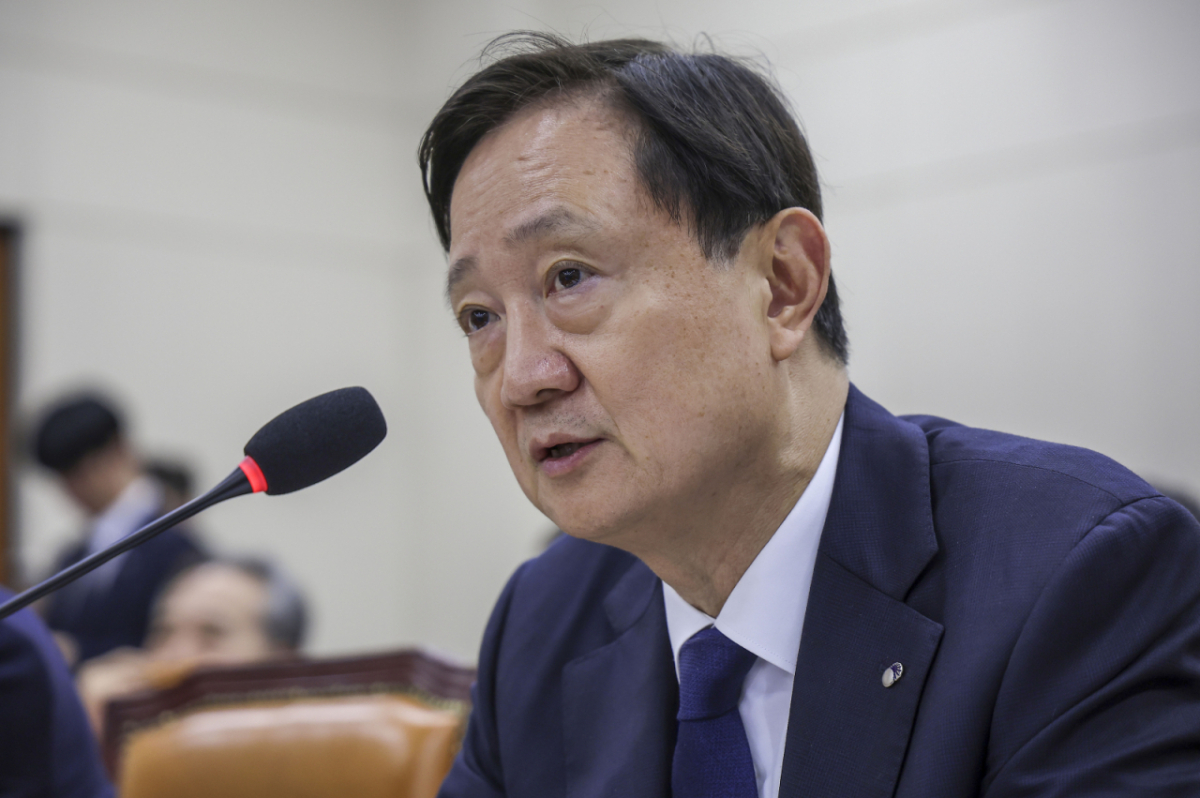
It was revealed that 99% of resolutions approved by the boards of directors of eight bank holding companies last year were passed as originally proposed. Lee Chan-jin, Governor of the Financial Supervisory Service, told the chairs of the bank holding company boards, “Cases in which outside directors voted against a resolution are very rare, and there have also been instances where sufficient board-level review was not conducted on major matters.”
Governor Lee held a regular meeting with the chairs of the boards of eight bank holding companies at the Financial Supervisory Service headquarters in Seoul Yeouido on the morning of the 28th. He stated, “Please do not rely solely on materials provided by management; conduct thorough reviews of resolutions through proactive requests for information and the use of external experts, thereby fulfilling your fiduciary duties as directors.”
Governor Lee pointed out the practice whereby outside directors of bank holding companies effectively approve management decisions without modification. Of the 993rd resolutions processed by the boards of eight bank holding companies last year, only nine were passed with amendments and one was deferred. The remaining 983 resolutions (99.0%) were all approved as originally proposed.
Governor Lee said, “Please strive to enhance the expertise and capabilities of outside directors by providing systematic training.” He added, “Please make decisions on key management issues such as business diversification and executive compensation and performance evaluation (KPIs) that align with the long-term interests of both the company and its shareholders.”
Ahead of year-end CEO appointments at financial holding company subsidiaries, he also emphasized the fairness of succession procedures. Governor Lee stated, “I understand that succession processes for CEOs of financial holding company subsidiaries are currently in full swing.” He urged, “Please further strengthen the transparency and fairness of subsidiary CEO succession procedures by fully reflecting the intent of governance improvement measures.”
Regarding recent hacking incidents that have occurred one after another in the financial sector, he called for expanded IT security investment at the board level. As of the 14th, intrusion incidents had occurred at 16 financial institutions, including banks, savings banks, mutual financial cooperatives, and specialized credit finance companies. The targets of attacks are also expanding to non-core facilities such as business support systems.
Governor Lee said, “It must not be repeated that IT security is treated as a secondary task with only formal compliance with regulatory requirements, or that IT security investment is perceived merely as a ‘cost,’ resulting in insufficient allocation of personnel and resources.” He added, “Please take the lead in enhancing IT security capabilities at the board level.”
Harsh criticism of local government sponsorship funds used to win safe deposit box bids: “Performative activities”
He also called for tangible results from social contribution activities in the financial sector. The scale of social contributions by the banking industry last year was 2.16 trillion won, an increase from 1.89 trillion won the previous year. The five major financial holding groups are also promoting a plan to expand inclusive finance by approximately 70 trillion won over the next five years.
However, Governor Lee pointed out that simply increasing the scale of support is insufficient. In particular, he viewed “social washing” practices—such as including local government event sponsorship funds for safe deposit box contract bidding, personnel costs for call center staff responding to voice phishing, and event expenses for customer acquisition—as social contribution achievements—as performative activities.
He also addressed the issue of financial exclusion resulting from the reduction of bank branches. The number of domestic bank branches at the end of last year was 5,517, a decrease of 314 (5.3%) compared to the end of 2022. Governor Lee said, “When making decisions regarding branch operations, please consider consumer financial accessibility alongside efficiency.” He added, “For the elderly and financially vulnerable groups, the closure of nearby branches can mean more than mere inconvenience; it can lead to being cut off from financial services.”
He also requested strengthened management and supervision of financial incidents at overseas branches. Financial incidents at domestic banks’ overseas branches surged from seven cases (150 million won) in 2024 to 12 cases (124.9 billion won) last year. Eleven financial incidents (84 billion won) occurred between January and September this year as well.
Governor Lee emphasized the establishment of an integrated computer system by headquarters for overseas branches, regular inspections, and improvements to incident reporting systems. He also stated that internal control and risk management capabilities must be substantively reflected in personnel policies and performance evaluation systems. Examples cited included establishing incentives to attract top talent to compliance and risk management departments, or incorporating internal control capabilities into personnel policies.
The Financial Supervisory Service is also planning to inspect whether existing systems—such as internal control innovation measures, loan process improvement plans, the accountability structure diagram, and measures to activate compliance whistleblowing—are functioning properly in the field, and to continuously address any deficiencies.
Governor Lee stated, “I hope that the issues discussed today will not remain fragmented topics but will develop into a broader direction focused on the robust growth of the financial industry and the inherent role of holding companies.” He added, “The Financial Supervisory Service, as a partner to the financial industry, will communicate closely with the market while sparing no effort in providing necessary institutional support.”

 in FINANCE
