

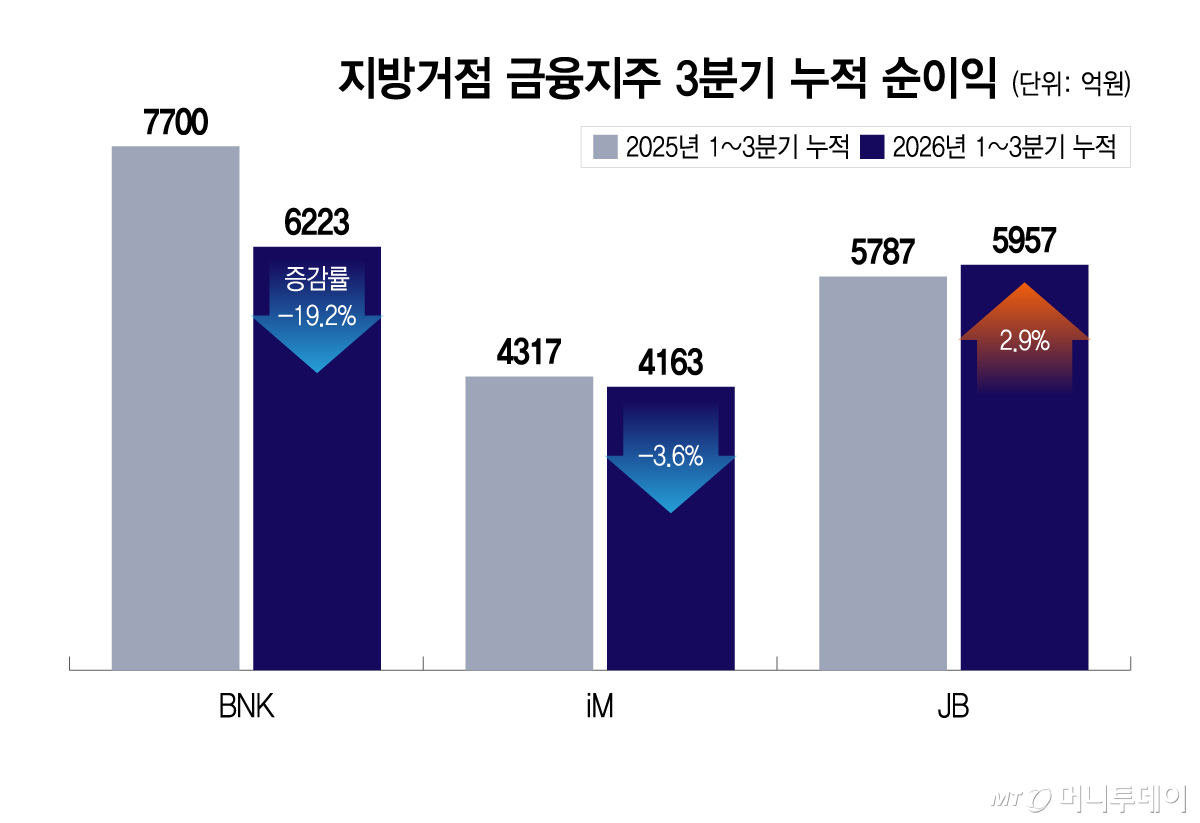
Unlike major financial holding companies that posted record-high profits, the cumulative net profit for the first three quarters of this year at three regional financial holding groups fell by more than 8% compared to the same period last year.
While interest income increased thanks to expanded corporate lending, the impact of sluggish non-interest income was significant, driven by rising bond yields and increased volatility in financial markets. In particular, BNK Financial Group recorded the largest negative growth, falling short of market expectations. On the other hand, JB Financial Group was the only one among the three to increase its net profit, achieving its highest-ever results.
According to industry sources on Tuesday, the combined cumulative net profit for the first three quarters of this year for three financial holding groups—BNK, iM, and JB Financial—was calculated at 1.6343 trillion won, a decrease of 8.2% from the same period last year.
JB Financial recorded 595.7 billion won, representing a 2.9% increase. Its cumulative net profit hit an all-time high, making it the only one among the three to achieve profit growth. In contrast, the other two companies saw their profits decline compared to a year ago.
BNK Financial's net profit for the period was 622.3 billion won, down 19.2% from a year earlier. While it had the highest net profit among the three, its rate of decrease was also the largest. iM Financial fell short of market expectations with a 3.6% drop to 416.3 billion won.
Sluggish non-interest income is cited as the background for the weak performance. In addition to poor stock market conditions, sharp rises in bond yields led to a significant reduction in profits related to securities and derivatives. For BNK Financial, while interest income grew by 4.7%, non-interest income declined by 16.5%.
The substantial decrease in profits from securities and derivatives was particularly painful. Valuation losses occurred on held stocks and bonds, and gains from the sale of loan receivables decreased. BNK Investment & Securities and BNK Asset Management, which had performed well in the first half, were sluggish. Securities profits fell by 318%, and asset management turned to a loss in the third quarter.
iM Financial's non-interest income was 342 billion won, showing only a 0.3% increase from the same period last year. This was due to a decrease in trading-related profits, despite fee income related to stock investments increasing by 73% and 23% at banks and securities firms, respectively.
JB Financial, which uniquely achieved net profit growth, also saw a decline in non-interest income. The company's non-interest income was 147.9 billion won, down 27.9%. Leasing income and securities-related profits decreased by 25.6% and 21.7%, respectively. During the same period, foreign exchange derivative-related profits also fell by 12.2%.
The burden of non-recurring costs also affected performance. Increased labor costs due to the inclusion of regular bonuses in ordinary wages, along with a hike in education tax, acted as factors for rising expenses. Burdens from contributions to the Credit Guarantee Fund and the Housing Finance Credit Guarantee Fund, as well as deposit insurance premiums, also pressured profitability.
On the other hand, interest income for all three groups showed solid growth. This was the result of defending interest income by expanding loan assets centered on corporate lending, despite a decline in net interest margin (NIM).
JB Financial's cumulative interest income increased by 9.5%, recording the highest growth rate. This is cited as the background for achieving net profit growth despite sluggish non-interest income. The cumulative interest income of BNK Financial and iM Financial increased by 4.7% and 5.6%, respectively, compared to the same period last year.
Asset soundness indicators varied by financial holding group. BNK Financial's non-performing loan (NPL) ratio at the end of the third quarter was 1.45%, down 0.01 percentage points from the previous quarter. In contrast, the delinquency rate rose by 0.06 percentage points over the same period to 1.40%. iM Financial saw improvements in both indicators. The NPL ratio fell by 0.33 percentage points from the previous quarter to 1.18%, and the delinquency rate also decreased by 0.16 percentage points to 1.22%.
On the other hand, JB Financial's asset soundness deteriorated slightly. The NPL ratio rose by 0.14 percentage points from the previous quarter to 1.57%, and the delinquency rate increased by 0.12 percentage points to 1.76%.

 in FINANCE
