

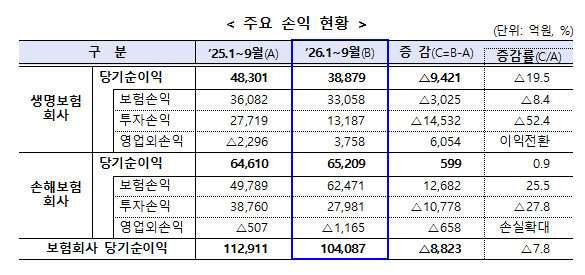
Domestic insurers' net profit fell nearly 8 percent in the first nine months of this year from a year earlier. While premium income rose more than 15 percent, reflecting growth in business volume, profitability declined due to weaker investment returns. Life insurers were particularly affected, with their net profit dropping nearly 20 percent.
According to the "Preliminary Operating Results of Insurance Companies from January to September 2026" released by the Financial Supervisory Service on Wednesday, the net profit of 52 domestic insurance companies (22 life insurance companies and 30 non-life insurance companies) was 10.4087 trillion won, a decrease of 882.3 billion won (7.8%) from 11.2911 trillion won in the same period last year.
The net profit of life insurance companies was 3.8879 trillion won, down 942.1 billion won (19.5%) from the same period last year. This was due to a decrease in insurance gains and losses by 302.5 billion won (8.4%), driven by an increase in experience variance losses and loss provision costs.
Investment gains and losses also plummeted by 1.4532 trillion won (52.4%) due to factors such as a decrease in gains and losses from the disposal and valuation of financial assets.
In contrast, the net profit of non-life insurance companies was 6.5209 trillion won, an increase of 59.9 billion won (0.9%) from the same period last year.
Although investment gains and losses decreased by 1.0778 trillion won (27.8%) due to a decline in gains and losses from the disposal and valuation of financial assets, insurance gains and losses increased by 1.2682 trillion won (25.5%), thanks to factors such as a drop in loss ratios for general insurance and auto insurance.
The premium income of insurance companies was 212.0325 trillion won, an increase of 28.6496 trillion won (15.6%) from the same period last year. The premium income of life insurance companies was 105.8953 trillion won, up 18.4%.
Premium income for savings-type insurance (34.0%), protection-type insurance (10.3%), and retirement pensions, etc. (35.9%) increased, while variable insurance decreased by 0.5%.
The premium income of non-life insurance companies was 106.1373 trillion won, an increase of 13.0% from the same period last year. Premium income for retirement pensions, etc., surged by 51.7%, while general insurance (8.6%), long-term insurance (7.7%), and auto insurance (4.2%) all also increased.
Profitability indicators declined. The return on assets (ROA) of insurance companies from January to September this year was 1.01%, down 0.15 percentage points (p) from the same period last year. The return on equity (ROE) also fell by 3.28%p to 6.98%.
In particular, the ROE of life insurance companies dropped by 3.40%p from 7.56% to 4.16%. The ROE of non-life insurance companies also decreased by 2.23%p from 13.98% to 11.75%.
The Financial Supervisory Service assessed that despite the external growth of insurance companies, profitability has declined due to factors such as deteriorating current period gains and losses.
It noted that while some insurance gains and losses were temporarily worsened by the actuarial supervision advancement measures implemented in June last year, this is expected to serve as an opportunity to reduce future earnings volatility and strengthen the inherent competitiveness of the insurance industry.
The Financial Supervisory Service is promoting the rationalization of actuarial assumptions, including applying conservative loss ratio assumptions of over 90% for new coverage and reflecting future inflation rates in expense assumptions.
Through this, it aims to reduce incentives for developing high-risk products and excessive competition, ensuring that the profitability assessment of insurance companies aligns with economic substance.
The Financial Supervisory Service stated, "As domestic and international investment conditions deteriorate due to factors such as expanded market volatility in interest rates and stock prices, more refined management of investment risk and asset soundness is essential."
It added, "We plan to closely monitor the earnings and soundness of insurance companies while proactively responding to potential risks arising from expanded market volatility."

 in FINANCE
