

"I regret having entrusted my stock investments to my husband."
"My loss rate is 80%. I deleted my stock app."
"We have no other investment alternatives to recommend to our clients."
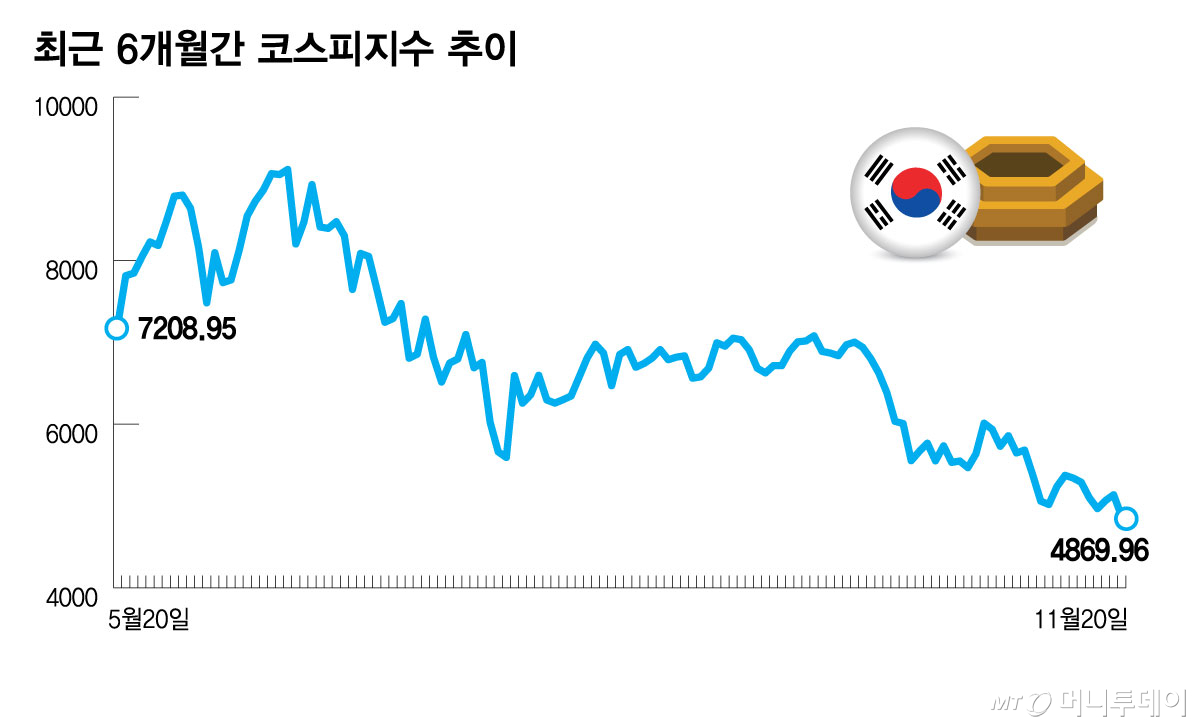
As the KOSPI fell below the 4,600 mark intraday on Monday, triggering a sell-side sidecar for the second consecutive day, despair and anger poured out from retail investors.
Lamentations continued, ranging from investors who deleted their stock trading apps to those blaming their husbands, whom they had entrusted with their investments. Securities firms, unable to find even one investment alternative to recommend to clients, are also in a depressed mood.
On Nov. 23, the KOSPI plunged by more than 5% intraday. In the morning, a sell-side sidecar, which temporarily suspends the validity of program selling orders, was triggered. Although the government held an emergency weekend meeting to announce measures to stabilize the stock market, selling pressure continued.
"I told him to sell, but he didn't"… Blame on family extends to criticism of the government
The anger of retail investors also directed toward their families. One woman said her husband had pooled the family's money to invest in stocks.
She said she regretted entrusting investment decisions to him because, when the KOSPI dropped into the 6,000 range, she had urged him to sell, but he claimed he would sell yet failed to dispose of the shares.
A significant number of investors were even afraid to check the scale of their losses. In an online stock community, retail investor A said that rather than enduring the price drop and deliberating on an investment strategy, they chose to ignore the screen displaying their losses. Investor B said they had deleted their stock app because their loss rate reached 80%.
Anxiety over further declines also spread. Investor C said they had expected the KOSPI to hold the 5,000 line, but when it fell to the 4,600 range intraday on the 23rd, they expressed concern about a steeper drop.
Investor D said, "Stocks are like a midsummer night's dream. As winter arrives, it feels as if everything is frozen solid."
Criticism of the government also continued. Investor E referenced the atmosphere that had evaluated the KOSPI's rise as an achievement of the president and argued that the government should be held accountable for the sharp drop.
Investor F expressed frustration, saying, "Even after announcing market stabilization measures, the government shows a cautious attitude toward actual implementation, citing 'under review' and 'depending on the situation.'" Investor G said, "The government is not going to ban short selling, and I don't expect them to wield a Goblin's bat."
Some also raised concerns about the domestic stock market's excessive reliance on large semiconductor stocks such as Samsung Electronics and SK hynix.
Investor H said, "The risks of the semiconductor sector are spreading to the entire market," adding, "Rather than blaming only the government for the sharp drop in the stock market, we should also consider the uncertainties in the global artificial intelligence (AI) industry."
"We have no products to recommend to clients"… Securities firms also in deep slump
The fear among retail investors was fully transmitted to securities firms. With not only stocks but a wide range of financial products falling into simultaneous weakness, responses emerged stating that it is difficult to find new investment destinations to offset client losses.
A brokerage official said, "Not only domestic stocks, but also U.S. stocks, funds, wrap accounts, ETFs, gold, and Brazilian government bonds have fallen significantly. As the returns on previously recommended assets have been poor, it is difficult to present other investment alternatives."
Securities firms are also unable to propose the recent sharp drop as a bargain-hunting opportunity to clients. This is because more investors are concerned about further market declines.
An official from Securities Firm B said, "Investors are in a state of resignation," adding, "Although the market has fallen significantly, almost no one sees it as a bargain-hunting opportunity. Something positive needs to happen."
What securities firms worry about is not just immediate losses. It is the possibility that the stock market may lose its credibility as a long-term asset-building tool amid repeated sharp swings.
An official from Securities Firm C said, "We had expected the asset market to shift from real estate to stocks, but experiencing extreme volatility such as a 100% rise and a 50% drop in the index within a single year has led investors not to view the stock market as a place for sound long-term investment," adding, "It seems it will be difficult for quite a long time going forward."

 in STOCK
