

[For more diverse corporate information on startups mentioned in this article, visit the Unicorn Factory big data platform 'Data Lab'.]
"Companies worldwide are flocking to SpaceX in the U.S., carrying bags of money. By drastically reducing launch costs through reusable rockets, they have seized control of global space logistics. South Korea, launching only once or twice a year, cannot compete in terms of economies of scale. If we do not want to lose access to the gateway to space in the future, we cannot afford to neglect the launch vehicle sector." (CEO of a space-related startup)
As global space giants backed by massive capital, such as SpaceX and Blue Origin, widen the technological gap, experts warn that South Korea’s space industry must urgently develop realistic survival strategies. Increasing launch frequency is essential not only to narrow the technological divide with global companies but also to build an industrial ecosystem, secure price competitiveness, and expand overseas.
Urgent Need to Expand Launch Frequency and Secure Customized Technologies
The most strongly advocated solution by experts is increasing launch frequency. Currently, the Nuri rocket’s annual launch rate remains at just 1–2 times. Consequently, even domestic satellite companies are forced to pay foreign firms like SpaceX to launch their satellites on schedule.
A space policy expert stated, "An industrial ecosystem cannot be built with only one or two launches per year as we do now. To accommodate domestic satellite demand using domestic launch vehicles, Nuri must be launched at least six times annually."
The logic is that increasing annual launches to six or more will realize economies of scale and enable control over the domestic market. Frequent launches are necessary to build launch vehicle reliability (heritage), which in turn makes it possible to attract overseas customers. Under the current structure, domestic private companies are compelled to spend money on SpaceX, raising concerns not only about capital outflow but also about the potential collapse of the domestic launch vehicle market.
Some argue that instead of betting everything on acquiring reusable launch technology like SpaceX’s, it is more realistic to first secure a flagship launch vehicle with proven price competitiveness. A representative role model cited is Japan’s 'H3', jointly developed by JAXA (Japan Aerospace Exploration Agency) and Mitsubishi Heavy Industries.
The H3 has demonstrated commercial competitiveness without relying on reusable technology. By simplifying components, reducing weight, and adopting 3D printing processes, it significantly lowered launch costs compared to previous models. While the H3 offers stronger thrust per engine than Japan’s former flagship rocket, the H2A, its launch cost is reportedly half that of the H2A. Although the first H3 launch in 2023 failed, subsequent launches have succeeded, and the vehicle has entered a stabilization phase.
An official from the academic space community analyzed, "While acquiring reusable technology is often seen as essential for South Korea’s space industry, realistically, securing a cost-effective flagship launch vehicle lineup like H3 may be more advantageous for survival. Devoting massive time and resources to developing advanced reusable technologies could cause us to lose the market entirely. Therefore, offering relatively affordable and stable launch vehicles is a practical solution to penetrate global market niches."
"Beyond Government Subsidies: The Government Must Become a Launch Customer"
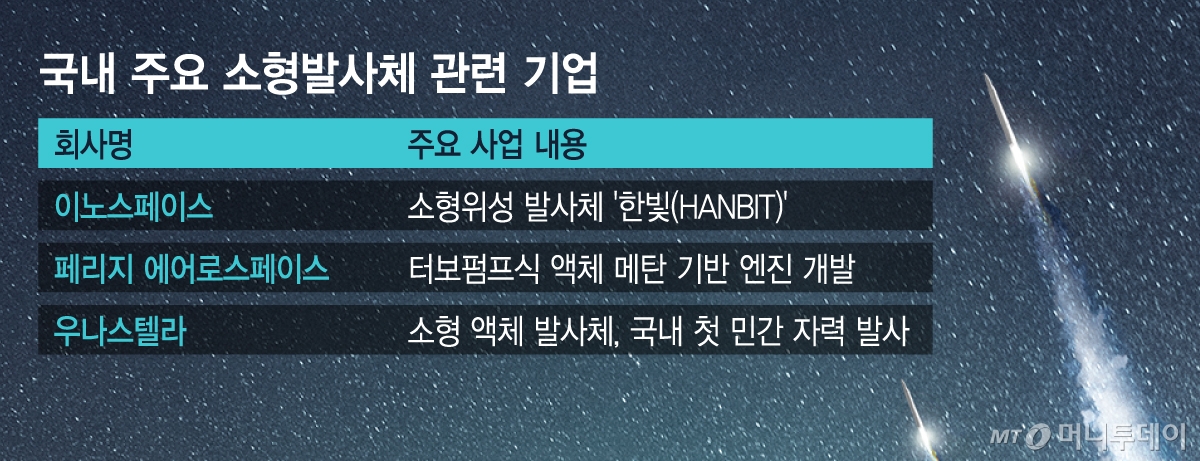
There is also a view that the government’s role must change. Rather than merely providing R&D (research and development) subsidies, the government should become an 'anchor tenant' (key customer) by directly purchasing private launch services in large volumes.
A university professor researching the space sector stated, "Just as NASA actively purchased private rockets to nurture SpaceX, our government must provide bold incentives when launching domestic satellites on domestic launch vehicles." Experts emphasize that decisive actions are needed, such as bundling public satellite launch volumes and signing long-term contracts with private companies.
An industry official remarked, "The U.S. government acted as an anchor tenant during the early stages of SpaceX and Rocket Lab’s establishment, creating opportunities for them. Providing as many launch opportunities as possible is the most effective form of support."
Insufficient launch site infrastructure and complex approval procedures are also challenges to address. Experts advise accelerating the opening of Naro Space Center to private entities and having the government build and share costly infrastructure such as post-launch tracking (telemetry) with private companies. Additionally, they stress the need for support in standardizing 'K-Launch Approval Procedures' through collaboration among the Korea Aerospace Research Institute, Agency for Defense Development, and other relevant bodies, alongside streamlining administrative processes.
An official from a domestic space startup stated, "For domestic private companies to perform various space-related tasks without issues, national launch vehicles are essential. To prevent the collapse of the launch vehicle market, we must streamline not only the environment but also complex procedures such as licensing and securing safety zones."
[MoneyToday Startup Media Platform Unicorn Factory]

 in FUTURE


