

[For more diverse corporate information on the startup featured in this article, please visit the 'Data Lab' section of the Unicorn Factory big data platform .]
Hundreds of thousands of news items are released every day. To extract in numerical terms which themes will move the market and which way investor sentiment is leaning requires a data pipeline and sophisticated mathematical models. This falls within the domain of financial engineering, commonly known as 'quant.' Even major domestic asset management firms find it difficult to handle this work directly.
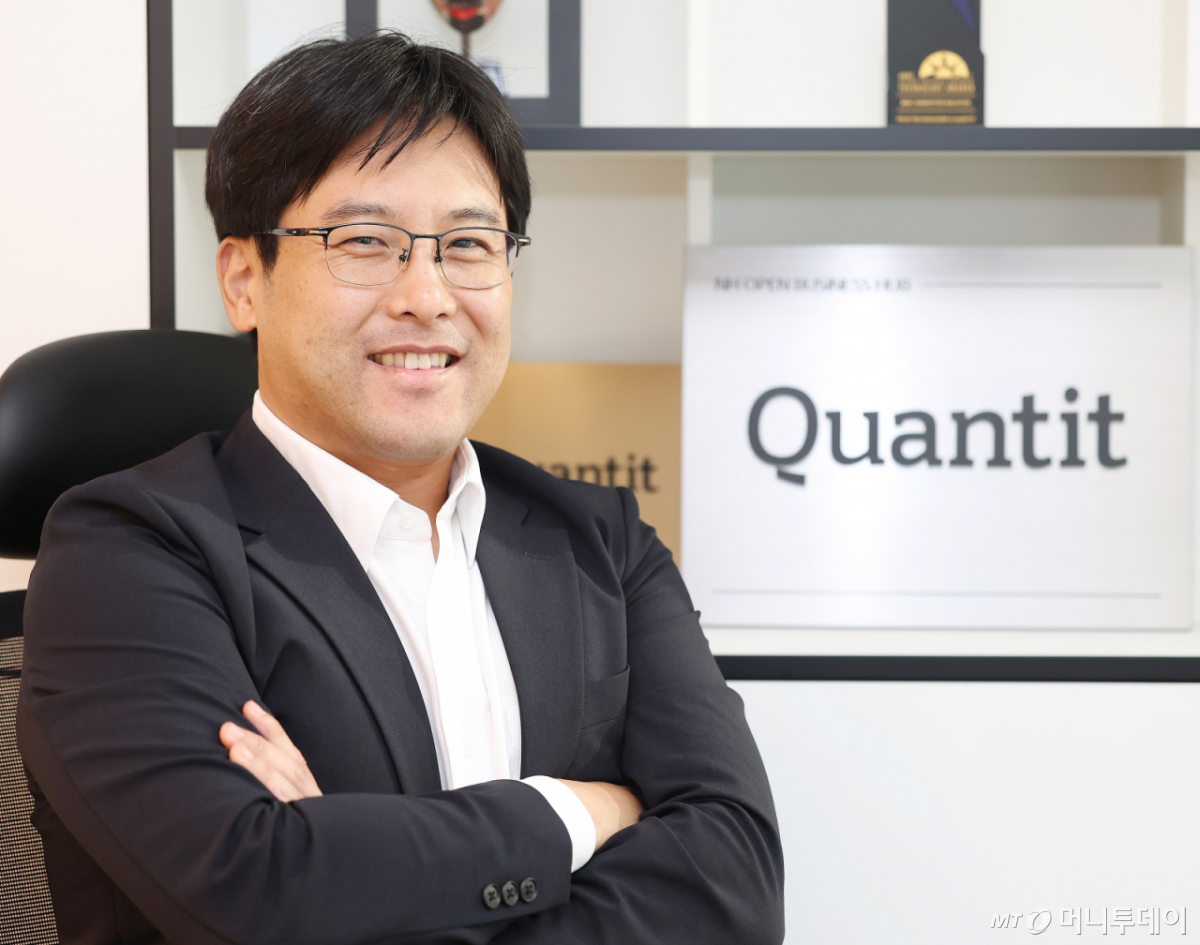
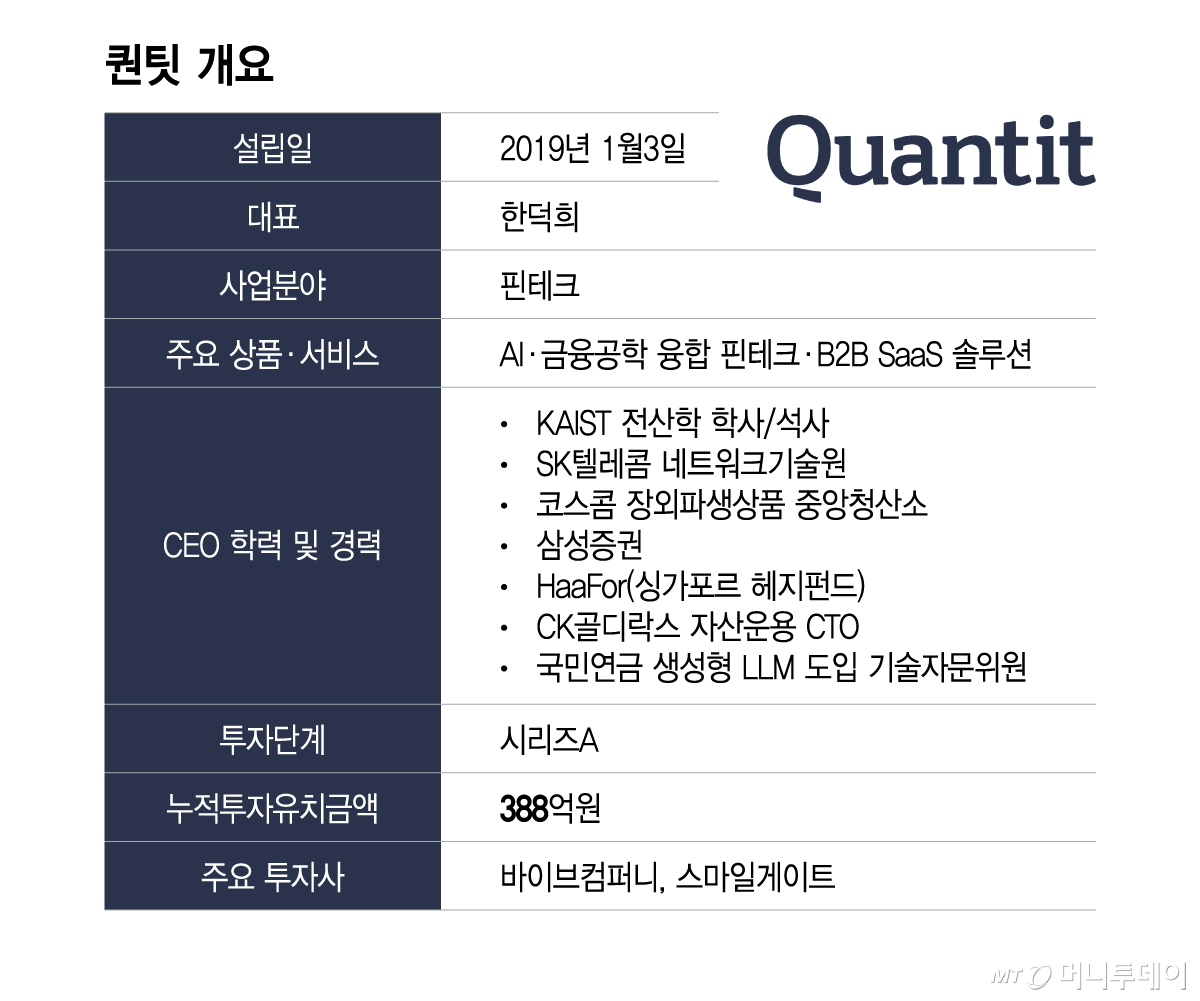
QuantIT is a company that performs these calculations on their behalf. Since its establishment in 2019, it has developed and supplied financial models tailored to the specific needs of asset management firms, securities firms, and public institutional investors. Han Deok-hee, CEO of QuantIT, stated, "We possess engine technology that calculates investment opportunities and risks through mathematical modeling, creating the models that institutional investors require on their behalf."
QuantIT Chosen by 'National Pension Service,' a Global Investment Powerhouse
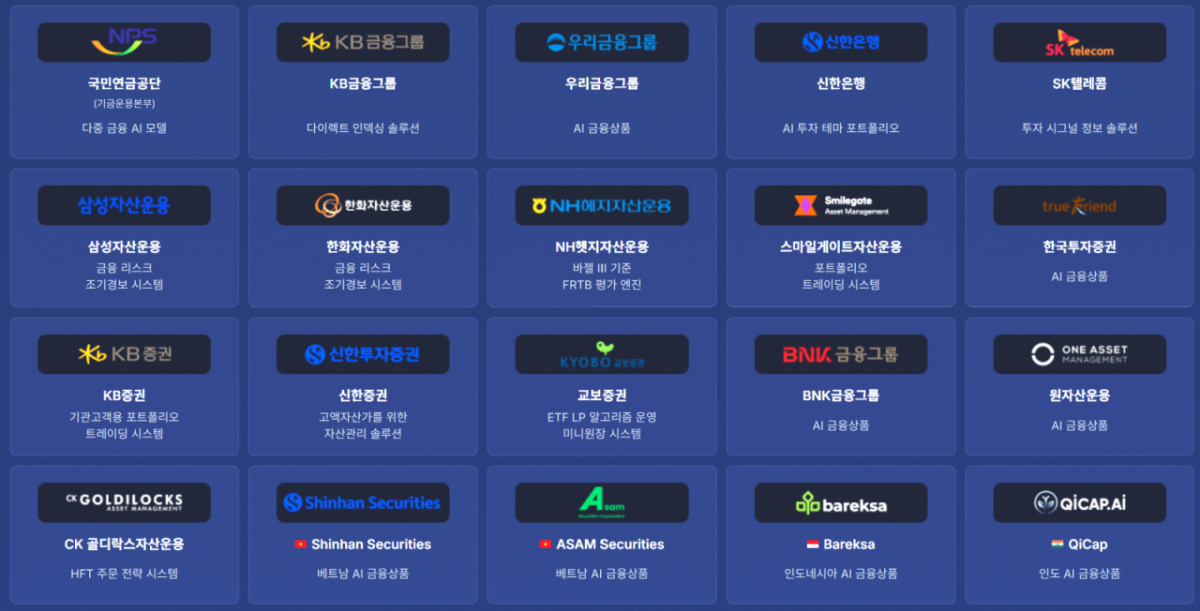
The models desired by each institutional investor are different. For instance, through NH NongHyup Bank's open innovation program, the 'NH Open Business Hub' this year, we are collaborating to create an innovative model for financial investment brokerage structures. CEO Han said, "It is a model that comprehensively views investment risks in the Korean and U.S. stock markets, quantifying everything from the overall market and individual stocks to macro variables such as foreign exchange." He added, "Even with the same market and the same investment targets, asset management firms, securities firms, and public institutional investors each want to see different aspects."
The reason many financial institutions struggle to build models in-house is the explosion of data that must be considered. The era has shifted from simply uploading data into Excel for calculation to a period requiring server resources. To directly establish an organization capable of processing big data and researching models would require setting up a dedicated quant research center.
The National Pension Service, regarded as a global 'big player,' also spent quite a long time domestically and internationally searching for a partner to entrust with such functions before commissioning QuantIT to develop three AI (artificial intelligence) models. These include: △a model that finds excess returns using U.S. stock market supply chain data; △an interest rate determinant analysis model; and △a bond yield optimization model. Developed over two years, these were supplied to the NPS, after which CEO Han was appointed as a technical advisory committee member for the National Pension Service's generative AI adoption. He said, "It was personally an honor to be invited to a position where we discuss how to incorporate AI into pension management that is responsible for citizens' retirement."
"Lack of Preliminary R&D Was Disappointing" — A 'Three-Year' Wait
CEO Han worked as a researcher at SK Telecom under the military service exemption program, then went on to work at KOSCOM, a subsidiary of Korea Exchange, Samsung Securities, a Singapore hedge fund, and a domestic asset management firm. As an engineer who moved through investment sites, he felt that it was difficult for domestic companies to invest in preliminary R&D (research and development). He said, "I thought that if they would wait while quant and IT personnel researched more comfortably and created solutions, good products might emerge." Thus, he established 'QuantIT,' a company name combining 'quant' and 'IT.'
In fact, for three years after its establishment, the company devoted itself to R&D. Revenue was minimal, but the center of gravity remained on research. It was essentially a period of 'closed-door training.' The R&D results honed in this way were born as QuantIT's internal R&D platform, 'FINTER,' specialized in the financial investment sector.
QuantIT's business based on FINTER is divided into three main areas. The primary revenue source is B2B services for institutional investors. Last year, it launched 'MoneyTering,' a personal AI investment information service that scans news, Telegram, and YouTube to summarize and provide Korean and U.S. stock information, gathering 300,000 users within one year. Its subsidiary, QuantIT Investment Advisory, directly manages funds. Assets Under Management (AUM) are at the level of 50 billion won, having increased for 14 consecutive quarters.
CEO Han stated, "Robo-advisors are just one part of our business area," adding, "Even looking at that field alone, we are likely almost the only company whose AUM has increased every quarter for three and a half years since launch."
U.S. Market Entry Results Materializing: "Secured Major Hedge Fund Clients"
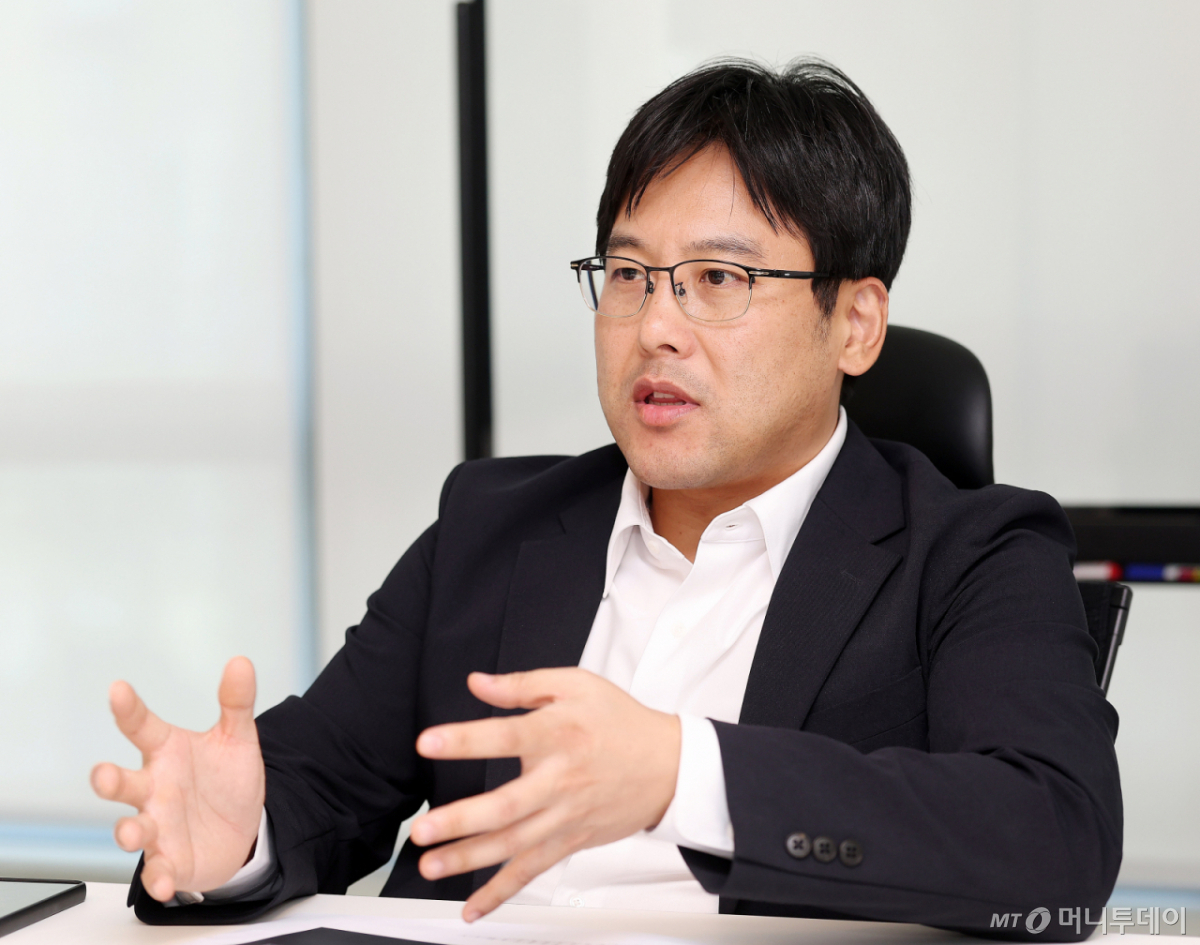
Where QuantIT is currently focusing its efforts is the United States. Compared to the domestic capital market, understanding and utilization of financial engineering are much higher in the U.S., resulting in a rich pool of potential clients. CEO Han said, "If there are about 10 potential clients domestically, there are dozens just in New York," adding, "The same solution receives a valuation approximately three times higher in Korea."
After sales efforts beginning at the start of the year, QuantIT is currently proceeding with its first commercial contract with a major U.S. hedge fund. CEO Han said, "Within the same hedge fund, there are dozens to hundreds of teams, and each team readily spends several hundred million won on quant models." He added, "As news of this contract spread, other stalled ongoing deals have also gained momentum."
This year's revenue is expected to be around 4 billion won. The profit structure is also projected to turn positive by next year. CEO Han emphasized, "For Korea's financial investment industry to surpass advanced markets like the U.S., Singapore, and London, it must boldly attempt to leapfrog during this period of change and the AI era." He added, "We will help domestic financial institutional investors make various attempts in line with the continuously expanding technology base."
[MoneyToday startup media platform 'Unicorn Factory']

 in FUTURE


