

[For more diverse company information on startups mentioned in this article, visit the Unicorn Factory big data platform 'Data Lab'.]
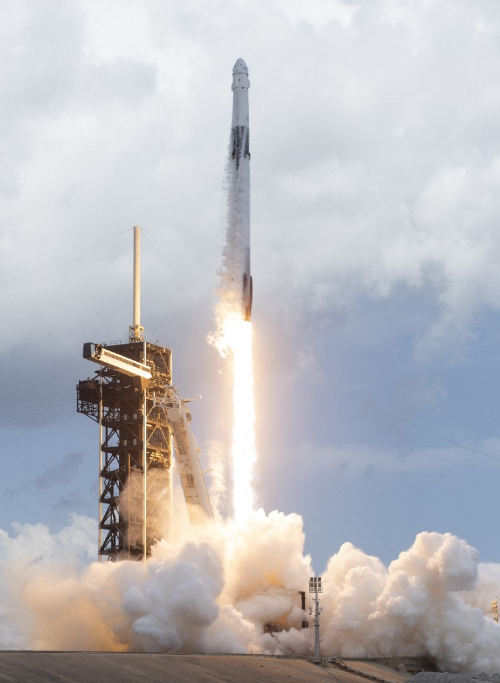
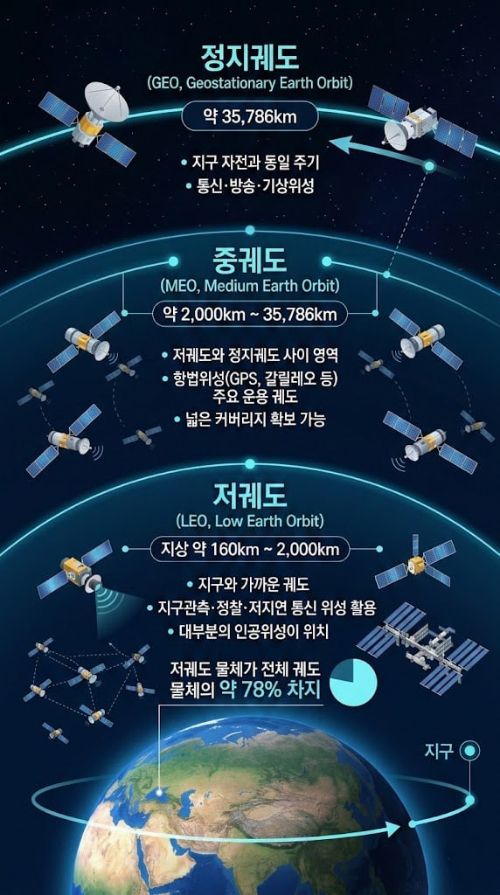
"Major global powers including the United States and China are waging a territorial war over the 'low Earth orbit (LEO)' space market at altitudes of 160 to 2,000 kilometers above Earth. SpaceX's revolutionary reduction in launch costs through reusable rockets has prompted it to view space—not merely as an exploration domain but as a platform directly tied to economic hegemony—and enter the race for dominance."
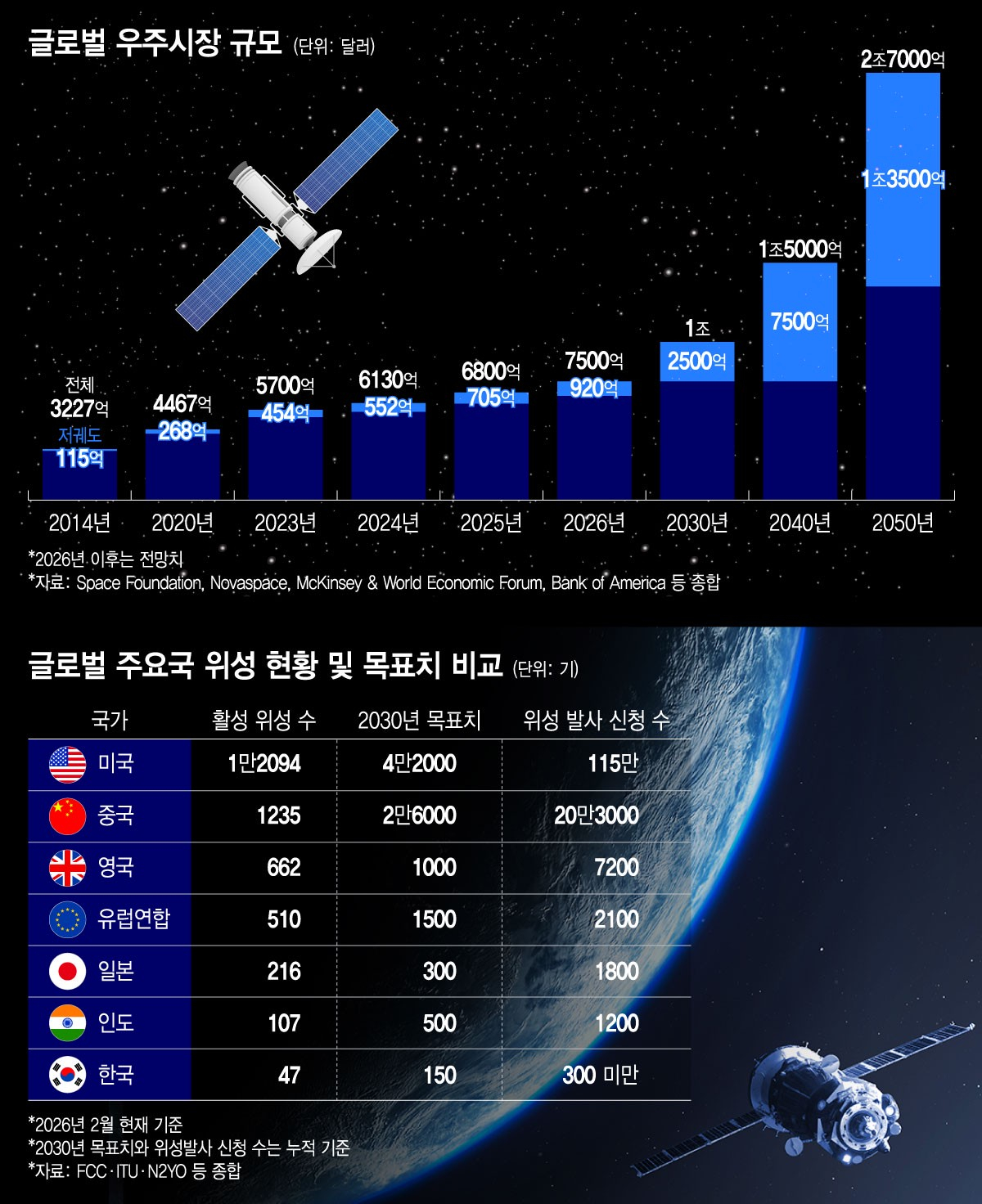
"On the 4th, MoneyToday startup media platform 'Unicorn Factory' analyzed data from major global investment banks including McKinsey, the World Economic Forum (WEF), NovaSpace, and Bank of America. The results show that the global LEO market grew by 163% in just five years, rising from $26.8 billion (approximately 39.3 trillion won) in 2020 to $70.5 billion (approximately 103.4 trillion won) last year."
"This growth stands out compared to the overall space market, which expanded by only 52.2% during the same period—from $446.7 billion (approximately 654.9 trillion won) to $680 billion (approximately 996.54 trillion won). For the first time last year, LEO accounted for over 10% of the total space market."
"Future projections are even more striking. Major institutional investors project that the global LEO market will grow to $250 billion (approximately 366.63 trillion won) by 2030, $750 billion (approximately 1,099.9 trillion won) by 2040, and 1.35 trillion won (approximately 1,979.8 trillion won) by 2050. They forecast that LEO's share of the total space market will reach 25% by 2030 and exceed 50% after 2040. This indicates a rapid shift in the center of gravity for the space economy from geostationary orbit (approximately 36,000 kilometers above Earth; GEO) to low Earth orbit, which offers shorter signal latency and lower launch costs."
"The rapid growth of the LEO market is driven by governments and private companies worldwide launching satellites in a competitive rush. Recognizing that LEO—where frequencies and altitudes are limited—is a first-come, first-served territory where the first to plant the flag secures ownership rights, these entities are pursuing aggressive expansion strategies."
"According to the International Telecommunication Union (ITU) and the U.S. Federal Communications Commission (FCC), as of February this year, the United States leads with 12,094 active satellites, far ahead of all others. China follows with 1,235, then the United Kingdom with 662, the European Union with 510, and Japan with 216. South Korea's count of active satellites remains below 50."
"The gap widens even further in satellite launch applications—a key indicator for future LEO dominance. Led by SpaceX, the United States has already applied to launch 1.15 million satellites. China has announced plans to launch 203,000 satellites and is closing the gap. The United Kingdom has applied for 7,200, the European Union for 2,100, and Japan for 1,800. South Korea's figure remains negligible at fewer than 300 according to industry estimates, falling short of official counts."
"Experts advise that South Korea must fundamentally transform its space industry structure. Lee Bok-jik, a professor at Seoul National University's Department of Aerospace Engineering, stated, 'As major powers rapidly secure low Earth orbit, it will become increasingly difficult for latecomers like South Korea to even find room to launch rockets in the future.' He added, 'South Korea must also view its space industry as a strategic national asset and platform, approaching it aggressively.'"
"A representative of a Korean startup emphasized, 'SpaceX is widening the technological gap by producing 60 satellites per week through automated processes and launching rockets more than 150 times annually. Since South Korea currently launches only one or two rockets per year, catching up to the U.S. immediately is not feasible. Instead, we must adopt tailored strategies such as developing dedicated space supply products that leverage our manufacturing strengths in materials, components, and equipment.'"
[MoneyToday startup media platform Unicorn Factory]

 in FUTURE


