

[For more diverse company information on startups mentioned in this article, please visit the Unicorn Factory big data platform 'Data Lab'.]
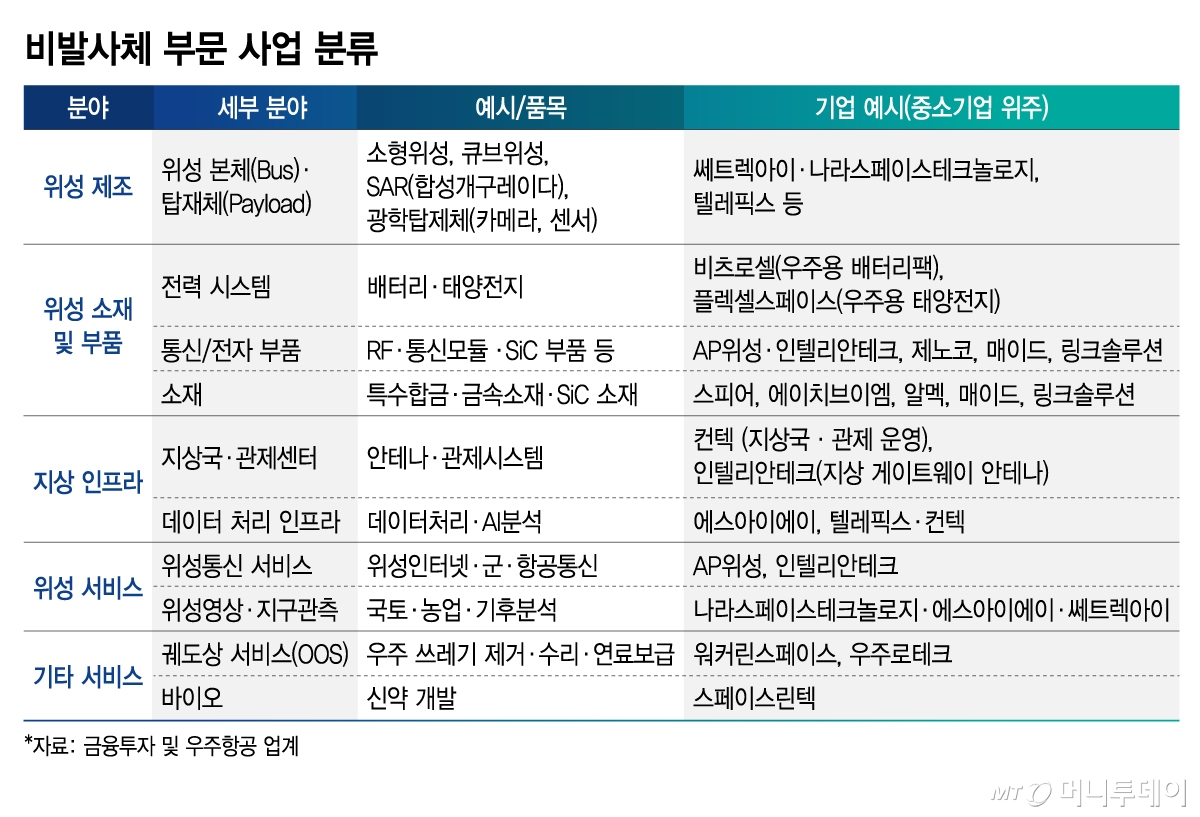
Evaluations suggest that South Korea's manufacturing capabilities accumulated in the shipbuilding, defense, nuclear power, and semiconductor industries can also become competitive strengths in the space industry. However, experts point out that growth is limited if relying solely on the domestic market, urging the government and private sector to actively seek entry into global supply chains together, similar to defense exports.
According to the space and aviation industry on the 4th, the background for South Korea's potential strength in the space industry lies in its manufacturing base accumulated over a long period. Structural stability under extreme environments, quality reliability, and ability to meet delivery schedules are cited as core capabilities commonly required not only in shipbuilding, defense, and semiconductors but also in the space and aviation sectors.
Jo Shin-hoo, CEO of Made, stated, "Structural stability and reliability under extreme environments are common important factors not only in semiconductors, shipbuilding, and defense but also in the space and aviation fields." He added, "Made also possesses technology to manufacture SiC (silicon carbide) parts for semiconductor equipment with high strength and heat resistance using 3D printing technology, and this manufacturing technology is being utilized in the space and aviation sectors as well."
In fact, cases are emerging where companies have been integrated into overseas value chains based on their manufacturing capabilities. Naraspace Technology, which has strengths in the ultra-small satellite production field, participated in manufacturing the main body of South Korea's ultra-small satellites to be deployed in NASA's Artemis manned lunar exploration program. It also holds reference data for payload supply in the fourth launch of Nuri (KSLV-II).
HVM, a specialist in special alloy manufacturing, supplies special alloys to SpaceX, a U.S. space launch vehicle company. Innox Advanced Materials has been supplying EMI (electromagnetic interference) carrier tape for aerospace use to SpaceX since 2023.
Experts point out that domestic space companies need to take more active steps to penetrate global supply chains. This is because growth is limited if relying solely on domestic business. According to data from the FCC (Federal Communications Commission) and ITU (International Telecommunication Union), the scale of U.S. low Earth orbit (LEO) satellites stands at 12,094 units, while South Korea has only 47 units. This amounts to less than 0.4% of the U.S. level.
Lee Sung-il, President of the Korean Aerospace Industries Association Jeong Chaek (Head), said, "Domestic manufacturing capabilities are solid, but the domestic market is not yet large." He added, "It is necessary for the government to provide support and connections so that companies with strong manufacturing capabilities can enter overseas value chains."
Unlike general manufacturing, the space and aviation sector has strong characteristics of national security and strategic industries, making it difficult for private companies to enter overseas supply chains alone. This is why there are calls for the government and private companies to form 'Team Korea' and actively attempt strategic entry into global supply chains, similar to defense exports.
Lee stated, "There are many G2G (government-to-government) projects that require intergovernmental cooperation and policy support, making it difficult for private companies to overcome market entry barriers with technology alone." He expressed hope that "private companies will also receive support from the government to actively promote domestic corporate capabilities and expand opportunities to participate in overseas projects, similar to Naraspace Technology's participation in the Artemis project."
In addition, the industry cites the government's role in supporting overseas networks, expanding domestic pilot projects and demonstration opportunities, and linking supply chains with large corporations as anchors. The argument is that a structure should be designed where companies first secure initial references domestically and then use them to enter global supply chains. In other words, a virtuous cycle must be created where domestic demonstrations lead to Yangsan and exports.
Jo Sin-hu (CEO) said, "There are many companies in South Korea with excellent materials, components, and process technologies, but there are not enough opportunities to apply them to actual systems and verify their performance." He added, "If system companies take the lead in integration and verification, creating a structure where multiple companies' technologies are applied and tested in actual projects, it will be possible to systematically develop manufacturing capabilities at the 'space grade' level specialized for space environments."
[MoneyToday startup media platform Unicorn Factory]

 in FUTURE
