

[For more diverse corporate information on the startups mentioned in this article, please visit the Unicorn Factory big data platform 'Data Lab'.]

"We are focusing on teams that aim to connect AI (artificial intelligence) technology to places where light does not reach. We believe that only when society as a whole becomes happier can the economy grow larger."
Jo Yong-min, CEO of Unbound Lab and former senior executive at Google Korea, emphasized the company’s philosophy of "AI impact investment" in an interview with Money Today's startup media platform, Unicorn Factory. He explained that the firm does not simply invest in AI technologies with high profitability but targets companies that can create positive social change while also generating profits.
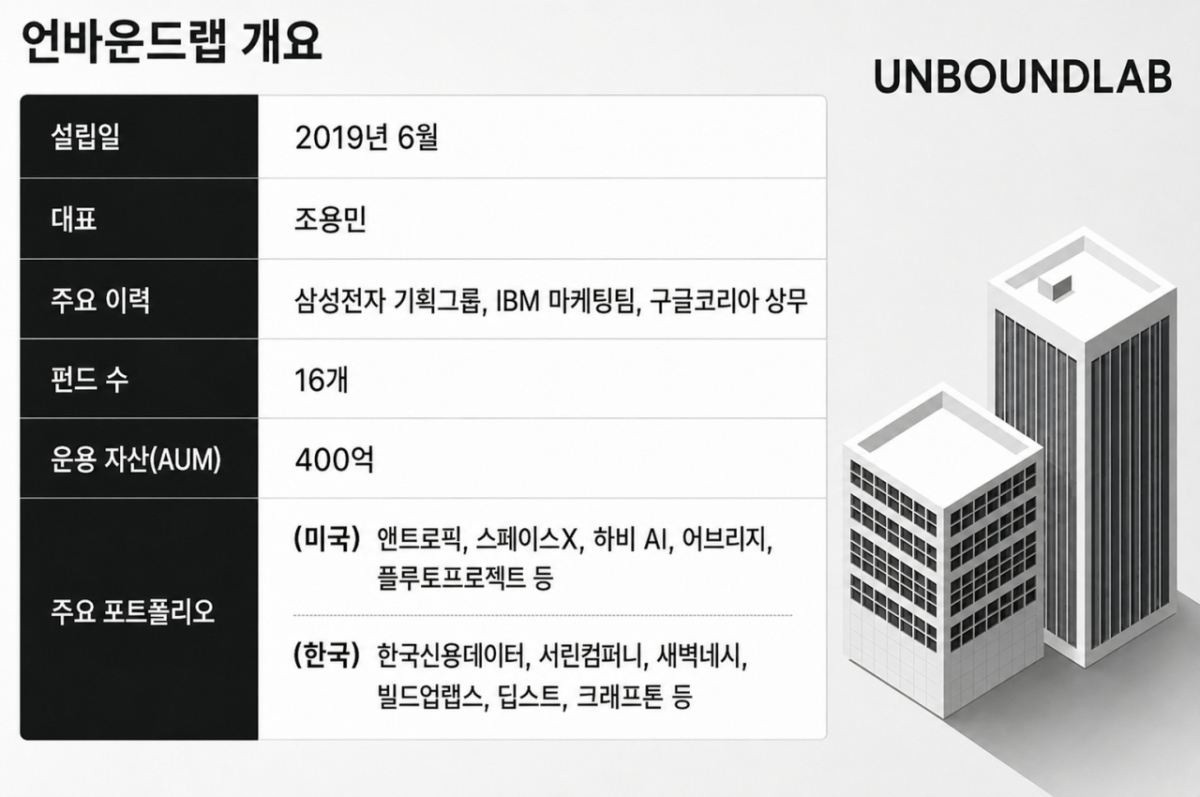
Founded in 2019, Unbound Lab is a U.S.-based venture capital (VC) firm that focuses its investments on AI deep tech and AI transformation (AX). Jo has gained extensive experience in both technology and business strategy through roles at Samsung Electronics' Planning Group, IBM's Marketing Team, and Google's Global Business Organization. Recognized for these qualifications, he was appointed as CEO of Unbound Lab in 2023.
Unbound Lab has built its investment expertise in the U.S. deep tech ecosystem by participating in early-stage investments in companies such as Anthropic, a generative AI firm, and SpaceX, led by Elon Musk. Since Jo joined, the firm has accelerated its expansion into investing in domestic AI startups. Key portfolio companies include Saebakneshi, Buildup Labs, Deepst, and Krafton.
Unbound Lab plans to aggressively expand its investment focus in Korea starting this year. Currently managing 16 funds, Unbound Lab maintains an investment ratio of approximately 80% in the U.S. and 20% in Korea but aims to gradually shift this balance to a 50-50 split in the future.
Jo stated, "Given that the government is actively driving the AI industry, we plan to stay longer in the Korean market starting this year and invest aggressively in domestic companies."
AX Ideas from the Frontlines… Why Focus on the Care Industry
The most critical investment criterion for Unbound Lab is not merely technical capability but the CEO's character and their ability to think from a user-centric perspective.
Jo remarked, "In the AI era, competitiveness will increasingly depend on how well a company solves social problems rather than just model performance. To achieve this, CEOs must possess the ability to design business models centered on actual demanders and users, not suppliers."
He further added, "If the CEOs of AI companies currently under investment become overly focused on short-term profitability, it could ultimately harm their long-term competitiveness and sustainability. Therefore, guiding them to consider ethical standards and social responsibility alongside business goals is also a crucial role for VCs."
The area receiving the most attention is the care industry. He explained, "The care industry inherently requires user-centric thinking. Continuously observing human behavior, emotions, and situations generates endless AX ideas." He elaborated, "In care settings, data about humans naturally accumulates. Through this process, previously unseen problems can be identified, and new ways of utilizing AI can be developed."
As an example, Jo cited children's crying data. He stated, "If we can continuously collect and analyze why a child cries, under what circumstances they calm down, and what behavioral patterns they exhibit, this itself can become a valuable AI data asset. There is a high potential for it to expand into AI-based behavior analysis or personalized care services in the future."
Looking ahead, Jo predicted that the core of AX in the care industry will shift from simple personnel matching to "user-customized AI." He noted, "Just as searching for the same kimchi stew on a delivery app yields different recommendation orders for each person, care services must connect teachers and providers based on a child's temperament and parents' needs. Ultimately, companies with user-friendly algorithms will grow at a significantly faster pace than those without."
[Money Today Startup Media Platform Unicorn Factory]

 in FUTURE

