

[For more diverse corporate information on the startups mentioned in this article, visit Unicorn Factory's Big Data Platform 'Data Lab'.]
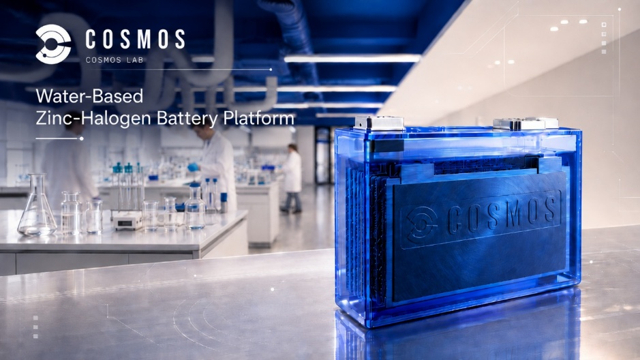
Non-lithium battery cell company Cosmos Lab announced on the 12th that it has secured a Series A investment totaling 220 billion won.
The investment included participation from multiple FIs (financial investors) and SIs (strategic investors), including Smilegate Investment. The company did not disclose the specific list of investors.
Established in 2021, Cosmos Lab is developing aqueous zinc-halogen batteries that utilize water-based non-flammable electrolytes and zinc- and halogen-based materials. Unlike existing zinc-bromine flow batteries or vanadium flow batteries, it features an integrated cell structure that does not require external electrolyte tanks or circulation pumps.
By applying halogen reaction technology, the company has enhanced energy density and space utilization while maintaining the safety of aqueous cells. The development scope spans from materials to cells and operating conditions in Jeonju.
Specifically, the strategy involves integrated development of cathodes, anodes, separators, electrolytes, charge-discharge operation technologies, cell structures, and manufacturing processes to transition R&D-stage technologies into large-scale commercial cells and products for Yangsan.
According to Cosmos Lab, as the center of the battery market shifts from electric vehicles to AI data centers and power grid ESS (energy storage systems), policy financing and private capital are pouring into non-lithium LDES (long-duration energy storage) technologies that complement lithium-ion batteries.
The company explained that the implementation of the U.S. IRA (Inflation Reduction Act) and Europe's CRMA (Critical Raw Materials Act), which have made supply chain stability a competitive factor, is also driving momentum for non-lithium batteries.
While existing non-lithium long-duration batteries have primarily formed markets around large-scale power grid facilities, Cosmos Lab aims to secure large-capacity cell technologies applicable even to industrial facilities that require limited space and high safety standards.
The investment funds will be used to strengthen domestic R&D capabilities and ensure the reproducibility and productivity of large-capacity cell manufacturing processes. The company plans to enhance verification of safety, lifespan, and energy density, while gradually advancing test evaluations and certifications required for ESS and AI data center environments.
Additionally, the company intends to verify applications up to modules, racks, and systems, securing products that global customers can adopt and establishing a foundation in Yangsan. Currently, Cosmos Lab is conducting joint development with SoftBank to achieve mass production of aqueous zinc-halogen battery cells in Yangsan, targeting AI data center ESS technology development for launch in Yangsan next year.
The company is also discussing demonstration possibilities with AI and data center-related companies in North America, Asia, and Europe. A Cosmos Lab representative stated, "We aim to grow as a non-lithium battery company in the AI data center and power grid ESS markets, expanding our application scope to include renewable energy-linked ESS, industrial power storage systems, and distributed power grids."
[MoneyToday startup media platform 'Unicorn Factory']

 in FUTURE
