

[For more diverse information on startups mentioned in this article, visit the Unicorn Factory big data platform 'Data Lab'.]
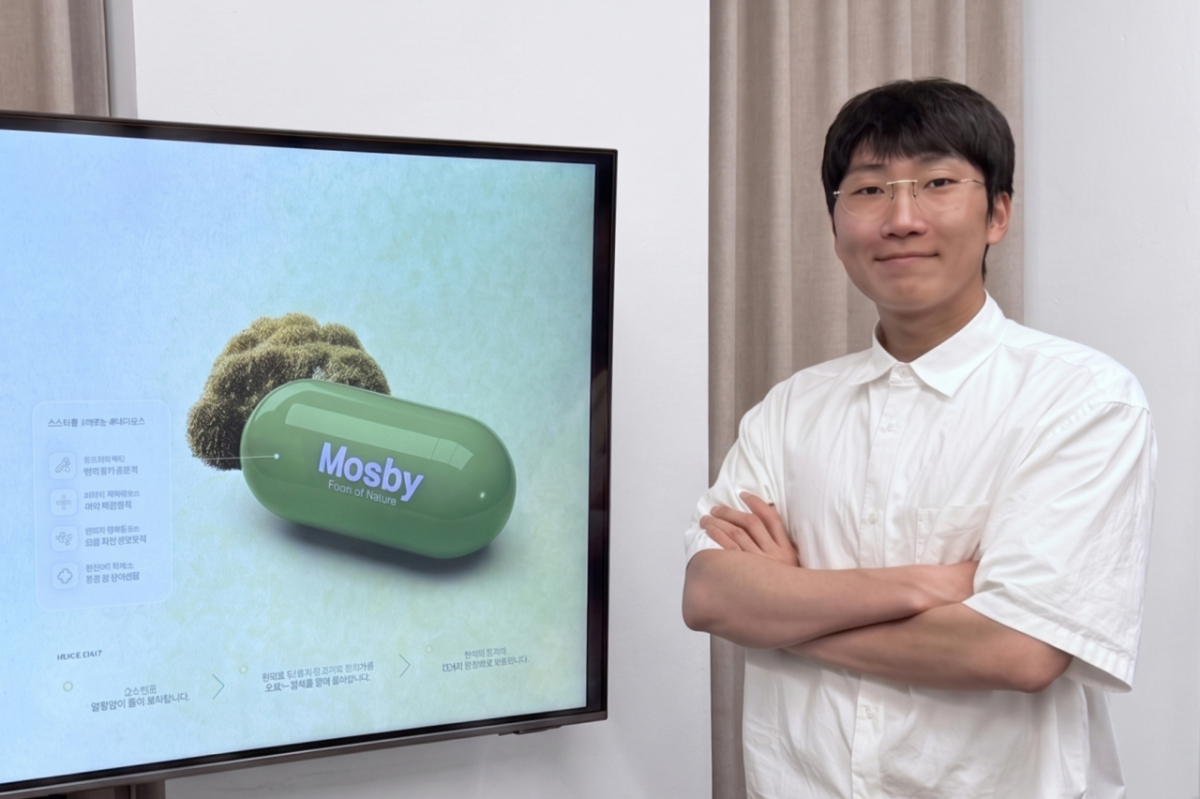
Code of NATURE, a startup utilizing moss for soil restoration, recently secured a wildfire recovery project in Canada covering an area equivalent to 100 soccer fields (100 hectares). This marks the company's first overseas project conducted with actual payment, not merely as a proof-of-concept (PoC).
Park Jae-hong, CEO of Code of NATURE, stated, "While 100 hectares is not an enormous scale in Canada, this contract holds significance as it was formally executed rather than just a PoC. The agreement was based on the principle of starting with 100 hectares and expanding if successful." He added, "We expect this year to mark the beginning of our full-scale growth phase."
"Twice as fast at one-tenth the cost"... Soil restoration magician: moss
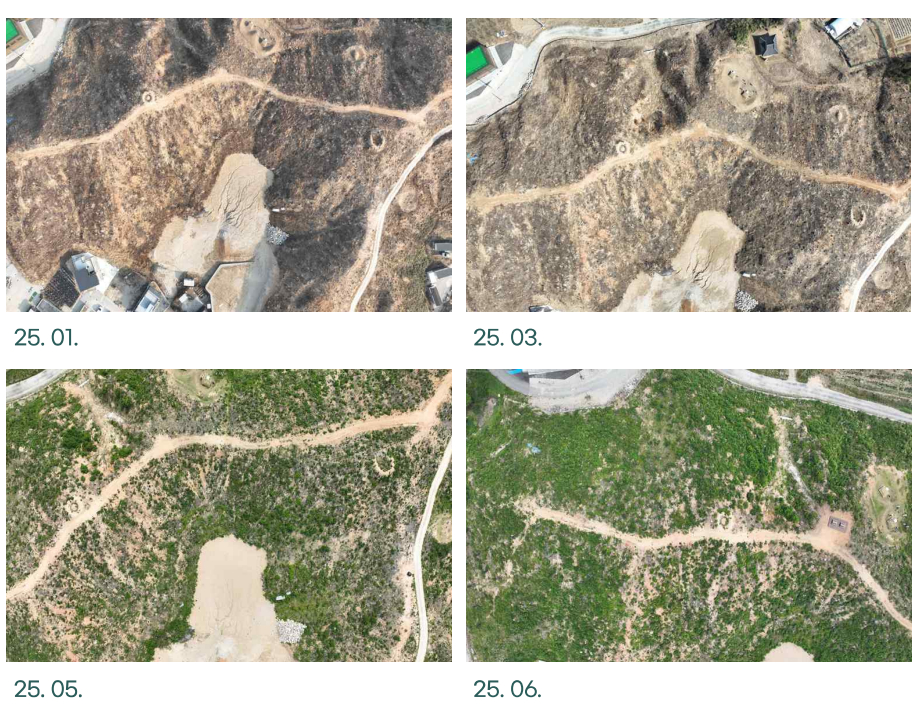
Code of NATURE is a startup that revitalizes degraded soil using moss. It selects suitable moss species based on the type of degraded soil and sprays a solution combining moss spores and culture media via drones, among other methods. The established moss increases carbon and organic matter within the soil, restoring its health. The initial greening process takes approximately 10 weeks—twice as fast as leaving the land untouched (about 20 weeks).
An even greater advantage is cost. In the common domestic approach of indiscriminately planting trees, 60% to 70% of saplings die because they cannot withstand degraded soil. Park (CEO) stated, "Ultimately, this method costs only one-tenth of tree planting."
Code of NATURE has restored sites including Jeju Island's Donuri Oreum, the Taeyang Jung-yeong reclamation area in South Chungcheong Province, and the Gangneung wildfire damage zone using this approach. Recently, international recognition of its technology has grown. Overseas markets have larger land scales and greater restoration demands, prompting attention to new technologies like those offered by Code of NATURE. The company has conducted PoCs successively in China and Australia and recently signed a formal contract with Canada, expecting revenue of approximately 3 billion won this year.
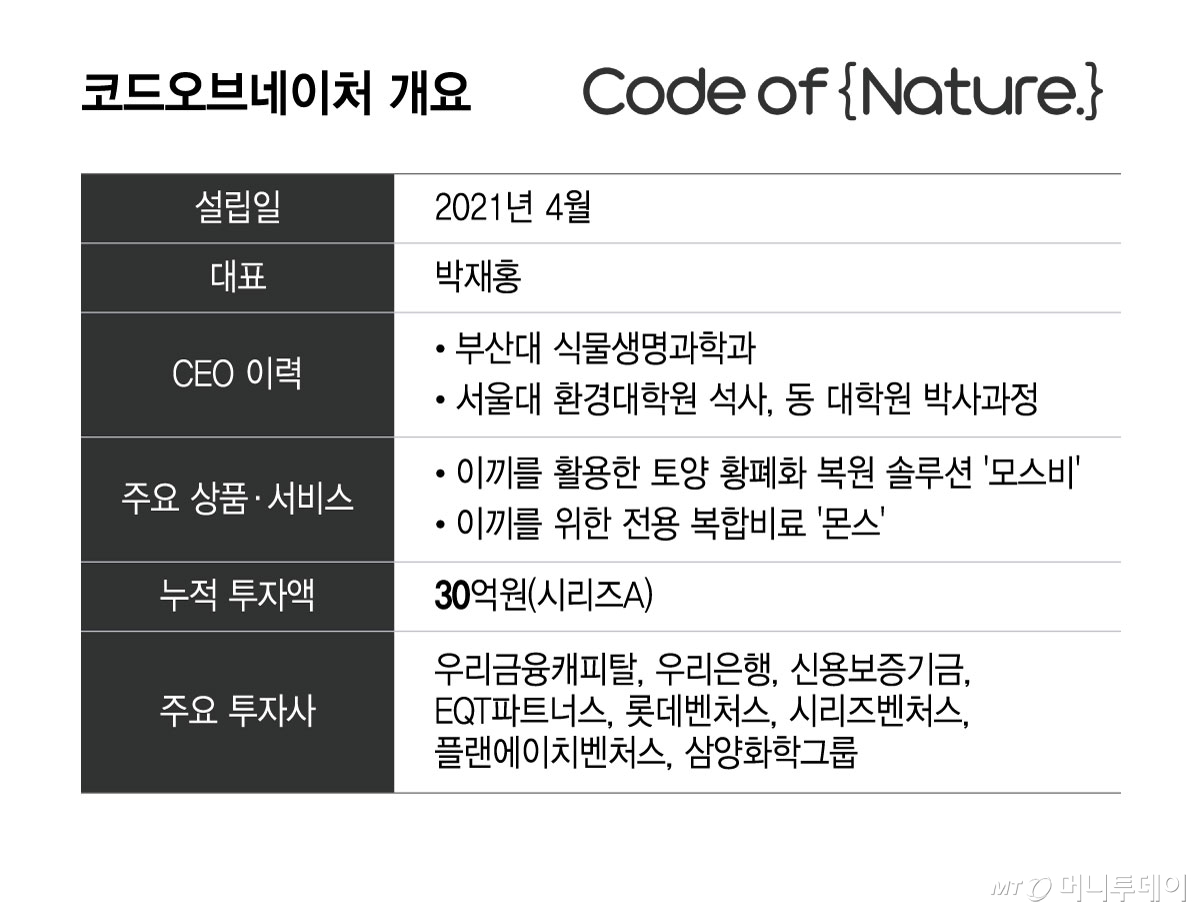
Investors have also recognized Code of NATURE's growth potential. At the end of last year, the startup secured Series A funding, raising a cumulative total of 3 billion won. The Series A round was led by Woori Financial Group, which identified Code of NATURE—a South Gyeongsang Province startup—through its open innovation program 'Dino Lab'. Woori Financial also facilitated investment from the Credit Guarantee Fund and supported the company in receiving 'First Penguin' guarantee assistance.
Technology validated through academic papers... "Agriculture possible even in space"
The area Code of NATURE is most focused on is terraforming soil on Mars, the Moon, and other celestial bodies—work to artificially create environments similar to Earth's. Park (CEO) said, "When humanity eventually lives on the Moon or Mars, we aim to verify the hypothesis that food can be produced using local soil without transporting Earth's soil."
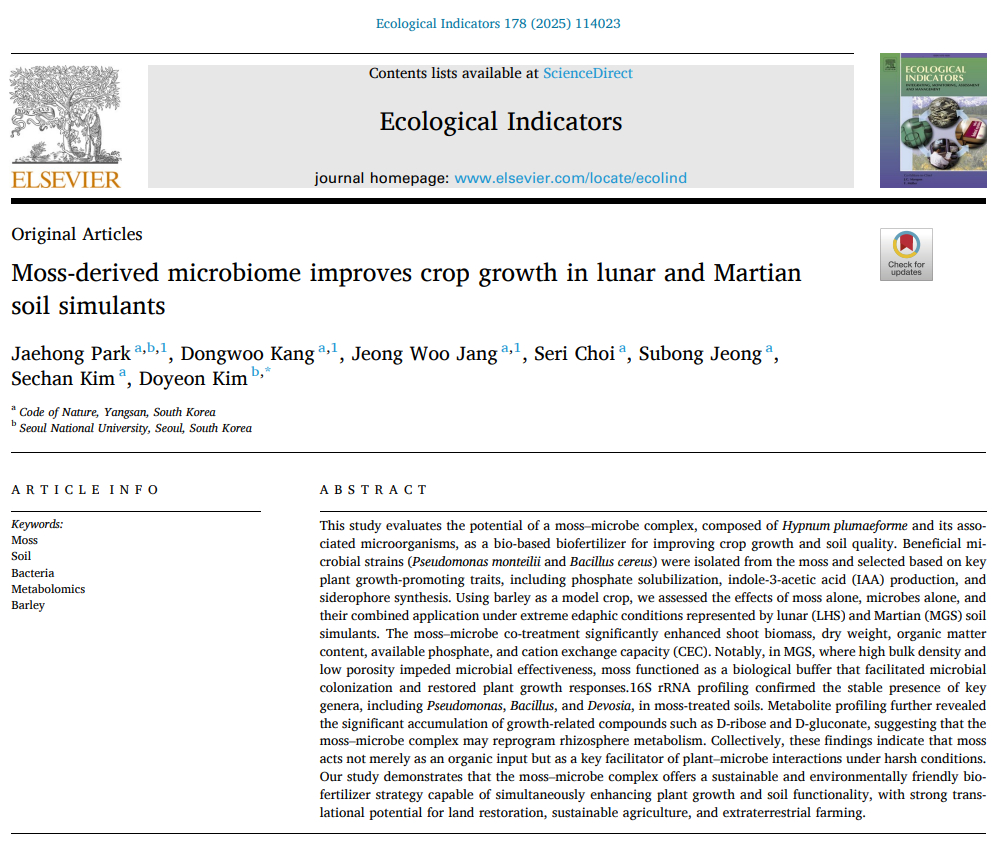
This hypothesis is becoming reality. Last year, the research team led by Park (CEO) and Code of NATURE enriched simulated Martian soil with moss and planted barley, confirming that crop length and weight increased by more than two to three times. Grain formation was also successful—exceeding expectations. The study was published in September last year in the academic journal 'Ecological Indicators', a prestigious publication ranked in the top tier (Q1) for citation index in ecology and environmental science.
Park (CEO) expects this research to lead to a business model based on "seed royalties." The moss and Misaeng water strains that proved effective in experiments are proprietary varieties developed by the company itself. Park (CEO) stated, "If we are to produce food on the Moon or Mars someday, our strains will likely need to be used."
Major corporations are also showing interest in related research. The Hyundai Motor Chung Mong-koo Foundation has supported R&D (research and development), and recently LG Group selected Code of NATURE through its open innovation program 'LG Super Start' to collaborate on related validation projects.
"Soil restoration is a food security issue... conducting business with pride"
When asked why soil restoration is necessary, Park (CEO) cited "food security." He explained, "The real issue of global warming is the reduction in areas where humanity can produce food. Soil degradation shares this same problem." The United Nations (UN) projects that by 2050, 90% of the world's soil will be degraded, hindering food production.
Park (CEO) stated, "The causes of rising agricultural prices include supply chains, but also production itself. If someone asks why we should restore soil, I answer that it is to ensure we can continue buying our favorite chocolate bread at current prices." He added, "Soil restoration is about the dinner tables of future generations. Code of NATURE will continue its business with the pride of doing something essential for humanity."
[MoneyToday startup media platform Unicorn Factory]

 in FUTURE


