

[For more diverse corporate information on the startup featured in this article, please visit the Unicorn Factory Big Data Platform 'Data Lab'.]
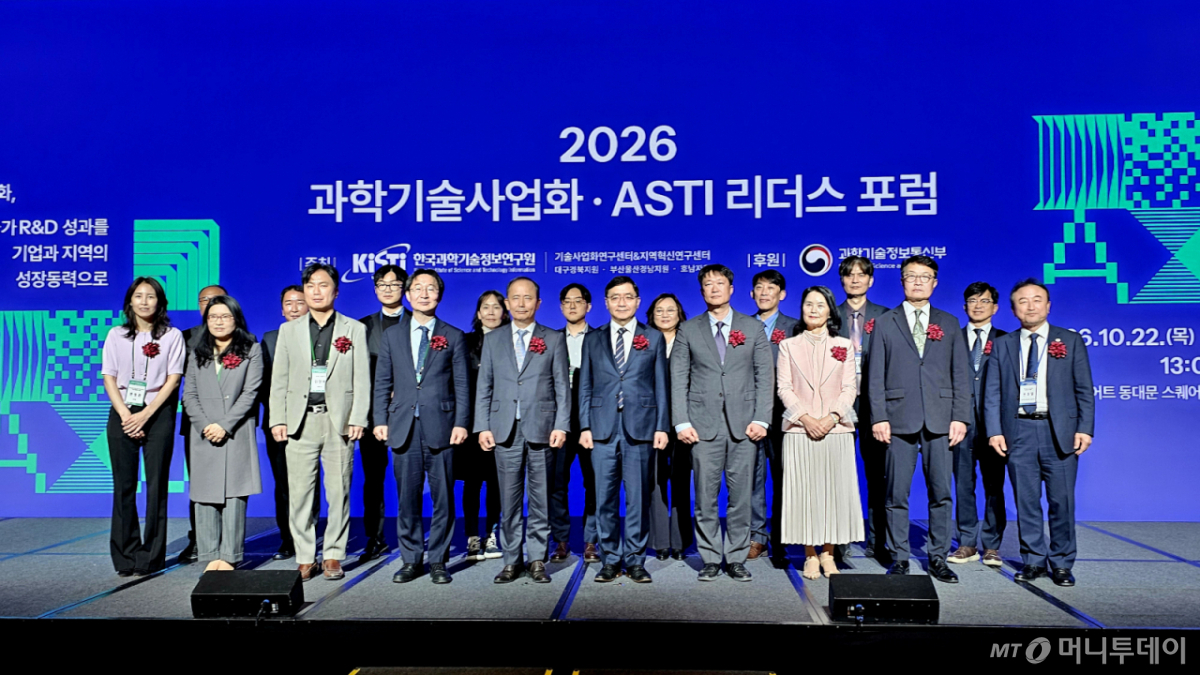
Can we finally break through the wall of a public technology transfer rate stuck in the 30th% range? An artificial intelligence (AI) 'matchmaker' has emerged that precisely connects national R&D (research and development) outcomes with companies in need, based on 374 million data points.
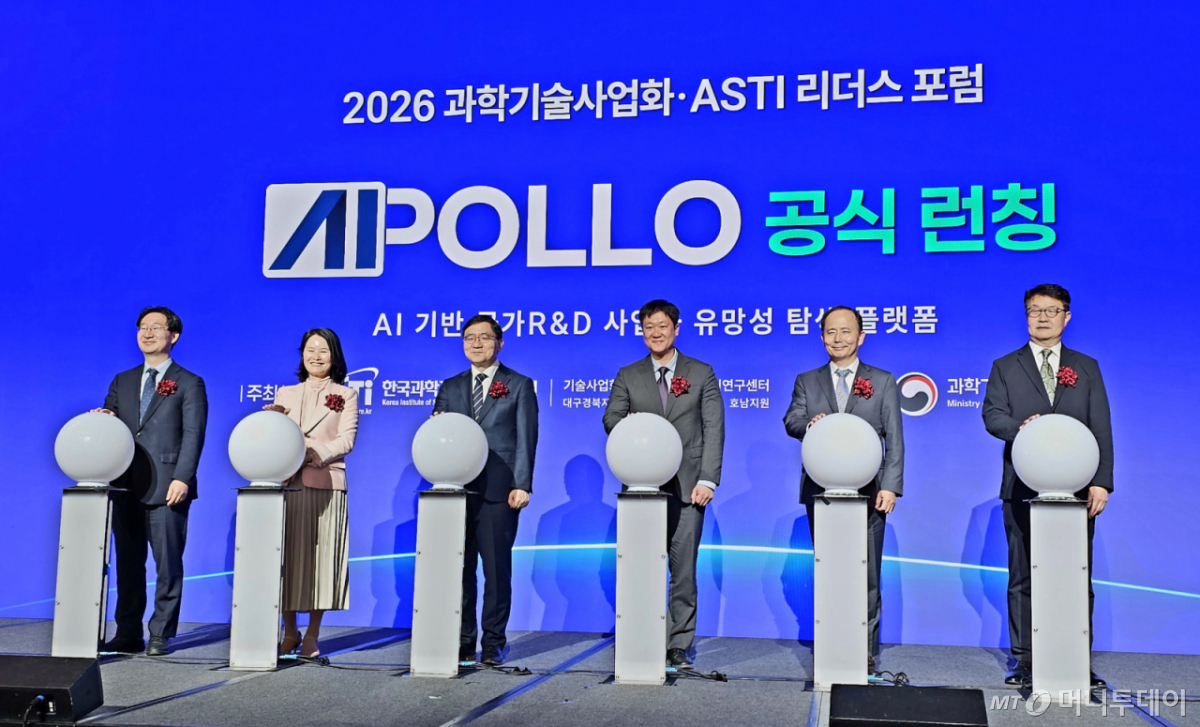
The Korea Institute of Science and Technology Information (KISTI) unveiled 'Apollo,' an AI-based platform for exploring the commercialization potential of national R&D outcomes, at the '2026 Science and Technology Commercialization and ASTI (Association for Science and Technology Information) Leaders Forum' held on the 22nd in the Grand Ballroom of Seoul JW Marriott Dongdaemun Square. Lee Sik, Director General of KISTI, stated in his opening remarks, "By combining Apollo with ASTI's corporate support capabilities, we will open a new horizon for the diffusion of national R&D outcomes."
ASTI is an industry-academia-research cooperation network operated by KISTI that connects companies with universities and research institutional investors to support technological innovation and growth for SMEs (small and medium-sized enterprises). Approximately 9,000 companies nationwide and 14,000 members participate in various collaborative activities ranging from technology information exchange to R&D, commercialization, and new business development.
Choi Moon-ki, Research Outcomes Innovation Officer at the Ministry of Science and ICT, said in his congratulatory address, "There are physical limitations to connecting technology with the market using only limited specialized personnel," adding, "We expect AI-based Apollo to quickly bridge technology and the market, resolving such bottlenecks."
The event was held under the theme 'AI Daejeon Transformation and Science and Technology Commercialization: Turning National R&D Outcomes into Growth Drivers for Companies and Regions,' with over 200 participants from industry, academia, research, and government.
Finding Promising Technologies and Companies Using 374 Million Data Points
Although the government's R&D budget reaches approximately 3.1 trillion won, the public technology transfer rate has stagnated, dropping from 31.7% in 2014 to 30.2% in 2023. Among transferred technologies, only 19.2% have actually led to revenue.
Apollo, developed to address these issues, utilizes approximately 374 million data points on projects, papers, patents, companies, and markets held by KISTI to connect national R&D outcomes with commercialization demand. After a pilot operation from last September to this February, the service officially launched on the 22nd, with plans to further develop it into an agentic AI solution in the future.
Byun Jeong-eun, Director of KISTI's Technology Commercialization Research Center, stated, "While existing platforms focused on registering and searching for technologies, Apollo is characterized by using AI to predict promising technologies and demand-side companies, even providing reasons for its recommendations."
Apollo's technology matching is leading to actual commercialization cases. Agricultural robotics company Shareflat was looking for technology needed to develop a dual-arm robot for harvesting and loading leafy vegetables when it received a recommendation through Apollo for Chonnam National University's 'flexible surgical robot' research. Although the technology was from the medical field, its dual-arm structure and path generation technology were suitable for agricultural robotics development. Lee Ji-hoon, CEO of Shareflat, revealed, "We signed a technology transfer contract with Chonnam National University in April last year, shortening the development period by 15 months from 36 to 21 months, and increasing revenue by 74% from 680 million won in 2024 to 1.19 billion won last year."
"Need to Strengthen Deep Tech Long-Term Investment, Early Demand, and AI Support"
Jung Hee-gwon, Lee (President) of the R&D Special Zone Promotion Foundation, who delivered the keynote speech, presented on the theme 'Challenges and Tasks in Deep Tech Commercialization: Cultivation Strategies for R&D Special Zones.'
Jung Lee (President) diagnosed that deep tech startups face an average 3 to 7-year 'death valley' at Technology Readiness Levels (TRL) 3 to 7. He explained that while two-thirds of domestic venture capital (VC) relies on funds of funds (Korea Venture Fund), and sub-funds typically have a maturity period of eight years, deep tech commercialization takes more than seven to 10 years, creating a mismatch between investment recovery structures and technology development cycles.
As an alternative, he proposed the 'research institute company' model, where public research institutional investors participate as shareholders to drive commercialization beyond simple technology transfer. As of September this year, there are a cumulative total of 2,339 research institute companies, which recorded revenue of 740 billion won and employed 5,108 people last year. Eleven special zone funds (totaling 562.8 billion won) invested 453.6 billion won in 267 companies, leading to KOSDAQ listings for 47 of them. Jung Lee (President) revealed, "We are also planning a deep tech-dedicated fund with an operating period of around 12 years."
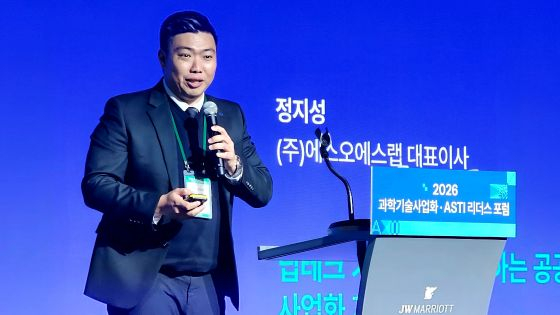
Jung Ji-seong, CEO of SOh E-seu-raep (CEO), presented on the theme 'Public Technology and Commercialization Support Needed by Deep Tech Companies.' Jeong (CEO) introduced the startup journey that began in a Gwangju Institute of Science and Technology (GIST) laboratory, went through student entrepreneurship programs and Korean-style I-Corps support, and led to the establishment of a corporation in 2016. S-O-S Lab is a company that has overcome the price and durability limitations of existing rotating LiDAR with a fixed LiDAR composed of 'two chips and two lenses.'
Jung Jeong (CEO) asked, "Can technology alone dominate a huge market?" comparing startups to koi fish, whose size changes depending on the size of the aquarium. He stated, "Just as NASA (National Aeronautics and Space Administration) became SpaceX's first customer, the Korean government and large corporations must create large-scale demand for startups to draw an J-curve." He added, "If South Korea wants to build the world's best spacecraft, we must not just let people plan R&D; we must make them dream of the endless universe."
Choi Gwang-hoon, Director of KISTI's Regional Innovation Research Center, presented on 'Activating the Regional and SME (small and medium-sized enterprise) AX Ecosystem and Bridging the Gap.' Choi diagnosed that "AI adoption is slower in places where vulnerable conditions such as non-capital regions, manufacturing, and SMEs overlap," stating that "structuring the tacit knowledge of experts takes precedence over model performance." He also introduced 'AXIS,' developed by KISTI. This is a decision-making intelligence platform that automatically derives everything from corporate AX diagnosis to evidence matching, strategy design, and execution roadmaps. He cited cases where companies participating in PoC (Proof of Concept) through AXIS saw improvements: C-N-E reduced annual quotation work from 3,694 hours to 1,446 hours, and Daewon Inmul reduced per-case ERP inquiry and aggregation time from 30 minutes to six minutes.
The panel discussion, chaired by Kim Eun-sun, Senior Researcher at KISTI, featured △Kim Sun-woo, Director of the Science and Technology Policy Institute △Kim Min-woo, Head of the Commercialization Promotion Agency for Science and Technology △Son Su-chang, Jin Heung-jae-dan (Head) of the R&D Special Zone △Oh Mi-hye, Campus Director of the Korea Automotive Research Institute △Kim Young-rok, CEO of Next Challenge △Jo Seung-pyo, CEO of H-Brain △Jeong Ji-seong (CEO), among others.
The discussion focused on cooperation methods among innovation actors to ensure that national R&D outcomes do not remain in laboratories but lead to actual corporate growth and market creation. Kim Eun-sun stated, "What was confirmed in today's discussion is that commercialization is not the responsibility of any single institutional investor," adding, "Innovation actors must divide roles and join hands so that the process continues seamlessly from technology transfer through validation, investment, and scale-up."
[MoneyToday Startup Media Platform Unicorn Factory]

 in FUTURE


