

[For more diverse corporate information on the startups mentioned in this article, visit Unicorn Factory's big data platform 'Data Lab'.]
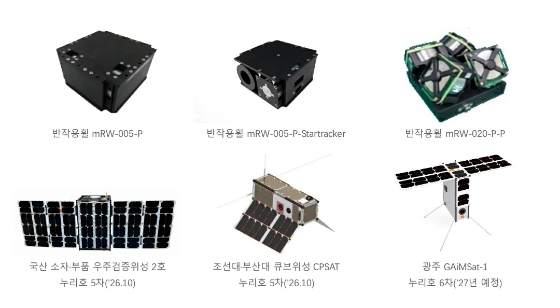
Momentum Space, a startup developing reaction wheels for satellite attitude control, will load its reaction wheel onto Nuri's fifth launch, scheduled for early next month, for an in-space demonstration. The company expects to begin generating significant revenue once the demonstration is completed, as it will then meet the commercial supply requirements of satellite manufacturers.
According to the company on Monday, a reaction wheel is a core drive component that precisely controls a satellite's attitude using reaction torque generated by rotating an internal wheel.
While essential for most satellites used in communications, Earth observation, and navigation, its domestic localization rate remains effectively at 0%, with full reliance on overseas imports.
Each unit costs over 100 thousand won, making customization difficult and driving high demand for domestic production. The government plans to develop approximately 170 public satellites by 2031, and private satellite launch plans by domestic companies are expected to reach 150 units, rapidly increasing the need for localized core components.
Momentum Space is the only company in Korea that holds both the first-ever heritage of a reaction wheel space verification and the longest orbital operation record domestically.
The first domestically developed reaction wheel, mounted on the Naro Science Satellite in 2013, operated normally in orbit for over two years (840 days). Additionally, the attitude control module supplied by Momentum Space to SNIPE (launched via Nuri Rocket's 3rd mission in 2023) has continued operations for over two years (880 days) to date.
On this Nuri Rocket 5th mission, Momentum Space's reaction wheel modules will be mounted on the 'Domestic Component Space Verification Satellite No. 2' developed by the Korea Aerospace Administration and the Korea Aerospace Research Institute, as well as on the joint cube satellite 'CPSAT' created by Chosun University and Pusan National University.
This marks the third orbital verification through a domestic official space component validation program. If successful, the Technology Readiness Level (TRL) will advance from the current level 7 to level 8. TRL 8 signifies that flight verification in actual space environments has been completed, meaning the company meets commercial supply conditions required by satellite manufacturers.
Momentum Space offers heritage-based verified products at prices over 30% lower than overseas competitors, highlighting its strengths in three-axis modular design and manufacturing customizable per customer mission, comprehensive system cooperation tailored to client needs, and technical support including after-sales service (A/S).
The company has also secured its first foothold for global expansion. Four of Momentum Space's reaction wheels are scheduled to be mounted on 'HABSat-1', a 3U cubesat currently being developed by the CubeCats student space program at the University of Cincinnati (UC) in the United States.
HABSat-1 is an Earth observation satellite designed to monitor harmful algal blooms (HABs) in the Great Lakes, including Lake Erie, using multispectral cameras from an altitude of 450 km. It requires precise pointing accuracy within ±1° for ground imaging, leading it to adopt a reaction wheel-based active attitude control system (ADCS). This marks the first case where a U.S. university space program selected a domestic reaction wheel, expected to serve as a stepping stone for entering the global satellite component market.
Next year, additional mounting is planned via Nuri Rocket's 6th mission on Gwangju Metropolitan City's GAiMSat-1 and Kookmin University satellites, ensuring a continuous pipeline from verification to commercialization.
Expansion into the domestic cluster satellite market is also becoming visible. On September 3, Momentum Space signed a memorandum of understanding (MOU) with Company A, a cube satellite development and operations firm, regarding the development and supply of reaction wheels.
Company A's prototype will be mounted on the Nuri Rocket 5th mission for performance verification before being expanded into cluster configurations. Both companies are currently discussing plans to mount Momentum Space reaction wheels (3–4 units per satellite) on cluster satellites scheduled for development starting in 2027.
Dong-ik Jeon, CEO of Momentum Space, stated, "From the Naro Science Satellite up to this Nuri Rocket 5th mission, all domestic reaction wheel space heritage has passed through our team's hands." He added, "Through this verification, we will achieve TRL 8, completing a domestic reaction wheel Yangsan system suitable for the era of satellite clusters. We aim to grow beyond reaction wheels into a total solution provider for satellite attitude control systems (ADCS)."
Meanwhile, Momentum Space was established in 2021 based on the satellite attitude control research lab at Korea Aerospace University and recently completed its Pre-Series A funding round, led by Nova Ventures.
Ji-young Park, CEO of Nova Ventures, said, "In the cluster satellite era, where orbital satellites are projected to reach up to 100,000 units by 2030, reaction wheels—mounted at 3–4 units per satellite—are core components whose demand will inevitably surge explosively." He continued, "Momentum Space is the only team in Korea to have accumulated space verification data among domestic commercial reaction wheels. This Nuri Rocket 5th mission verification will be a turning point where domestic localization of space components translates into actual revenue."
[MoneyToday startup media platform Unicorn Factory]

 in FUTURE
