

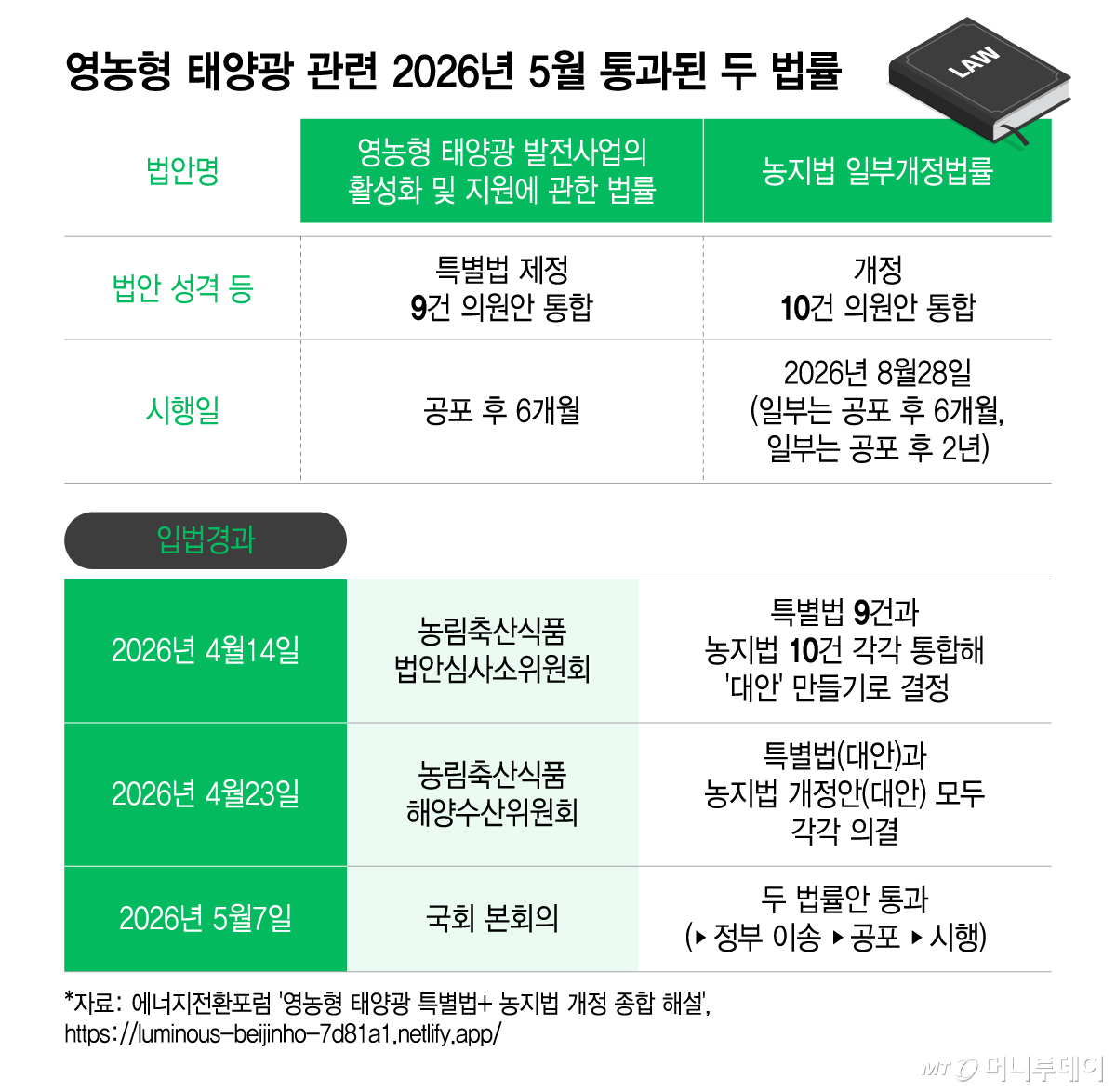
The 'Act on the Promotion and Support of Farming-Type Solar Power Generation Projects (hereinafter referred to as the Farming-Type Solar Act)', which passed the National Assembly plenary session last month on the 7th, is evaluated as significant for opening up new economic pathways for rural areas facing the dual hardships of population collapse and declining income. On the same day, it coincided with the passage of an amendment to the Agricultural Land Act in the National Assembly, thereby laying the institutional groundwork to expand the domestic foundation for renewable energy production.
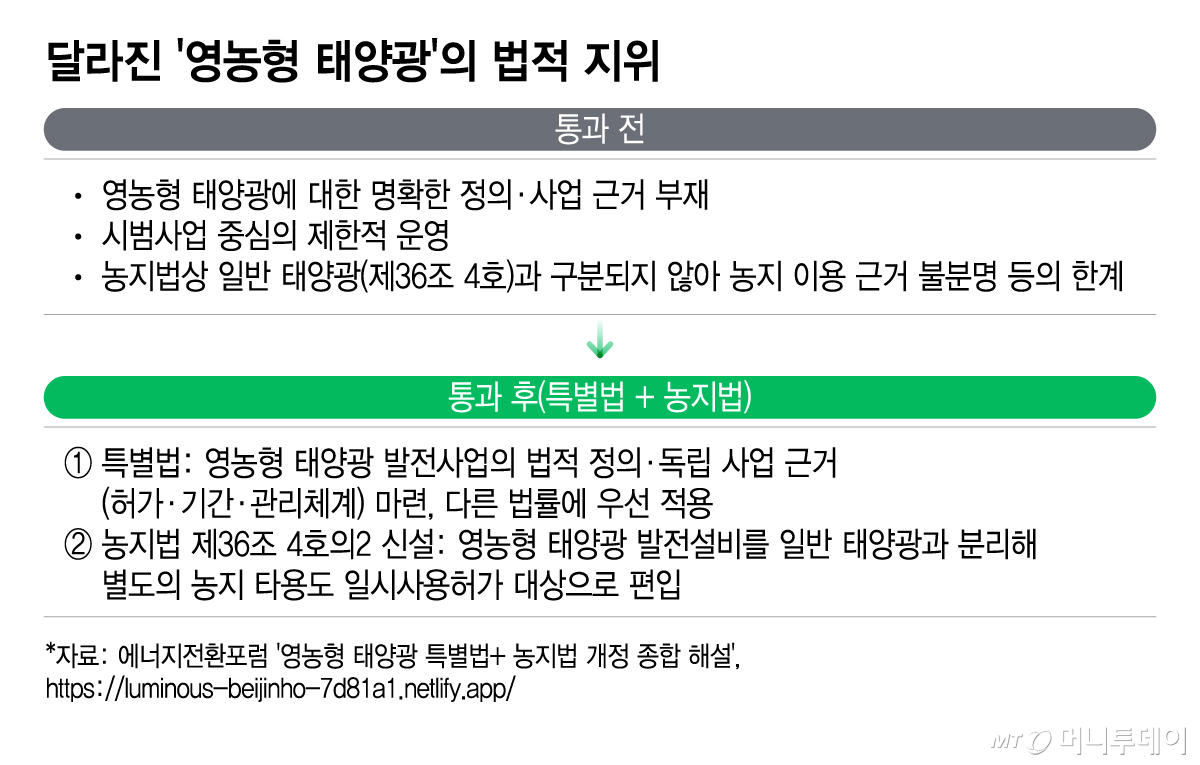
First legal codification of solar panels on farmland in Korea… Penalties if farming is not conducted
One of the core elements of enacting the Farming-Type Solar Act and amending the Agricultural Land Act is that it clearly established the legal basis for farming-type solar power generation projects, which had previously lacked a clear legal definition in Korea. Notably, the duration of farming-type solar power generation projects has been explicitly codified as 'up to 30 years'. Although some agricultural lands under the existing Agricultural Land Act framework could obtain temporary permits for alternative use to conduct solar power generation, that period was limited to a maximum of eight years. Since solar power generation projects typically calculate profitability based on a project duration of over 20 years, this amendment has created the basic institutional foundation necessary to advance such projects.
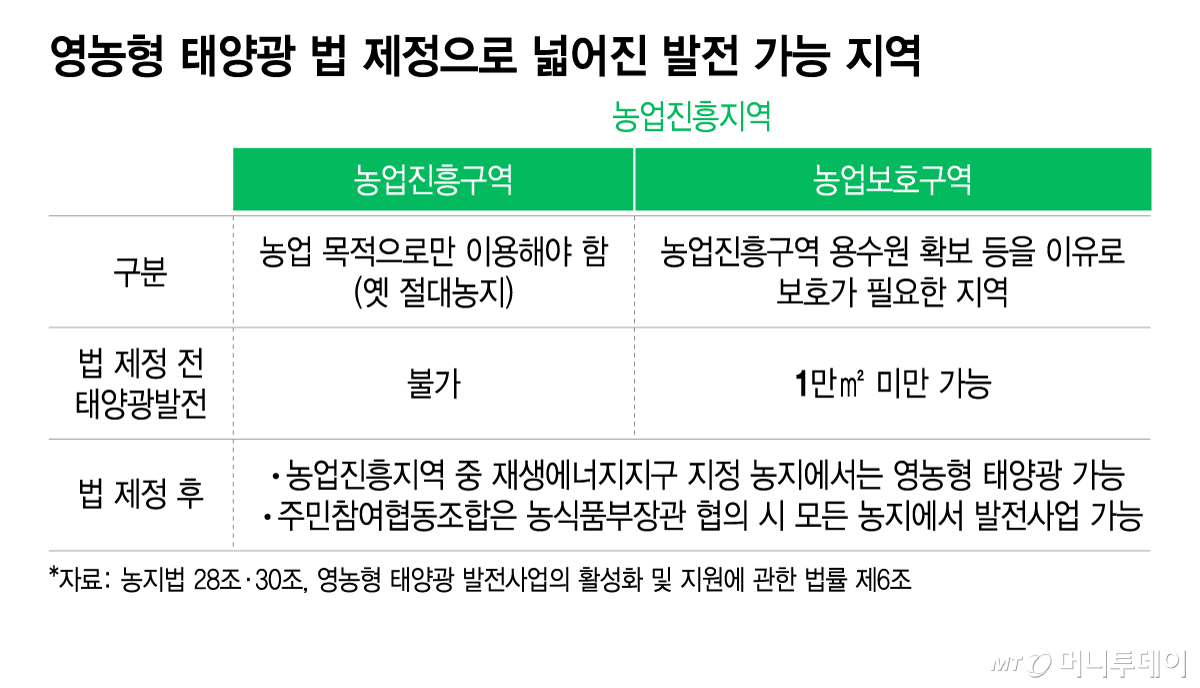
The exceptional inclusion of a legal basis for installing solar facilities within Agricultural Promotion Zones is also an important change. Until now, 'best-quality agricultural land' within Agricultural Promotion Zones could not be used for purposes other than agriculture. The newly enacted law allows farming-type solar power generation projects even within Agricultural Promotion Zones if designated as renewable energy zones. This opens a path to concurrently conduct farming and power generation on high-quality farmland.
Explicitly stipulating strict 'farming obligations' is another key component of this bill. If the project operator fails to continue agricultural activities or conducts business differently from what was permitted, they may face revocation of their business permit or an order to suspend operations. This serves as a mechanism to block speculation by so-called 'fake farmers'. It reflects the government's and National Assembly's determination to establish a system that does not merely utilize farmland for solar power generation but instead embeds the practice of concurrently conducting farming and power generation.
Lim Mi-ae, a Democratic Party of Korea lawmaker who was one of the sponsors of this bill, recently emphasized in an interview with Money Today: "While electricity production is important, if farmland loses its function as farmland, it does not align with the purpose of the law." She further stated, "Paradoxically, if solar power revenue is stably guaranteed, farmers will have no choice but to continuously manage their farmland and continue farming activities in order to maintain that revenue."
The 'Details' of Institutional Design Are Crucial
The key now is whether this law, which has taken its first step, can establish detailed foundations to enable active farming-type solar power projects on the ground. Preserving agricultural productivity is therefore important. To prevent side effects such as reduced crop yields due to shading from solar panels or the concentrated cultivation of specific plants that thrive in shaded areas, it is urgent for the Ministry of Agriculture, Food and Rural Affairs to establish an inspection system and guidelines for fulfilling farming obligations that are tailored to reality.
In addition, a 'predictable' revenue structure that allows farmers to secure profits through renewable energy sales, aligned with the sunset clause of the upcoming Renewable Portfolio Standard (RPS) system, is necessary for institutional stabilization. Furthermore, measures must be taken to enable farmers to access finance so they can invest in farming-type solar power generation.
Insufficient power grid infrastructure is also a challenge that must be addressed. Major regions with large areas of farmland, such as the Honam region, already face difficulties in entering the power generation business due to saturation of transmission and distribution networks. For farmers' power generation revenues to be realized, plans to efficiently operate existing power grids and expand new ones must be implemented concurrently.
Some voices also call for connecting farming-type solar power with large-scale demand centers. The current bill limits project operators to farmers and resident-participation cooperatives to prevent indiscriminate entry by external developers. However, given that a significant number of large-scale renewable energy demand centers are corporations, there is an opinion that practical alternatives linking supply and demand must be sought.
A representative from a renewable energy supply company advised: "The current bill focuses on small-scale projects centered on individual farmers, which could create administrative burdens and high transaction costs for large corporations requiring massive amounts of electricity, as they would need to negotiate contracts individually with numerous farmers." They added, "It is necessary to design and supplement the system in a way that protects farmers' rights and interests while allowing companies to procure a certain scale or more of power in a single transaction."

 in INDUSTRY


