

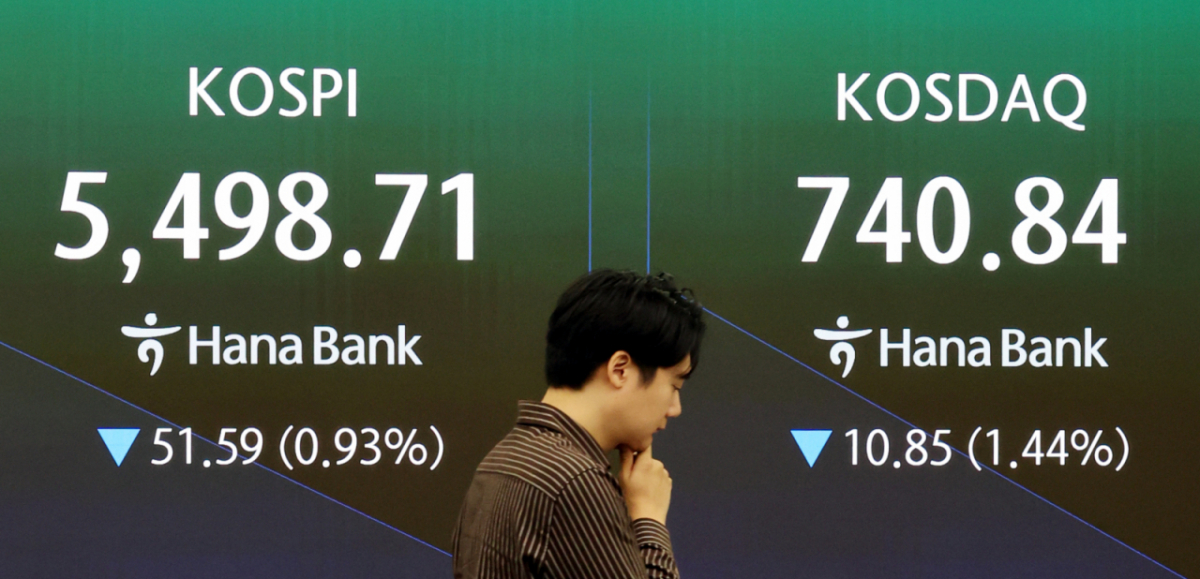
As foreign investors withdrew from both major markets and the decline continued on Monday, robotics-related stocks rose by more than 5%, showing strong performance.
It is interpreted that expectations for earnings at KOSDAQ-listed companies providing robot-related services and components have been reflected in stock prices due to the emphasis on physical artificial intelligence demand.
As of 10:56 a.m., Robotis was trading at 245,000 won, up 20,000 won (8.89%) from the previous trading day. Robot automation platform company Bigwave Robotics surged in the 13th% range, and intelligent robot solution company Anrobotics surged in the 11th% range.
Other robotics technology companies listed on the KOSDAQ are also strong. Service robot specialist Everybot rose in the 6th% range, and robot actuator company SPJ rose in the 2nd% range.
At the same time, while the KOSDAQ was weak at 736.16, down 15.53 points (2.07%) from the previous trading day, robotics-related stocks are emitting pillars of fire.
Researchers Kim Seok-hwan and Kim Ju-yeon at Mirae Asset Securities analyzed, "There is a trend of increasing shipments of components such as actuators due to the expansion of global physical AI research and development demand," adding, "Related stocks rose on expectations of earnings growth."
News of progress in Tesla's robotics business in the United States also appears to have acted as a positive factor. Researcher Yang Seung-yoon at Eugene Investment & Securities noted, "Tesla explained in its third-quarter earnings announcement that Optimus has moved beyond the research and development stage into the initial mass production preparation stage," adding, "Mass production has begun at the Fremont factory, with the goal of delivering to external customers by the end of 2027. While there are no visible results yet, gradual progress is being confirmed."
Healthcare companies that have integrated AI with healthcare also saw their stock prices surge. Lunit recorded a limit-up at 14,690 won. Brain disease AI solution company Neurophet rose in the 26th% range, and deep learning-based medical AI company VUNO surged in the 23rd% range. Lemon Healthcare, a medical information software company listed this year, also rose by more than 20% at one point in the morning.
On the other hand, large semiconductor stocks remained slightly down or flat, and the KOSPI was weak, falling below the 5,500 line as of 11 a.m. Samsung Electronics was slightly down, while SK Hynix rose in the 1st% range before turning to decline, showing an overall trend with limited gains. SK Square and Samsung SDI were also slightly down or flat.
Foreign investor outflows from both major markets are also continuing. As of 11 a.m., foreign investors sold a net 362.1 billion won in the KOSPI market and 54.6 billion won in the KOSDAQ. Conversely, retail investors made net purchases of 135.1 billion won in the KOSPI and 103.9 billion won in the KOSDAQ.
Researcher Kang Jin-hyuk at Shinhan Investment Corp noted, "The KOSPI is in a state of waiting for events such as third-quarter earnings and the U.S. FOMC (Federal Open Market Committee) amid persistent AI anxiety and inflation concerns," adding, "For the KOSDAQ, despite positive factors such as robotics, the index's decline widened due to the sluggishness of major large-cap stocks centered on materials, components and equipment."

 in STOCK
