

While the domestic automotive industry faces difficulties due to slowing global demand and the penetration of low-priced Chinese electric vehicles, the government's reduction of tax benefits has triggered an emergency in sales expansion efforts.
According to relevant industry sources on the 29th, the government plans to include in next month's early tax law revision bill whether to end the year-end exemption measures for electric vehicle individual consumption tax, education tax, and acquisition tax. Previously, this tax reduction system was introduced in 2012 to promote electric vehicle purchases, extended each time its sunset clause approached, and is now approaching another termination at the end of this year.
It is reported that the government is considering ending the system by the end of this year, reflecting President Lee Jae-myung's directive to "re-examine tax exemptions from scratch." Criticisms of "double benefits" resulting from subsidy payments and a recent surge in electric vehicle purchases are also cited as reasons for reconsideration. In fact, annual new registrations of electric vehicles, which were around 100,000 units five years ago, rose to 220,000 units last year, and have already approached 200,000 units in the first half of this year alone. This appears to be influenced by rising oil prices due to the Middle East war and intensified price discount competition among automakers.
Concerns are rising that electric vehicle purchases will plummet if exemption measures such as the individual consumption tax end. The current tax benefits amount to up to 5.3 million won (individual consumption tax: 3 million won, education tax: 900,000 won, acquisition tax: 1.4 million won), and adding these costs would significantly increase the purchase burden. An industry official stated, "One of the biggest reasons consumers hesitate to buy electric vehicles is their high price," and pointed out that "ending exemption measures such as the individual consumption tax, which have been maintained for 14 years, is no different from a sharp price increase for consumers and will directly hit demand."
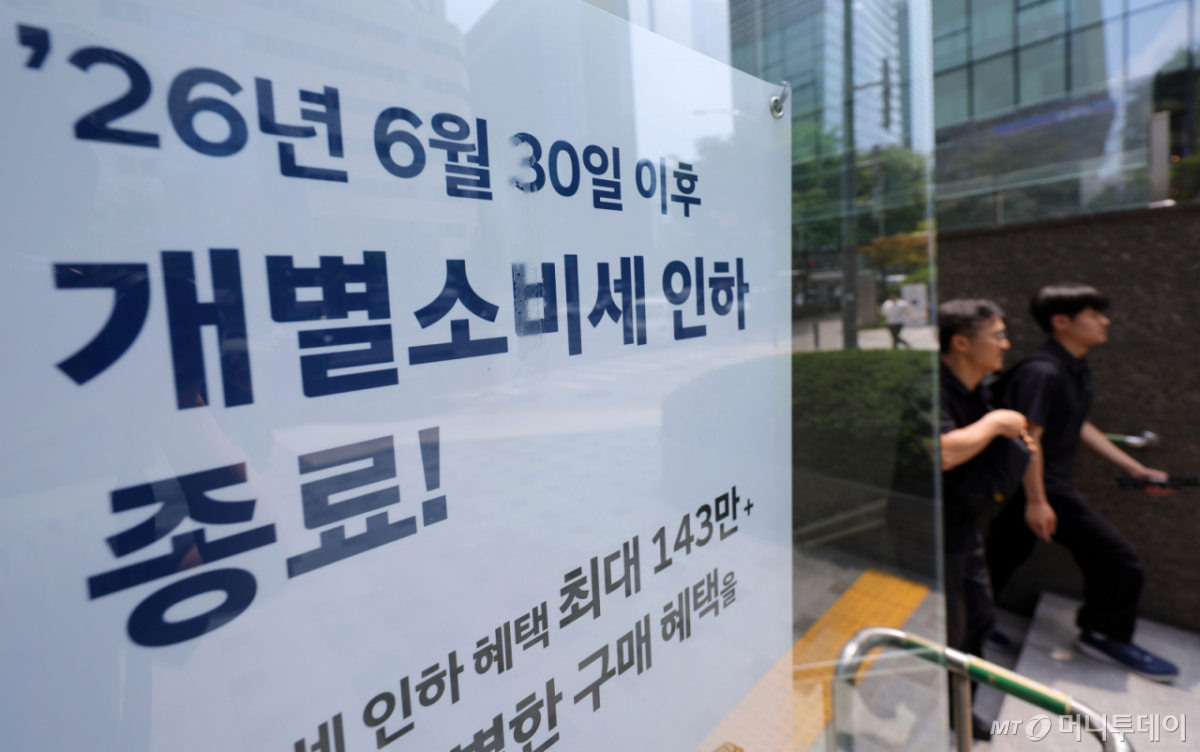
The industry expressed concern that if the government ends exemption measures including the individual consumption tax, tax support for the automotive industry would be excessively reduced. The government had already ended its measure to reduce the individual consumption tax (from 5% to 3.5%) applied when purchasing internal combustion engine vehicles at the end of last month. As a result, consumer cost burdens increased by up to 1.43 million won, prompting automakers to launch large-scale sales promotion events to prevent sales declines.
Additionally, the government has tentatively concluded not to include electric vehicles in the scope of the "Domestic Production Promotion Tax System." This system reduces corporate taxes and other levies based on the domestic production and sales volume of strategic industrial products. The domestic automotive industry strongly requested that electric vehicles be included in the system's scope to counter the "low-price offensive" by Chinese automakers, but the government did not accept this. Detailed plans related to this are expected to be included in this year's tax law revision bill.
The industry urged the government to strengthen tax support, considering that automobiles are becoming increasingly important as a national strategic industry and that domestic corporate management difficulties are worsening. In fact, Hyundai Motor and Kia reported second-quarter operating profits declining by 20.8% and 4.9%, respectively, compared to the same period last year. KG Mobility also saw its operating profit drop by 50.8% during the same period, leading to analysis that profitability for domestic brands is deteriorating overall.

 in INDUSTRY
