

As the KOSPI index fell to its lowest level in seven months, analysts forecast that it will fluctuate within a range of 5,300 to 5,800 this week ahead of Q3 earnings announcements from major domestic and international companies and the U.S. policy rate decision.
With no significant positive catalysts, foreign investors continue to exit the market, while trading volume itself has declined, leading analysts to believe that retail and institutional investors have also adopted a wait-and-see stance.
On the 26th, the KOSPI closed at 5,469.47 in the Korea Exchange regular session, down 80.83 points (1.46%) from the previous trading day. Based on the closing price, this is the lowest level in approximately seven months since April 6 (5,450.33).
The KOSPI opened at 5,499.05, down 0.92%, and showed mixed signals by briefly turning positive early in the session before widening its losses to close with a decline of over 1%.
Lee Kyung-min, a research analyst at Daishin Securities, diagnosed, "With major events scheduled, including the October U.S. FOMC (Federal Open Market Committee) meeting, key corporate earnings releases, and U.S. midterm elections, a wait-and-see mood is prevailing over hasty bargain hunting or panic selling." He added, "KOSPI trading volume remained at around 3 trillion won during intraday trading, indicating shrinking market participation. Amid continued net selling by foreign investors, there is also a lack of clear buying entities to absorb the supply."
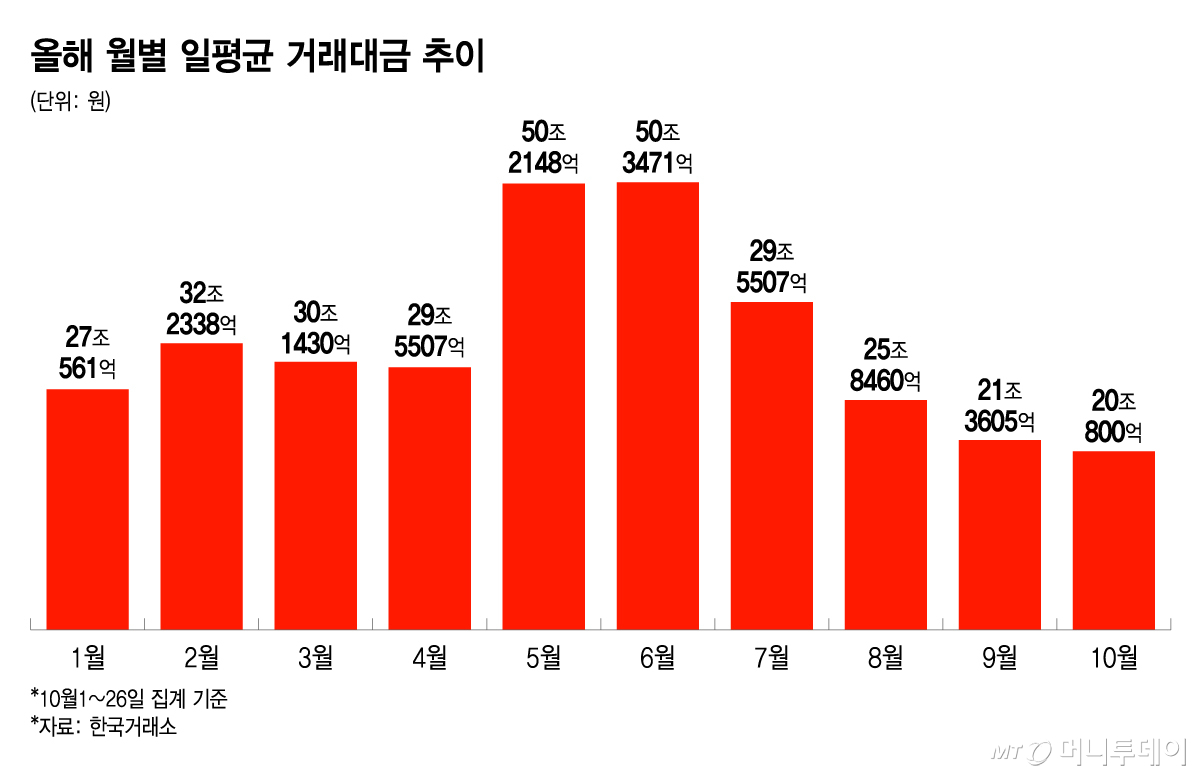
According to the Korea Exchange, KOSPI trading volume was recorded at 12.011 trillion won as of 4:30 p.m. KOSPI trading volume had reached 28.64 trillion won on the 15th but has fallen below 20 trillion won, decreasing to 20.06 trillion won on the 19th, 17.055 trillion won on the 20th, and 14.916 trillion won on the 22nd.
Looking at top market capitalization stocks, Samsung Electronics closed regular session trading at 213,000 won, down 2,500 won (1.16%). SK Hynix closed at 1,277,000 won, up 2,000 won (0.16%), driven by expectations for shareholder return policies despite weakness in the semiconductor sector. SK Square and Samsung Electro-Mechanics ended slightly lower, while LG Energy Solution and Kia fell by over 1%.
Banking stocks were hit by declining NIM (Net Interest Margin). KB Financial Group, a major financial stock, closed down in the 3rd% range, and Shinhan Financial Group closed down in the 2nd% range. Hanwha Aerospace also weakened by over 4%.
The trend of foreign investors selling off continued in the KOSPI market. According to Korea Exchange data as of 4:45 p.m., foreign investors sold approximately 706.3 billion won worth of shares. Foreign investors, who had recorded net sales of 18.4053 trillion won cumulatively from the 1st to the 23rd of this month, continued their selling streak on this day as well. In contrast, institutional investors made net purchases of 596.9 billion won, and retail investors made net purchases of 706.4 billion won.
On this day, the KOSDAQ fell by over 3%, a larger drop than the KOSPI. The KOSDAQ opened at 742.17, down 9.52 points (1.27%), and closed at 727.21, down 24.48 points (3.26%), slipping below the 720th mark.
In the KOSDAQ market, retail and foreign investors made net purchases, but institutional investors sold off, resulting in a third consecutive trading day of declines.
However, the robotics and healthcare sectors were strong. While all top market capitalization stocks closed lower, RoboTech rose by over 9%. Robotics-related stocks such as Everybot, T-Robotics, and SPG showed strength. Luvit, which combines medical technology/healthcare with AI, hit its daily limit up, while Vuno and C-ares surged by over 20%.
Lim Jeong-eun, a research analyst at KB Securities, analyzed, "RoboTech spiked after signing a supply contract for 750,000 small robot suit actuators with a French robotics company, amid expectations of further demand expansion next year." She added, "Medical AI firm Lunit hit its daily limit up on news of an AI biomarker research collaboration with U.S. biotech firm City Therapeutics for the development of immunotherapy drugs."
Amid generally subdued investor sentiment, the October FOMC meeting and earnings from leading domestic and international stocks are cited as key variables for this week's stock market. Lim Jeong-eun noted, "Major central bank monetary policy meetings, including the FOMC, and earnings releases from major companies such as SK Hynix (on the 28th) and Samsung Electronics (on the 29th) are scheduled." She emphasized, "It is necessary to pay attention to the sustainability of AI investment monetization results, expectations for semiconductor industry improvement, and future interest rate paths."
Forecasts also suggest that the KOSPI will continue a volatile trading trend within the 5,300–5,800 range this week. Han Ji-young, a research analyst at Kiwoom Securities, predicted, "This week is a 'super week' with a concentration of domestic and international macroeconomic and corporate earnings events in the latter half, so frequent volatility expansion is expected." She added, "Domestically, earnings releases and conference calls from Samsung Electronics and SK Hynix are key events that could shift the stock market mood."
Han Ji-young stated, "Market attention is currently focused on the sustainability of semiconductor profits after 2027–2028, rather than current high earnings." She forecasted, "In this earnings release, conference calls will be important regarding demand and price outlooks for HBM (High Bandwidth Memory) and general-purpose DRAM, as well as supply-demand changes due to future production capacity expansion."

 in STOCK
