

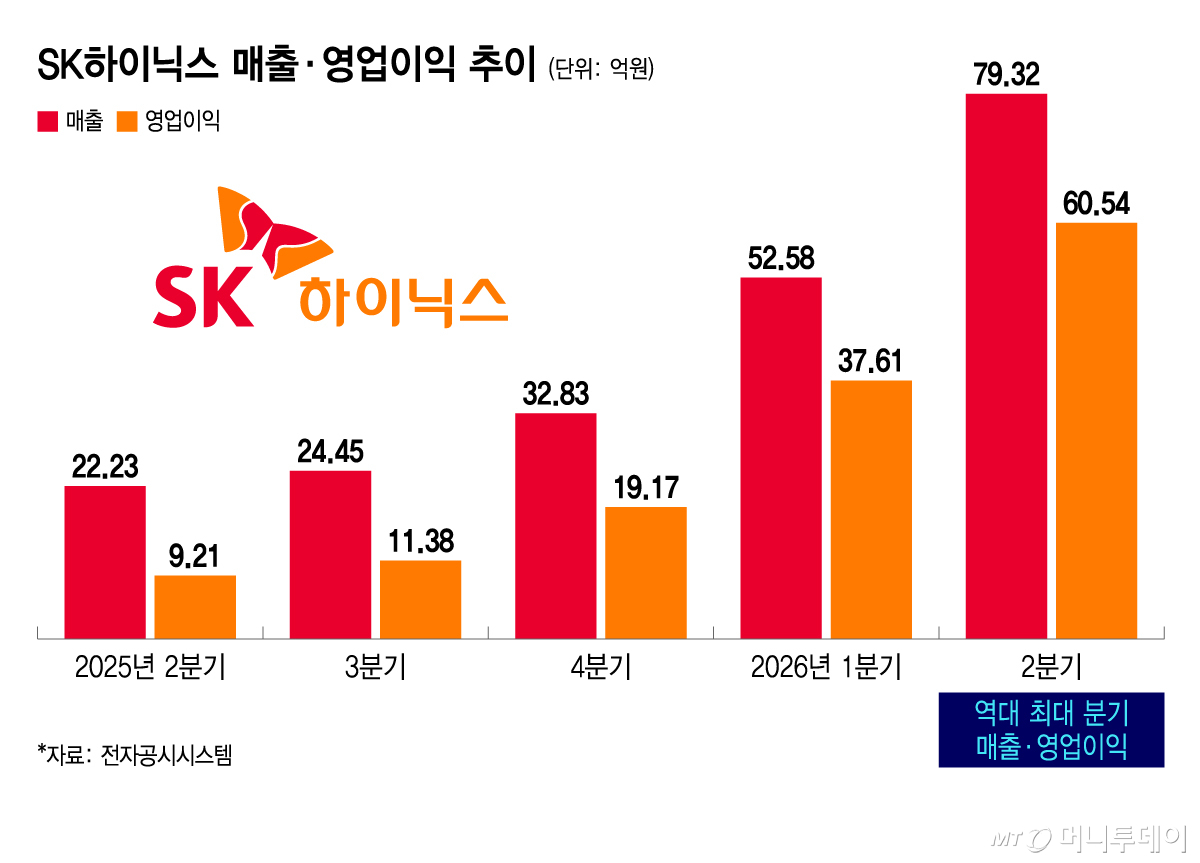
SK Hynix is accelerating the expansion of memory semiconductor (hereinafter referred to as memory) production capacity based on medium-to-long-term demand visibility. As a supply shortage situation where "what is produced sells" continues, the ability to expand production capacity has emerged as a core competitive factor determining market leadership. SK Hynix's facility investment scale this year is expected to reach the late 40 trillion won range.
Song Hyun-jong, SK Hynix CoLee Teu-sen-teo (President), emphasized on the 29th during the second-quarter earnings announcement conference call that "in the AI era, not only technological competitiveness but also supply capability to respond to customer demand volumes in a timely manner is a core competitive strength." This means that amid ongoing memory supply shortages, production capacity has become a key factor determining business competitiveness.
In fact, SK Hynix is focusing on expanding production capacity to meet customer demand. Cheongju M15X in Chungbuk began wafer (thin circular plates used to make semiconductor chips) input in the first quarter this year, advancing the Yangsan timeline. Once M15X begins full operations, SK Hynix's monthly production capacity based on 300mm wafers is expected to increase from the current 550,000 units to 630,000 units.
The Yongin semiconductor cluster in Gyeonggi Province aims to open Phase 1 cleanrooms by early next year. SK Hynix plans to sequentially build four fabs (factories) in Yongin with a total investment of 600 trillion won. The first fab will consist of six cleanrooms, with each cleanroom having a production capacity of approximately 60,000 units per month based on 300mm wafers. The completion timeline for subsequent fabs is also accelerated by 12 years compared to the original plan. In the medium-to-long term, SK Hynix will pour 80 trillion won into Cheongju M17 fab in Chungbuk to expand NAND flash production capacity. Construction is scheduled to begin next year with operations expected in the first half of 2029. Additionally, 20 trillion won will be invested in P&T7 to strengthen advanced packaging competitiveness.
The facility investment scale is expected to reach the late 40 trillion won range, an increase of at least 15 trillion won compared to last year's 30.173 trillion won. The background for this record-high level of investment lies in the judgment that AI memory demand will continue to expand. Song (President) predicted that "CSP (cloud service provider) AI infrastructure investments will remain robust beyond next year, leading to expanded demand across all memory segments." Major hyperscalers' capital expenditures related to AI are expected to exceed 1 trillion dollars (approximately 1,481.5 trillion won) next year.
There is also a possibility of announcing additional investment plans. SK Group Chairman Choi Tae-won emphasized at the Korea Chamber of Commerce and Industry Jeju Forum meeting on the 15th that "we need to increase production capacity as quickly as possible with our best efforts" and "building wherever we can build is the current situation." Song (President) also stated during the earnings announcement conference call that day, "Our basic direction is to comprehensively consider electricity, water resources, manpower, supply chains, semiconductor ecosystems, and customer accessibility rather than distinguishing between domestic and foreign production bases when reviewing optimal plans," while adding, "(However) there are no decided matters regarding additional investments beyond those already announced."
Regarding concerns about 'supply glut' resulting from large-scale capacity expansion, Song (President) drew a line by stating that "the possibility of leading to supply glut is limited." Since the expansion is based on long-term supply contracts (LTA) with multiple customers, there is little likelihood of expanding supply beyond market demand. Furthermore, analysis suggests that a different phase has formed compared to the typical cycle of the memory industry where preemptive expansions and supply gluts repeatedly occurred in the past. Song (President) stated, "We will secure production bases to meet growing customer demand at the right time and improve investment efficiency by balancing the utilization of existing assets with new investments."

 in INDUSTRY
