

LG Energy Solution, Samsung SDI, and SK On, the three leading domestic battery manufacturers, have all emerged from a prolonged period of losses. Amid a continued electric vehicle (EV) demand slump, efforts to secure energy storage system (ESS) demand centered on the U.S. and reduce costs have led to simultaneous profit records.
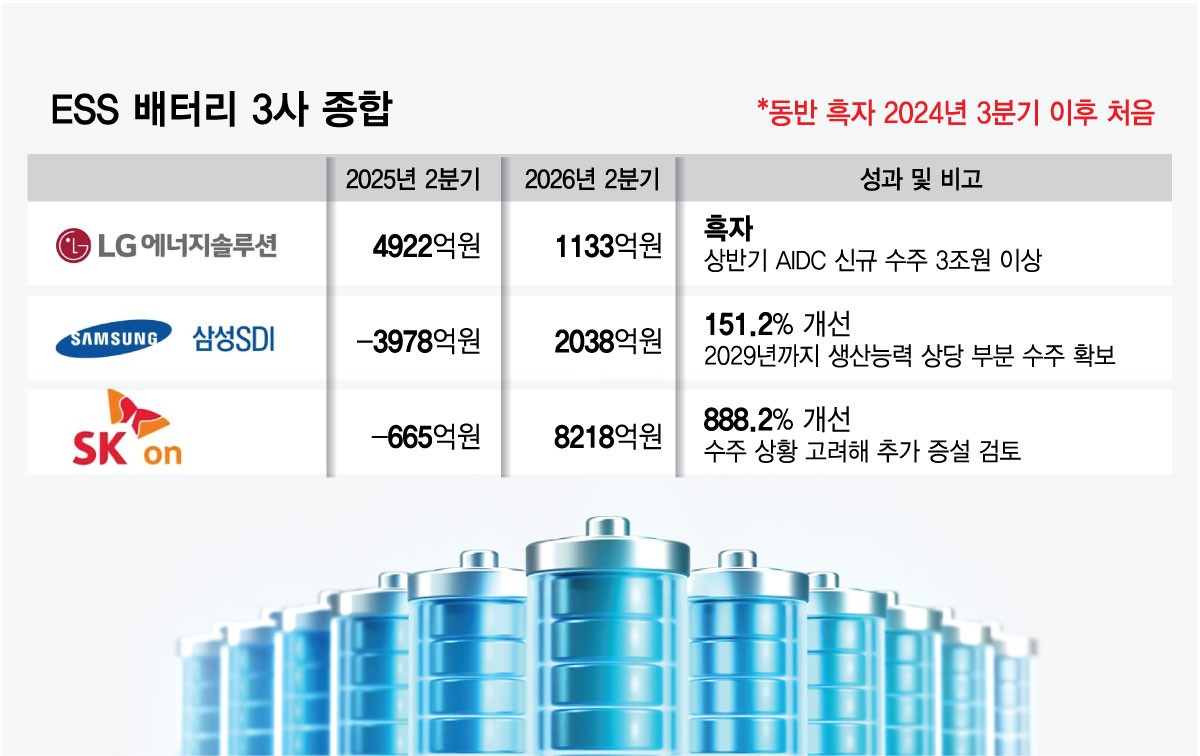
According to the battery industry on the 30th, all three domestic battery companies recorded operating profits in the second quarter of this year. This marks the first time since the third quarter of 2024 that all three companies posted profits simultaneously. Profitability improved due to expanded ESS orders, improved utilization rates, cost reductions, and factors such as U.S. production tax credits and one-time items.
LG Energy Solution recorded an operating profit of 113.3 billion won on a consolidated basis in the second quarter of this year. Although this represents a 77% decrease compared to the same period last year, it turned from an operating loss of 27.8 billion won in the first quarter back into profit within one quarter. The company also escaped two consecutive quarters of losses starting from the fourth quarter of last year. This was driven by a 4.6-fold increase in second-quarter ESS sales compared to the same period last year, as it absorbed local demand based on five ESS production sites in North America. In the first half of the year, it secured new orders worth over 3 trillion won for artificial intelligence data centers (AIDC).
Samsung SDI also turned from an operating loss of 397.8 billion won in the same period last year to a profit with an operating profit of 203.8 billion won in the second quarter. Even excluding the $107.7 billion Advanced Manufacturing Production Tax Credit (AMPC) from the U.S., it achieved an operating profit of 96.1 billion won, confirming its own profitability recovery. As a result, it recorded cumulative operating profits of 48.2 billion won in the first half of this year, achieving its "performance turnaround" promise ahead of schedule. The improvement was bolstered by long-term supply contracts with U.S. ESS customers based on the competitiveness of prismatic batteries and local production capabilities. According to the company, the secured order volume is sufficient to cover a significant portion of its 2029 production capacity.
SK On achieved a profit turnaround with an operating profit of 821.8 billion won, representing a 1337% improvement compared to the same period last year (an operating loss of 66.5 billion won). This is the highest operating profit in 19 quarters since its spin-off in 2021. This was supported by expanded sales in Asia, receipt of compensation following the termination of its joint venture with Ford, and an increase in tax credit amounts under the U.S. Inflation Reduction Act (IRA).
All three battery companies are expected to focus on building local supply chains in the second half of the year. Lee Chang-sil, CFO of LG Energy Solution, stated, "We will expand our existing pouch-type LFP ESS production capacity and prepare for prismatic LFP (lithium iron phosphate) batteries at Yangsan next year without any delays to maximize benefits from customer investment tax credits (ITC), strengthening our position as the largest ESS supplier." He added, "We also plan to secure sodium battery technology suitable for long-duration ESS markets."
Samsung SDI plans to expand local production capacity by approximately 30 GWh (gigawatt-hours) annually at its joint venture Star Plus Energy (SPE) plant in Indiana, U.S., this year, including LFP batteries for ESS. Jo Young-hee, head of Samsung SDI's ESS business team, emphasized, "The U.S. prismatic LFP line is currently undergoing quality verification at Yangsan. As originally planned, we will begin cell production at Yangsan in October and start supplying customers with the Samsung Battery Box (SBB) 2.0 solution by year-end."
SK On has also established a production capacity of over 100 GWh through four plants in the U.S.: SK Battery America's existing Georgia standalone plants (57 GWh), Tennessee standalone plant (45 GWh), and the HSBMA plant scheduled to operate this year (35 GWh). An Geon, SK On Gi Hoek-jo-jeong (Head), added, "We are preparing to effectively enter the ESS business," and stated, "We will decide on further ESS transitions in the future considering the scale of orders."

 in INDUSTRY
