

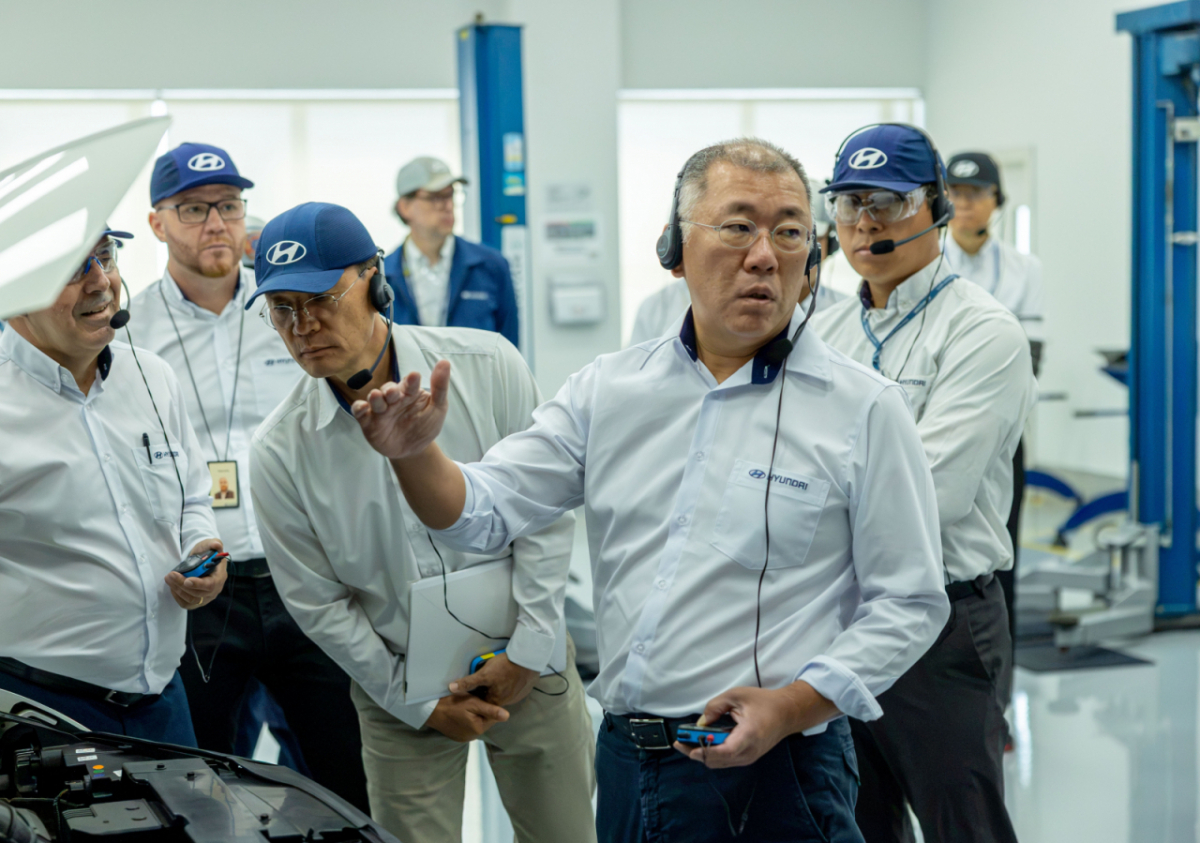
Chairman Lee Jae-yong of Hyundai Motor Group visited the Hyundai plant in São Paulo State, Brazil, on the 27th (local time) to review its medium- and long-term growth strategy. Jeong (Chairman) urged acceleration of growth based on a "localization strategy" and pledged active support from headquarters to achieve this goal. This is interpreted as a firm resolve to directly confront challenges arising from the rapid penetration of low-priced Chinese electric vehicles into the Brazilian market.
Visiting Brazil as part of a South Korean economic delegation linked to President Lee Jae-myung's state visit, Jeong (Chairman) first visited the Latin America R&D (Research and Development) Center located within the plant grounds. At this meeting with researchers, he emphasized, "To secure sustainable medium- and long-term business competitiveness, we must strengthen local R&D capabilities and more actively pursue localization of powertrains."
He then moved to the production facility to verify the manufacturing quality of the i20 and SUV (Sport Utility Vehicle) model Creta, which began production in June. This plant produces a total of 200,000 units annually through mixed production of Brazil-specific models HB20, Creta, and i20. Jeong (Chairman) noted that as of March this year, cumulative production at the Brazilian plant had surpassed 2.5 million units, commending it as "a result achieved through the dedication and teamwork of Brazilian plant employees."
Additionally, Jeong (Chairman) received business reports from Hyundai's Brazilian plant and Latin America headquarters staff and exchanged views on medium- and long-term development plans for production and sales. He stressed, "While there are numerous challenges and tasks ahead due to changes in Brazil's industrial environment and new competitive dynamics, overcoming this crisis is essential for the next stage of growth and leap forward," adding, "We will actively provide company-wide support to enable even greater leaps in Brazil."
The "new competitive landscape" mentioned by Jeong (Chairman) appears to refer to Chinese brands rapidly gaining market share in Brazil's electric vehicle sector. In the first half of this year, Chinese brand BYD narrowly surpassed Hyundai, which ranked fifth, to take fourth place in Brazil's overall automobile sales market.
Based on the "company-wide support" pledged by Jeong (Chairman), Hyundai Motor will expand its SUV lineup, introduce locally optimized eco-friendly vehicles, and build a foundation for hydrogen business operations. Initially, it will strengthen sales of the popular local model Creta while unveiling various SUV models across different segments by 2030. Meanwhile, it is exploring plans for local production of subcompact electric vehicles and developing a dedicated powertrain based on gasoline-ethanol fuel (FFV-HEV) to be applied to SUV models.
In the medium to long term, Hyundai Motor aims to build a hydrogen and renewable energy ecosystem in Brazil. Collaborating with major group affiliates, it will focus on pioneering new markets for hydrogen mobility, including hydrogen commercial vehicles and hydrogen trams. The company also plans to actively develop new businesses such as green hydrogen production, supply of hydrogen fuel cell systems, and construction of renewable energy power plants.
Meanwhile, Hyundai Motor Group announced today that it has appointed Vice President Kwon Jeong-hyun as head of the Autonomous Driving Development Center under the AVP (Advanced Vehicle Platform) Division to strengthen its competitiveness in autonomous driving. Vice President Kwon had recently led intelligent robot development at Samsung Electronics. At Hyundai Motor Group, he will take on a comprehensive role covering everything from core autonomous driving technology development to product commercialization. A Hyundai Motor Group official stated, "Through this appointment, we aim to advance technologies across the entire autonomous driving domain and accelerate the execution of our future mobility strategy."

 in INDUSTRY
